
 By info@zhiweichem.com
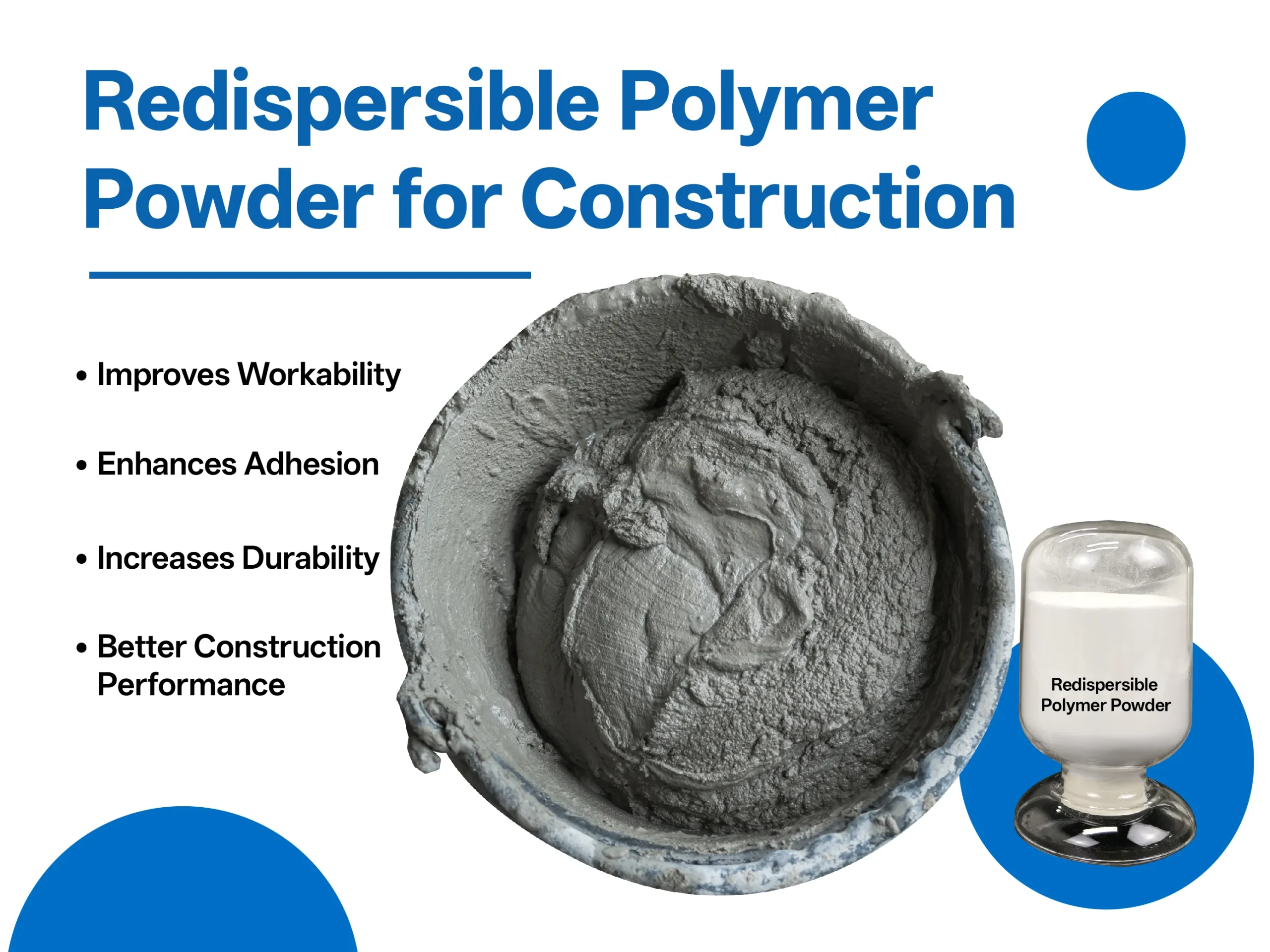
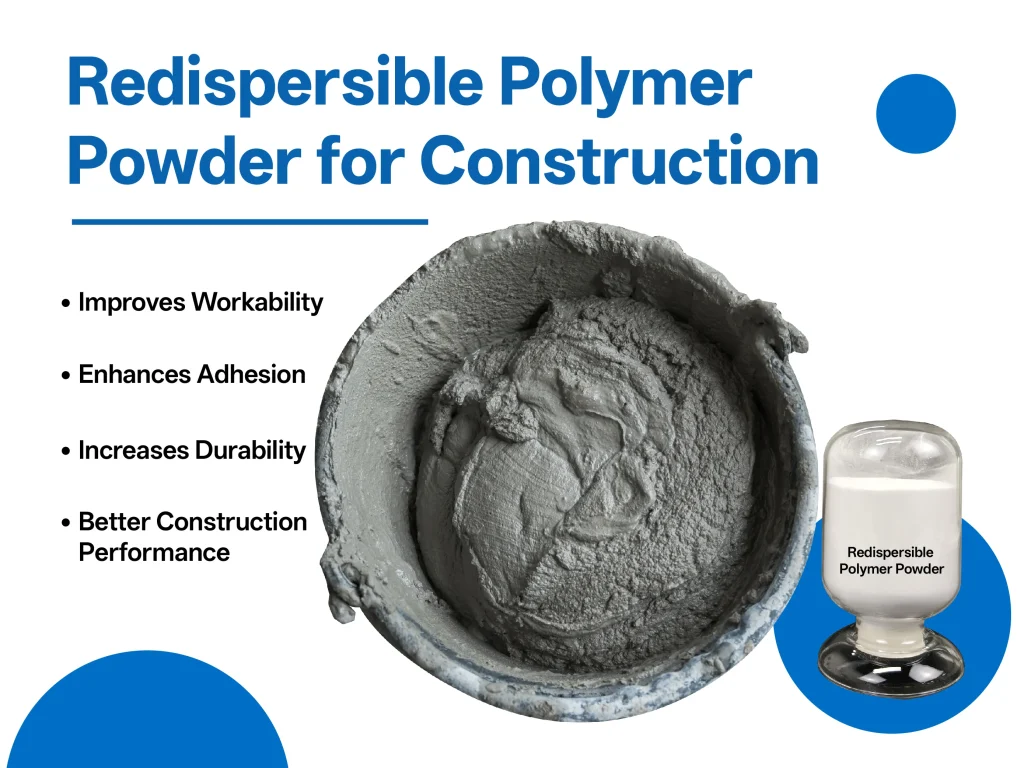
What does RDP stand for in chemicals? In construction chemicals, RDP stands for redispersible polymer powder. It is a powder-form polymer binder used in dry-mix products such as tile adhesive, wall putty, insulation mortars and self-leveling compounds. When the mortar is mixed with water, the powder redistributes its polymer particles into an aqueous dispersion.
The acronym has another meaning in the chemical industry. In flame-retardant applications, RDP can refer to resorcinol bis(diphenyl phosphate). This is a different material with a different function. Always confirm the full product name and intended application before ordering.
At Zhiwei, our construction RDP range concerns redispersible polymer powder. This guide explains the terminology, its role in mortar and the questions that help manufacturers choose a suitable grade.
Two Chemical Meanings of RDP
| Context | Meaning of RDP | Intended role |
|---|---|---|
| Construction additives and dry-mix mortar | Redispersible polymer powder | Polymer modification of compatible mortar formulations |
| Flame-retardant chemistry | Resorcinol bis(diphenyl phosphate) | A phosphorus-based flame-retardant material |
The second meaning appears in ICL’s Fyrolflex RDP product information and in the Danish Environmental Protection Agency’s report on phosphorus flame retardants.
These products are not substitutes for each other. A purchase description containing only “RDP chemical” leaves a major ambiguity. Include the full name, grade, application and relevant technical documentation.
For construction procurement, a useful inquiry reads: “Redispersible polymer powder for cementitious tile adhesive formulation.” That tells the supplier what family of products to discuss. The formulation target then helps narrow the choice.
What Does Redispersible Mean?
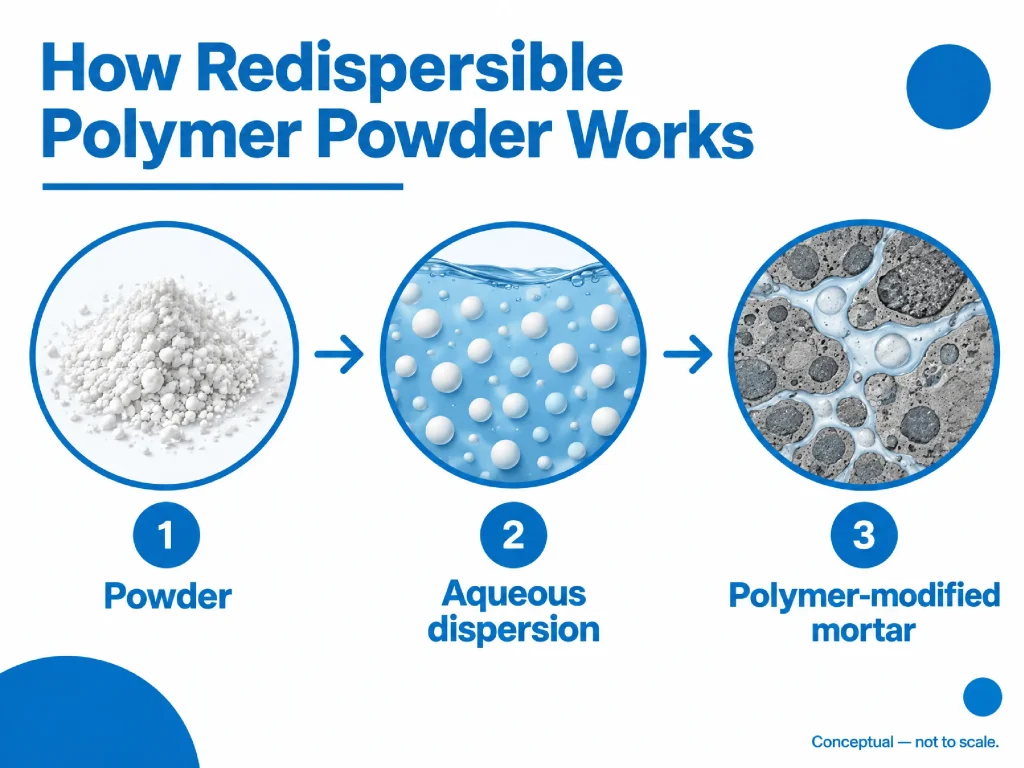
“Redispersible” describes the powder’s ability to form a polymer dispersion again when mixed with water under suitable conditions. The polymer particles become distributed through the liquid phase of the mortar.
Dispersion is different from molecular dissolution. A polymer dispersion contains particles; it should not be described as the polymer simply dissolving like sugar in water. The quality of redispersion also depends on the powder and mixing conditions.
As water is removed and the mortar develops, polymer particles can form films or connected polymer regions under suitable conditions. This polymer component works alongside the mineral binder. The exact structure depends on the polymer, its quantity, cement chemistry and curing environment.
The result is a polymer-modified mortar. It remains a formulated material containing several ingredients, so its final properties cannot be predicted from the RDP name alone.
What Is Construction RDP Made From?
Construction RDP normally begins as a polymer dispersion that is converted into a powder. Vinyl acetate-ethylene, often abbreviated VAE or VAc-E, is one common polymer platform. Other monomer combinations are used to create different properties.
A commercial powder may also contain protective colloids and mineral anti-blocking materials. These components help support processing, redispersion and powder handling. The powder is therefore not necessarily a chemically pure polymer with one universal molecular formula.
Three terms should be kept separate:
- RDP describes the redispersible powder product category.
- VAE identifies a particular polymer chemistry.
- PVA, commonly used here for polyvinyl alcohol, can describe a protective colloid rather than the main VAE binder.
Ask suppliers to spell out their abbreviations. In some markets, similar shortened names are used loosely, which can cause confusion between polymer chemistry and product form.
A technical data sheet should identify the grade and provide useful specifications. A safety data sheet provides handling and composition information within its reporting scope. Neither should be replaced by a generic internet description of “RDP powder.”
How Is RDP Produced?
The broad manufacturing route converts a suitable polymer dispersion into a redispersible powder, commonly through spray drying. The process involves preparing the feed, atomizing it, removing water, collecting the powder and controlling its final handling characteristics.
WACKER’s overview of dispersible polymer powders describes production by drying dispersions. The polymer system and processing conditions determine whether the finished powder is suitable for its intended use.
For buyers, the practical questions concern consistency: Does the powder redisperse appropriately? Does it remain usable after specified storage? Does it behave consistently in the actual mortar?
There is no universal dryer temperature or particle-size setting that defines all RDP grades. Zhiwei’s RDP manufacturing process guide explains the manufacturing topic in more detail.
Why Add RDP to Cement-Based Mortar?
Cement provides the hydraulic binding phase. Polymer modification can help adjust properties that matter at interfaces and under deformation, including adhesion, cohesion and flexibility. The benefit depends on using a suitable polymer within a balanced formula.
WACKER’s technical overview of tile-adhesive binders explains how polymer binders modify adhesion and mechanical behavior in cementitious systems.
For a manufacturer, the objective should be specific. A wall adhesive may need reliable holding behavior and good transfer to the tile back. A repair mortar may need suitable adhesion and compatibility with the substrate. A skim coat may need surface integrity and practical troweling.
More polymer is not automatically better. Changing dosage can also change water demand, air content, handling and the balance of cured properties. Evaluate a range around the intended development target and record the results.
RDP is also not a standalone installation adhesive. It is an ingredient used by formulators. Adding loose powder to a finished commercial mortar without its manufacturer’s approval changes the product and may invalidate its declared application instructions.
Where Is RDP Used in Construction Chemicals?
Tile Adhesive
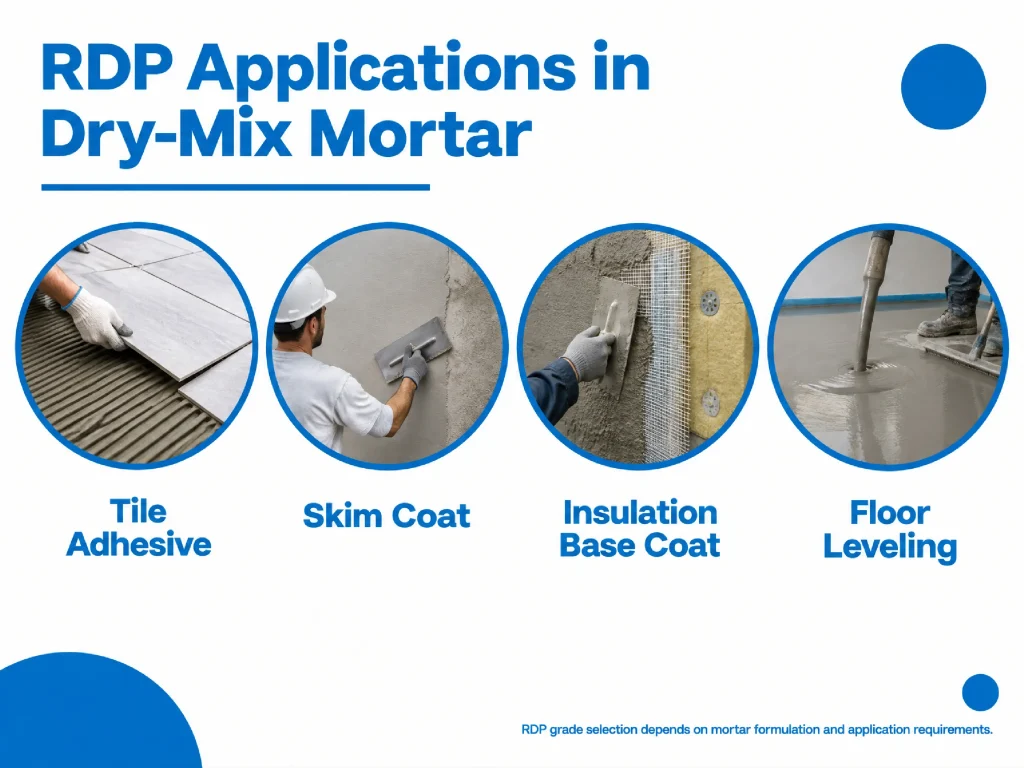
RDP is used in polymer-modified tile-adhesive formulations. The developer selects the polymer around the intended tile, substrate, exposure and performance target.
A powder grade does not independently carry the finished adhesive’s C1, C2, S1 or S2 classification. The complete mortar must be tested. Zhiwei’s RDP for tile adhesive guide covers this application in greater depth.
Wall Putty and Skim Coat
For thin finishing materials, manufacturers may evaluate polymer modification to support bonding and surface integrity. Handling, sanding and appearance remain important, so the strongest or most flexible grade is not necessarily the best choice.
Evaluate the complete finish on representative substrates, including the coating that will later be applied over it.
EIFS and ETICS Mortars
External insulation systems use mortars with defined bonding and reinforcement functions. Polymer selection must fit the approved system, including the insulation material, base coat and service exposure.
An RDP suitable for a general adhesive is not automatically approved for every insulation system.
Waterproof and Repair Mortars
Some grades are positioned for flexible or hydrophobic formulations. Reduced water absorption and greater flexibility can be useful development targets, but they are separate from proving that an assembly is waterproof.
Test the finished material and its installation details against the actual requirements. A hydrophobic powder does not replace joints, detailing or an approved waterproofing system.
Self-Leveling Compounds
Self-leveling formulations need flow, stability and suitable cured properties. A polymer designed for this balance can be more appropriate than a grade selected primarily for non-sag wall application.
This is one reason an RDP portfolio contains several grades rather than one universal powder.
RDP Compared with HEMC and HPMC
These ingredients can appear in the same mortar, but their main formulation roles differ.
| Ingredient | Typical formulation role | What to check |
|---|---|---|
| RDP | Polymer modification of adhesion and mechanical behavior | Polymer chemistry, redispersion and complete mortar performance |
| HEMC or HPMC | Water retention and rheology control | Grade, viscosity measurement method, dosage and fresh mortar behavior |
| Cement | Hydraulic binding | Source, setting behavior and compatibility |
| Graded minerals | Particle structure and application body | Distribution, cleanliness and water demand |
Cellulose ether and RDP should be evaluated together when both are present. A change in water retention or consistency can affect practical application and the interpretation of bonding results.
Zhiwei’s HEMC for cement-based tile adhesive page discusses fresh mortar properties and relevant formulation variables. Select the combination around the actual application rather than treating either additive as a universal solution.
Zhiwei RDP Grades and Their Main Directions
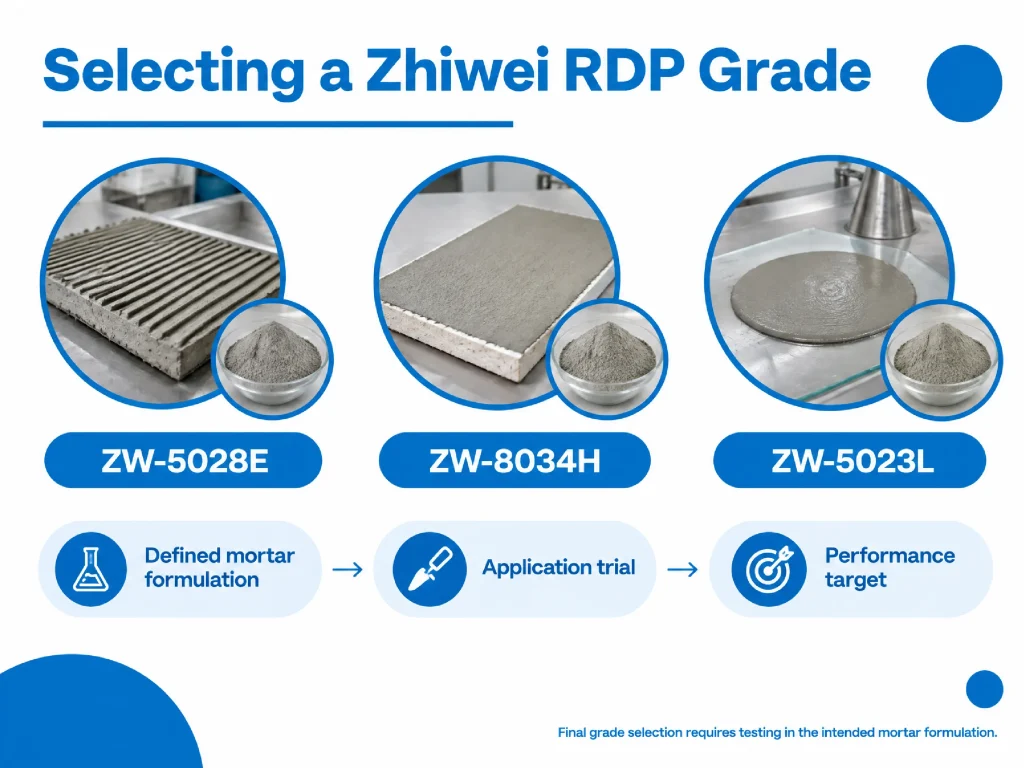
Our RDP product catalog includes eight grades with distinct positioning. The table below provides an application starting point. It does not promise that a powder will deliver a finished-product certification at a fixed dosage.
| Grade | Positioning | Main selection direction |
|---|---|---|
| ZW-4023N | Neutral general-purpose grade | Standard tile adhesive, putty and general grout development. |
| ZW-5010N | Neutral high-strength grade | Strength-focused comparisons in tile adhesive, grout and skim-coat formulations. |
| ZW-5044N | High-flex waterproof grade | Flexible insulation, waterproof and repair mortar systems. |
| ZW-5028E | Enhanced tile adhesive grade | Upgraded tile-adhesive development. |
| ZW-7034E | Enhanced multi-application grade | Broader development across adhesive, insulation, grout and repair applications. |
| ZW-8034H | Hydrophobic waterproof grade | Hydrophobic grout, waterproof mortar and compatible skim-coat development. |
| ZW-5021T | Thixotropic tile adhesive grade | Anti-sag and trowel-applied mortar development. |
| ZW-5023L | Self-leveling specialty grade | Flow and leveling balance in self-leveling compounds. |
Start with the application and the problem you need to solve. For example, a wall adhesive and a leveling compound should not automatically use the same trial grade. Compare candidates in a controlled base formula, then validate the required properties.
The current grade-specific TDS and sample results should guide final selection. Portfolio descriptions help narrow the screening list; they do not replace formulation testing.
Which RDP Specifications Matter?
Minimum Film-Forming Temperature
MFFT describes film formation under a specified test. It can help screen polymers for the intended conditions, but it is not a standalone minimum site-application temperature for a complete mortar. Cement hydration and other product requirements also matter.
Glass-Transition Temperature
Tg helps describe polymer thermal behavior and can inform comparisons of harder and softer polymer systems. It does not independently establish mortar flexibility or the deformability classification of tile adhesive.
Moisture, Ash and Bulk Density
Moisture and powder handling matter for storage and dry blending. Ash content needs interpretation because mineral components can be deliberately included in commercial powders. It is not a universal purity ranking.
Bulk density affects packaging and volumetric handling. Compare values measured by the same method and weigh ingredients when controlling formulation dosage.
Application Test Results
The most useful evidence is how the powder performs in the intended mortar. Review practical handling, relevant conditioned adhesion, dimensional behavior and any water-related requirements. A promising raw-material specification is the beginning of evaluation.
How to Request the Right RDP Sample
Include the full product family in your request: redispersible polymer powder for construction mortar. Then share the application, base formula, target market, desired performance and current technical issue.
Ask for the proposed grade’s TDS and SDS, along with batch information where available. Define the comparison method before testing samples. Keep cement, mineral grading, mixing and curing controlled so you can interpret differences.
Check storage instructions on the supplied documentation. Protect moisture-sensitive powders according to the stated requirements, and use the actual shelf-life conditions rather than assuming every RDP has the same storage limit.
Before a production decision, repeat the promising formulation with representative materials and processing conditions. Select the grade that meets the complete target consistently and at an acceptable formulation cost.
Frequently Asked Questions
What Does RDP Stand for in Chemicals?
In construction chemicals, it stands for redispersible polymer powder. In flame-retardant chemistry, it can mean resorcinol bis(diphenyl phosphate). The full name and application identify which material is intended.
Is RDP the Same as VAE?
No. RDP describes a powder product category. VAE describes vinyl acetate-ethylene polymer chemistry, which is commonly used in that category. Other polymer systems also exist.
Does RDP Dissolve in Water?
Construction RDP redisperses into polymer particles in an aqueous dispersion. That behavior should be distinguished from molecular dissolution.
Can RDP Replace HEMC or HPMC?
They have different main roles and are not direct substitutes. Formulators may combine RDP with a suitable cellulose ether to balance polymer modification, water retention and application behavior.
Is Every RDP Waterproof?
No. Some grades support hydrophobic or waterproof mortar development. The finished material and complete assembly still require validation for the intended exposure.
Does an RDP Grade Guarantee C2 or S1 Adhesive?
No. Those classifications concern the tested finished adhesive. Polymer choice, dosage and the rest of the formulation all contribute to the result.
Conclusion
In construction chemicals, RDP means redispersible polymer powder: a polymer binder supplied in a form suitable for dry-mix formulations. Confirm that full name when purchasing, because the acronym also appears in flame-retardant chemistry.
For mortar development, select RDP by application and validate it in the complete formula. Explore Zhiwei’s RDP grades and our cellulose ether portfolio. Share your formulation and performance targets so our team can help identify candidates for a focused sample trial.