
 By info@zhiweichem.com
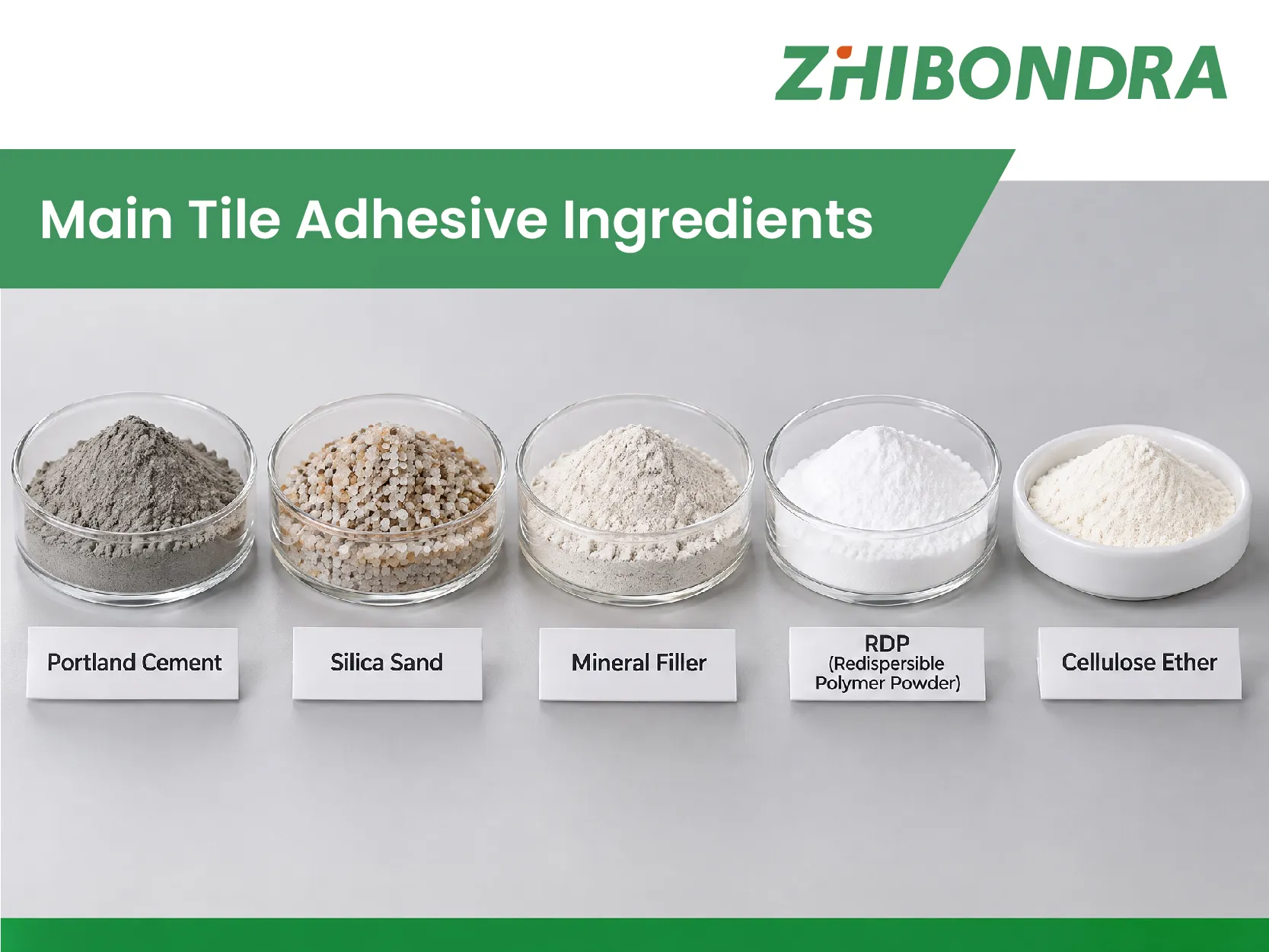
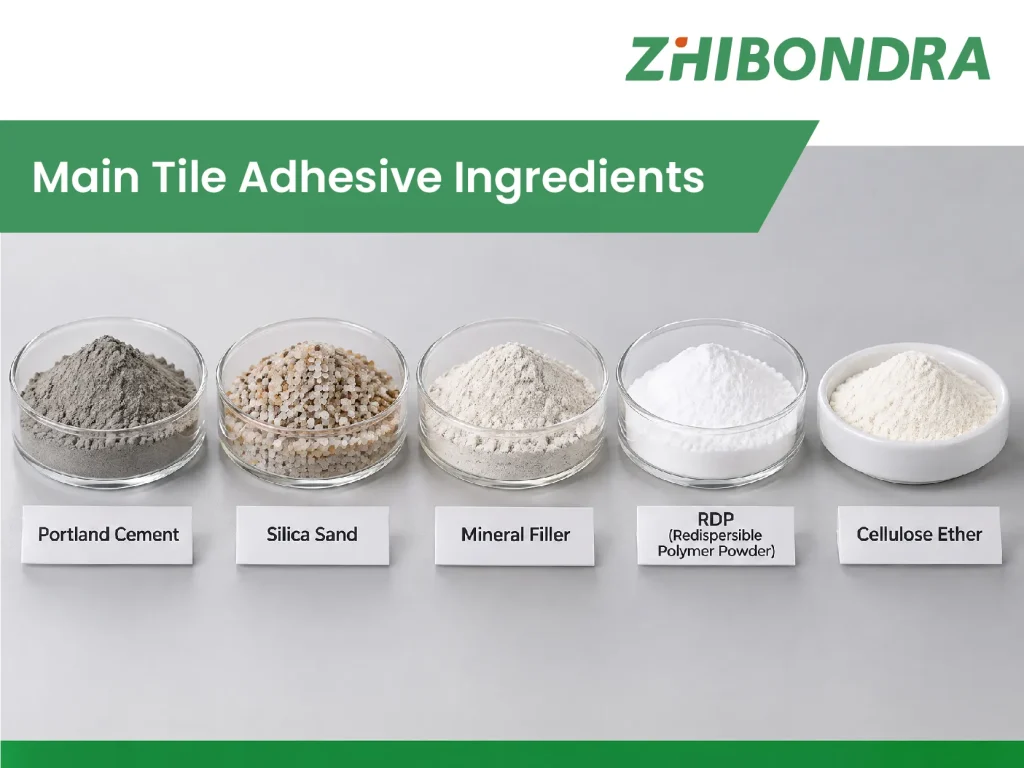
The main tile adhesive ingredients in a polymer-modified cementitious product are cement, graded sand or other selected minerals, redispersible polymer powder and cellulose ether. Manufacturers may add starch ether, defoamer, set-control agents or other functional materials when the formulation requires them.
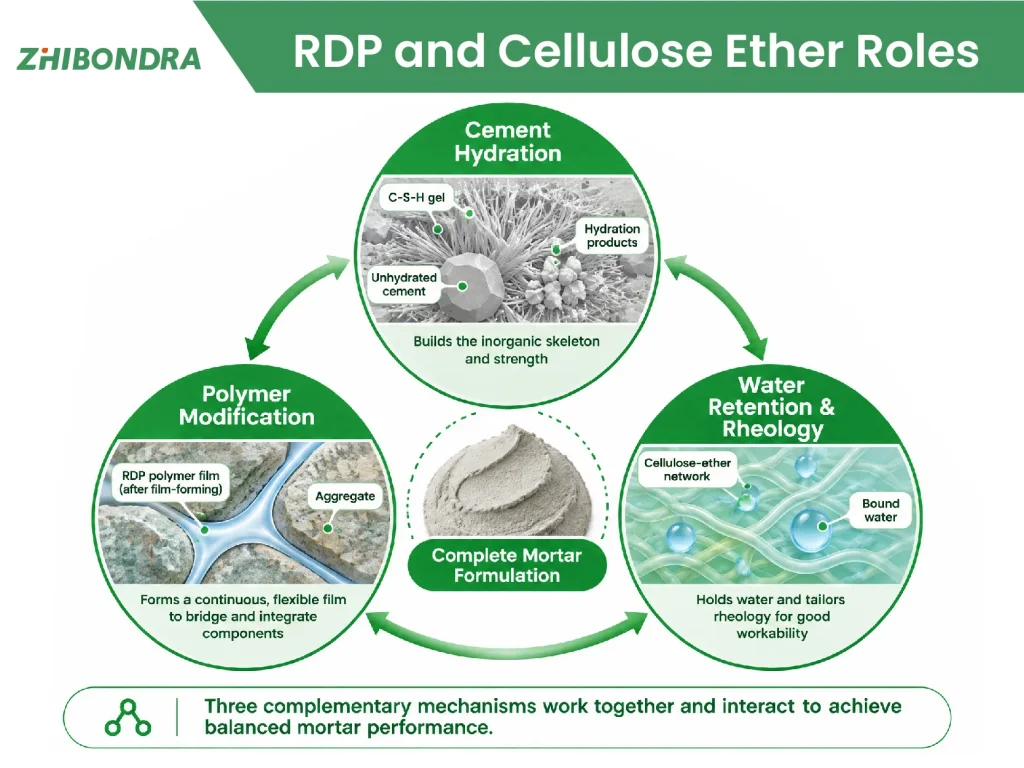
Each component has a specific purpose. Cement provides the hydraulic binder. Mineral grading shapes the mortar’s particle structure. Polymer modification supports bonding and mechanical behavior. Cellulose ether manages water retention and fresh consistency. The final result depends on how these ingredients work together.
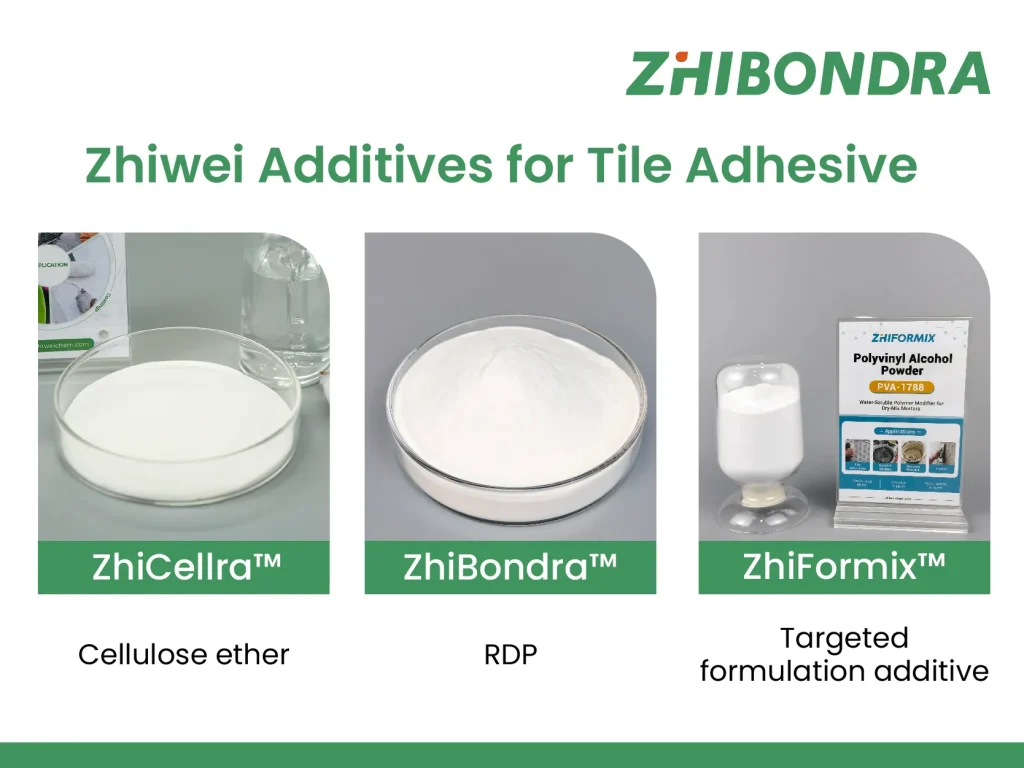
At Zhiwei, we approach adhesive development as a complete formulation task. Our ZhiCellra™ cellulose ethers, ZhiBondra™ polymer powders and ZhiFormix™ functional additives provide different tools for that work. The right combination starts with the intended tile, substrate, application method and finished-product requirements.
Which Type of Tile Adhesive Does This Guide Cover?
Tile adhesives include cementitious, dispersion and reaction-resin products. Their binder systems and mixing instructions differ. This article focuses on cementitious adhesive, especially dry powder products mixed with a specified amount of water.
In a one-component dry-mix adhesive, RDP supplies the polymer in powder form. Some two-component systems instead use a specified liquid polymer component with a mineral powder. Neither route should be confused with a ready-mixed dispersion adhesive supplied in a bucket.
A description of one family cannot serve as a universal ingredient list for the others. For example, a two-component epoxy adhesive has different chemistry and curing behavior from a cement-based product.
Tile Adhesive Composition at a Glance
| Ingredient group | Main function | Typical formulation question |
|---|---|---|
| Cement | Hydraulic binding and strength development | Does the binder give suitable setting and conditioned performance? |
| Graded sand and mineral filler | Particle structure, packing and application body | Does grading suit the bed thickness and spreading method? |
| RDP | Polymer modification of adhesion, cohesion and deformation behavior | Which grade and dosage meet the complete performance target? |
| HEMC or HPMC | Water retention and rheology | Can the mortar retain water, spread and transfer appropriately? |
| Starch ether | Targeted rheology adjustment | Does it improve the required handling without impairing transfer? |
| Defoamer | Control of unwanted air | Is air reduced without adverse effects on the formulation? |
| Set-control additive | Adjustment of setting behavior | Does it fit the cement and required early development? |
| Other specialist ingredients | A defined application need | Is the benefit demonstrated in the finished adhesive? |
The first decision is which functions the product needs. Adding every available ingredient is unlikely to produce a balanced adhesive.
Cement Provides the Hydraulic Binder
Cement reacts with water and develops the mineral binding phase. Its source, composition and fineness influence how the mortar sets and develops strength.
More cement does not automatically produce a better tile adhesive. A change in cement content also changes the relationship between binder, aggregate, water and additives. It may alter consistency, setting and dimensional behavior.
During development, record the cement type, supplier and batch. If the source changes, repeat the relevant checks before assuming the previous formula will perform identically.
Gray and white cement can serve different appearance requirements. Color alone is not a performance rating. Where stone staining or moisture sensitivity matters, select an adhesive system specifically approved for the material.
Sand and Fillers Build the Particle Structure
Graded quartz sand and suitable mineral fillers contribute to the body and packing of a dry-mix adhesive. The relevant specifications include particle-size distribution, cleanliness, moisture and consistency.
A useful grading system contains particles suited to the application. A single uniform particle size is not automatically ideal. An unsuitable coarse fraction can interfere with a thin bed, while an excessive fine fraction can increase water demand or make the mortar difficult to spread.
Distinguish mineral materials by identity and function. Limestone filler, lime, fly ash and lightweight aggregate are different materials with different effects. They should not be treated as interchangeable low-cost powders.
Before adjusting an additive, inspect the grading. A persistent spreading problem may originate in the mineral blend rather than in insufficient cellulose ether or polymer.
RDP Provides Polymer Modification
Redispersible polymer powder is a polymer binder supplied in a form suitable for dry blending. When the adhesive is mixed with water, polymer particles redisperse into the fresh mortar. Under suitable conditions, they form polymer regions within the developing mineral matrix.
Polymer selection can help modify adhesion, cohesion and the response to deformation. WACKER’s technical overview of tile-adhesive binders explains these roles in cementitious systems.
The powder is one part of the adhesive. Its grade name does not independently establish C2 adhesion performance or S1/S2 deformability. Those properties must be demonstrated by testing the complete mortar.
State the Polymer Dosage Basis Clearly
A polymer percentage needs a denominator. Percentage of total dry mortar, percentage of cement mass and polymer-solids-to-cement ratio are different expressions.
For example, 20 kg of supplied RDP in a final 1,000 kg dry blend represents 2% of total dry mass. If the blend contains 300 kg of cement, that supplied RDP mass is approximately 6.7% of cement mass. This arithmetic example is not a production recipe or a measured active-polymer ratio.
A liquid polymer introduces another distinction: wet emulsion mass includes water. It cannot be compared directly with the same mass of powder. Record solids information and recalculate the complete water balance when changing technologies.
Explore our RDP application guidance when defining a polymer screening program.
Cellulose Ether Controls Water Retention and Rheology
HEMC and HPMC are important ingredients in many cementitious tile adhesives. They help manage water retention and fresh consistency, which support practical spreading and placement.
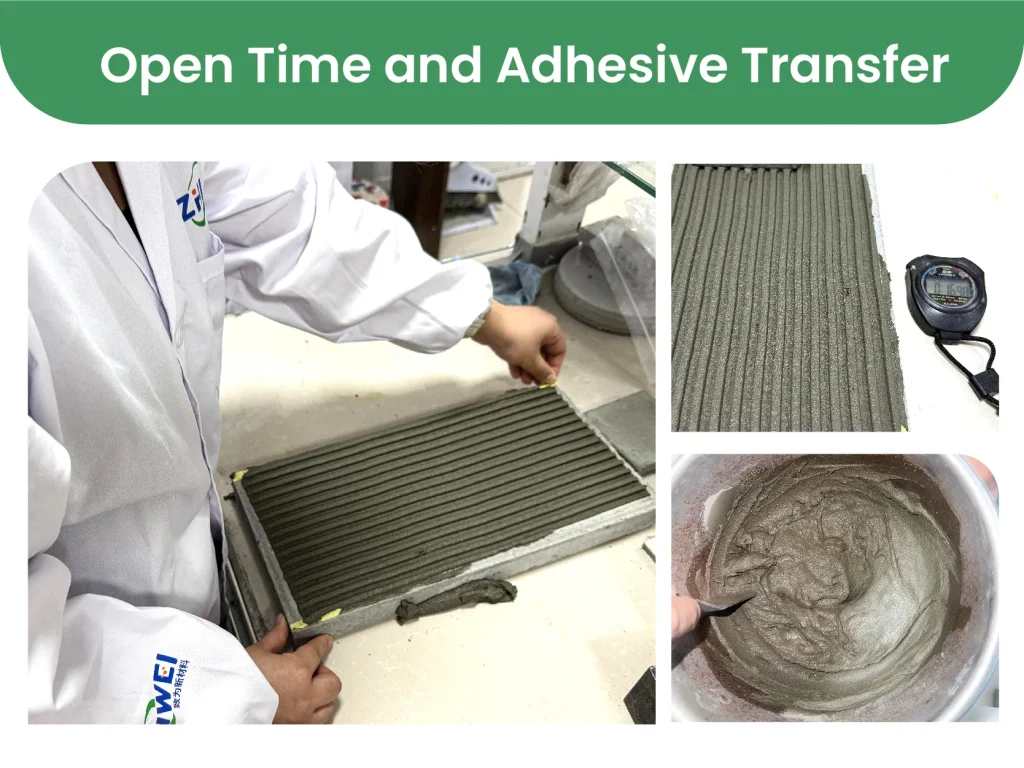
Water retention matters because a thin layer can lose water to the substrate and surrounding conditions. However, a thick-feeling mortar is not automatically a well-performing one. The adhesive must also wet the tile back and allow the ridges to collapse during bedding.
Dow’s HEMC information for cement-based tile adhesives illustrates the connection between cellulose grade, water retention, workability and anti-slip behavior. These properties require evaluation within the actual formula.
Viscosity Alone Is Not Enough
A nominal viscosity label does not fully describe mortar application behavior. Compare cellulose specifications using the stated concentration, temperature, instrument and test conditions.
The practical comparison should include mixing response, trowel drag, water retention, transfer and the placement window. A higher viscosity option may introduce trade-offs instead of solving the target problem.
Our HEMC for cement-based tile adhesive page explains the formulation details that help guide this selection.
Optional Additives Make Targeted Adjustments
Starch Ether
Starch ether can adjust rheology and help address handling or sag-related requirements. It complements the existing binder and cellulose system rather than replacing the whole water-management function.
AGRANA’s construction starch-ether guidance identifies tile adhesives among its applications. As with other rheology additives, evaluate the selected grade and dosage for both holding behavior and tile transfer.
Dispersants and Water Reducers
A compatible dispersant may help control particle dispersion or water demand. It is not a mandatory ingredient in every tile adhesive.
More flow is not always desirable on a wall. Assess slip, stability and practical bedding alongside any reduction in water demand. A water reducer selected for concrete cannot automatically be assumed suitable for a particular thin-bed adhesive.
Defoamers
Mixing and formulation choices can introduce unwanted air. A suitable defoamer may help control it, but performance depends on the entire system.
Compare the mortar’s air-related behavior and relevant strength properties. Do not assume that a defoamer improves the adhesive simply because fewer visible bubbles appear during mixing.
Retarders and Accelerators
Set-control ingredients affect the mineral binder’s development. They need careful compatibility checks with the cement and other additives.
Retarding setting does not necessarily preserve open time on a spread surface. Open time, pot life, setting time and adjustment time describe different aspects of application or material development.
A gypsum retarder should not be substituted for a cement retarder based on the general word “retarder.” Confirm the intended binder system.
Waterproofing Agents, Fibers and Pigments Are Not Universal Ingredients
Some formulations use hydrophobic additives to reduce water uptake. This does not automatically turn a tile adhesive into a waterproof membrane. Wet-area installation still requires the specified waterproofing assembly and compatible details.
Fibers are also optional. They may be useful in a deliberately designed formulation, but they are not a standard requirement for every tile adhesive. Their material, length and dosage can affect mixing, spreading and the adhesive bed. Glass fibers require appropriate compatibility with the alkaline cement environment; an unspecified glass fiber is insufficient for selection.
Color is usually secondary for an adhesive hidden beneath tile. Pigments may be used for a particular product requirement, but they need compatibility checks. Grout color matching is a different application objective.
Antimicrobial additives and claims need their own justification, testing and applicable regulatory review. An adhesive’s concealed position does not establish that an antifungal ingredient is necessary. Likewise, biodegradability is not a general formulation target for the durable organic components of a tile adhesive.
Mixing Water Is Part of the Performance System
Water enables cement hydration and affects fresh application. For a finished bagged adhesive, follow the stated mixing-water range and procedure.
Extra water can change consistency, slip, pore structure and cured behavior. The installer should not use it to compensate for an unsuitable substrate or an adhesive that has exceeded its usable period.
Keep three time concepts clear:
- Pot life: The stated usable period for the mixed product under specified conditions.
- Open time: The placement interval after spreading during which the adhesive meets the relevant bonding requirement.
- Adjustment time: The period during which tile position can be corrected according to product instructions.
A mix may remain workable in the bucket after the spread adhesive has skinned. Check practical transfer and work in manageable areas, particularly when temperature, airflow or substrate absorption changes.
Zhiwei Products for a Controlled Formulation Program
Our current product structure connects cellulose ether, polymer binders and functional additives. The examples below come from the ZHIWEI product-model system. Confirm the exact commercial grade, current TDS and sample availability before setting a production specification.
| Product family or model | Workbook positioning | Purpose of a formulation trial |
|---|---|---|
| ZhiCellra™ HEMC-C75M | Modified construction HEMC | Evaluate water retention, spreading and placement behavior in a cementitious adhesive. |
| ZhiCellra™ HPMC-C200M | Modified construction HPMC | Compare fresh mortar handling and compatibility against the defined target. |
| ZhiBondra™ VE30-GP | Flexible general-purpose RDP | Establish a polymer reference for a suitable adhesive formulation. |
| ZhiBondra™ VE40-GP | Very flexible general-purpose RDP | Evaluate a different flexibility balance where the complete mortar requires it. |
| ZhiBondra™ VE40-AD | Enhanced-adhesion functional direction | Compare adhesion with an appropriate GP reference under controlled conditions. |
| ZhiBondra™ VE30-TH | Thixotropic functional direction | Investigate holding behavior while checking spreading and transfer. |
| ZhiBondra™ VE40-WR | Water-resistance functional direction | Evaluate the relevant mortar properties after specified water exposure. |
| ZhiFormix™ SE-01 | Starch ether | Investigate a targeted rheology adjustment. |
| ZhiFormix™ DF-P01 | Powder defoamer | Investigate unwanted air and its effects on the finished mortar. |
| ZhiFormix™ PCE-WR01 | High-water-reduction PCE | Consider a controlled water-demand trial where the adhesive design warrants it. |
| ZhiFormix™ CR-01 | Cement retarder | Evaluate setting control separately from open-time performance. |
| ZhiFormix™ HP-01 | Hydrophobic powder | Investigate reduced water uptake where relevant; do not infer membrane performance. |
The C and M codes in these cellulose examples identify construction application and modified positioning. The number is a grade designation; obtain its confirmed viscosity specification and method before comparing it with another supplier’s label.
Similarly, ZhiBondra™ flexibility levels describe relative portfolio positioning. They do not replace finished-adhesive classification tests. WR concerns water-resistance performance, while HY concerns hydrophobic behavior; select the objective before requesting a functional option.
Visit zhiweichem.com for our broader formulation portfolio and rdppowderfactory.com for RDP-focused information and technical discussions.
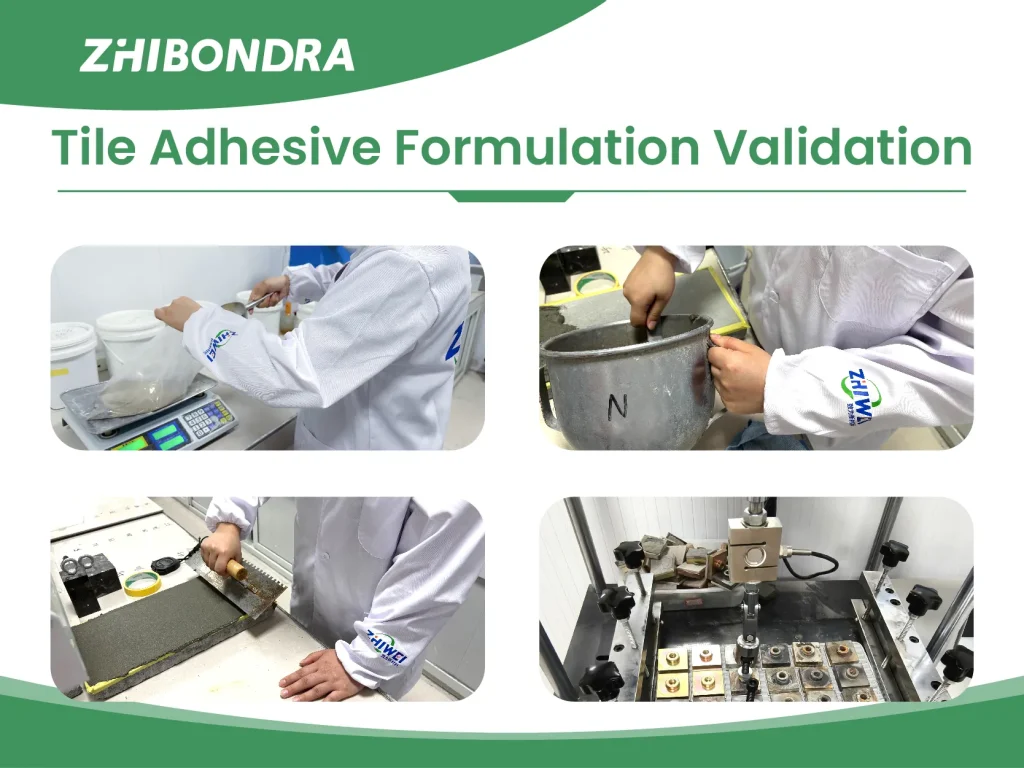
How to Develop a Balanced Tile Adhesive
Define the Application and Acceptance Criteria
Specify the tile, substrate, wall or floor use, exposure and intended bed thickness. Identify the market’s applicable test requirements. A large porcelain installation and a routine interior ceramic application may need different products.
Define what needs improvement in measurable terms. “Longer open time while retaining acceptable slip and conditioned adhesion” is a clearer objective than “more premium handling.”
Build a Complete Formula Record
List each dry ingredient and its mass. The total dry blend must equal 100%. Record mixing water separately, along with any specified liquid polymer.
Document cement source, mineral grading, product codes, dosage basis and mixing procedure. These records help distinguish an ingredient effect from a processing change.
Compare a Manageable Set of Variables
Start with a controlled reference. Change one factor at a time for diagnostic work, or use a planned trial matrix when studying interactions. Avoid changing polymer, cellulose, water and grading simultaneously without a comparison design.
Assess fresh properties first, then complete the required curing and conditioning tests. Keep relevant application observations alongside numerical results.
Verify the Finished Mortar
Evaluate initial and conditioned adhesion as required, open time, slip and deformability where relevant. Check representative tile contact and practical mixing as well.
A successful result cannot be inferred from polymer dosage, a viscosity label or powder appearance. Repeat promising formulations with representative raw-material batches and production conditions before adopting a commercial specification.
Common Problems and Ingredient Checks
| Observation | Useful checks |
|---|---|
| Short practical placement window | Cellulose selection, water balance, substrate absorption, airflow and temperature |
| Tile slip | Fresh rheology, water addition, tile loading and approved application method |
| Poor transfer despite stiff consistency | Water balance, mineral grading, surface skinning and bedding technique |
| Weak adhesion after conditioning | Polymer choice, binder compatibility, curing, preparation and failure location |
| Excessive bubbles or variable density | Mixing, air-modifying ingredients and defoamer compatibility |
| Inconsistent production behavior | Raw-material identity, weighing, minor-additive distribution and moisture |
Use the observation to choose the next test. Increasing every additive at once can obscure the original cause and create new trade-offs.
Frequently Asked Questions
What Are the Main Tile Adhesive Ingredients?
A polymer-modified cementitious adhesive commonly contains cement, graded minerals, RDP and cellulose ether. Optional additives address specific handling, air, setting or exposure requirements.
Is RDP the Same as Cellulose Ether?
No. RDP provides polymer modification. HEMC and HPMC mainly support water retention and rheology. Their contributions interact in the complete mortar.
Is There One Standard Ingredient Percentage for Every Adhesive?
No. Composition varies with binder technology, raw materials and the target performance. State the dosage basis clearly and validate the complete formulation.
Do All Tile Adhesives Contain Fibers?
No. Fiber reinforcement is an optional design choice. It needs application-specific compatibility and handling checks.
Can a Retarder Alone Give Longer Open Time?
Do not assume it will. Setting and surface open time are different. Evaluate the adhesive after controlled placement delays rather than judging only the mixed material’s consistency.
Can Installers Add More Polymer or Cement to a Finished Adhesive?
Only when the adhesive manufacturer specifies that procedure. Unapproved additions change the tested formulation and its intended application behavior.
Conclusion
Tile adhesive ingredients form an interacting system. Cement and minerals establish the basic mortar structure. RDP contributes polymer modification. Cellulose ether manages water and fresh consistency. Optional additives should each solve a defined, verified need.
At Zhiwei, our ZhiCellra™, ZhiBondra™ and ZhiFormix™ families provide starting points for controlled development. Share your base formula, intended application and performance target through Zhiwei, and explore our RDP website for polymer-focused guidance. Use that information to build a practical sample plan and test the complete adhesive.