 By info@zhiweichem.com
Mortar glue vs tile adhesive is a useful purchasing question only when the two products are clearly identified. For bonding tiles, choose a finished adhesive or a documented mortar system approved for the tile, substrate and exposure. An unspecified additive mixed into cement and sand does not automatically provide equivalent performance.
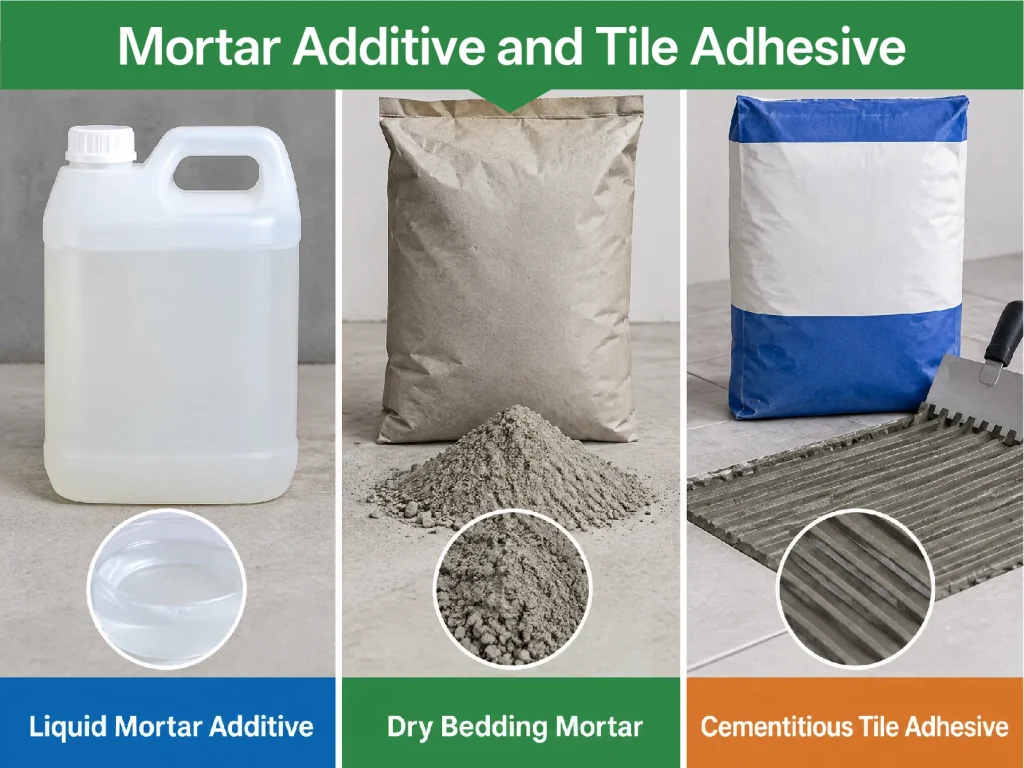
The term “mortar glue” can refer to a mortar additive, a bonding agent or a premixed bonding mortar. A cementitious tile adhesive is itself a type of mortar. The choice is therefore about the product’s function and verified suitability, rather than whether its name contains “glue” or “mortar.”
At Zhiwei, we recommend comparing technical data, application instructions and the complete installation system. For manufacturers, we also recommend selecting polymer and cellulose additives around defined formulation targets. This guide explains both decisions.
First Identify What Mortar Glue Means
A Liquid or Powder Mortar Additive
An additive modifies a mixture. It is not necessarily a complete adhesive, and it may require specified proportions of cement, aggregate and water.
For example, SikaBond SBR is described as a bonding agent, primer and mortar admixture. Its different uses depend on the manufacturer’s instructions. This illustrates why a liquid sold for bonding cannot be judged solely by the word “glue.”
Check whether the product is intended for mixing into mortar, preparing a bonding slurry or priming a surface. Do not assume these procedures are interchangeable.
A Cement and Sand Bedding Mortar
A bedding mortar may provide a supporting layer, establish levels or form part of a specified thick-bed installation. It has a different job from a thin bonding layer.
Factory-prepared bedding mortars and site-batched mixtures also differ in how their composition is controlled. A properly designed bedding system can be appropriate. It should not be dismissed as inherently inferior because it contains cement and sand.
LATICRETE’s thick-bed mortar and screed range shows that engineered bedding materials and latex admixtures remain established installation categories.
A Premixed Bonding Mortar
Some products called mortar glue may already be formulated tile-setting mortars. If so, the comparison should use their declared performance and approved applications.
Ask the supplier for the exact product name and technical data sheet. Without that information, assigning a universal bond strength or service life to “mortar glue” is not meaningful.
What Is a Tile Adhesive?
Tile adhesive is a broad category. Cementitious products commonly arrive as dry powders that require a measured mixing liquid. Dispersion adhesives may arrive ready mixed. Reaction-resin products follow their own component-mixing and curing instructions.
The packaging format does not establish suitability. A bucket may be convenient, but a ready-mixed product can have limitations relating to tile size, absorption and drying conditions. ARDEX’s guidance on ready-mixed adhesives directs large-format installations toward an appropriate cement-based adhesive.
For this comparison, the main finished-product option is a formulated cementitious tile adhesive used according to its stated instructions. It may contain cement, graded minerals, polymer and rheology-control additives. Its suitability comes from the complete formulation and test evidence.
Mortar Glue vs Tile Adhesive at a Glance
| Question | Mortar additive or site-mixed system | Finished cementitious tile adhesive |
|---|---|---|
| What is supplied? | An ingredient, or a mixture requiring a defined site recipe | A formulated powder with specified mixing instructions |
| What determines performance? | Additive compatibility, dosage, cement, sand, water and processing | Complete formulation, correct mixing and installation conditions |
| Is tile suitability automatic? | No; confirm the approved recipe and application | No; confirm the exact product’s approved tiles and substrates |
| Is thickness fixed by the category? | No; the installation method determines the range | No; follow the product’s permitted bed thickness |
| Is it ready to use? | Depends on what the product actually is | Dry cementitious products normally require mixing |
| How should cost be compared? | Include all ingredients, batching and application work | Include yield, preparation, application and waste |
The practical advantage of a finished adhesive is a defined product and application procedure. That reduces the number of formulation decisions left to the installation crew. It does not remove the need for substrate preparation and contact checks.
Compare Test Evidence Rather Than General Claims
Bond Strength Needs a Test Method
A statement such as “this adhesive achieves 0.5 MPa” is incomplete without the test method, conditioning, age and requirement being assessed. Initial adhesion and adhesion after water exposure answer different questions.
For a classified cementitious adhesive, examine the declared classification and supporting test data. C2 describes an improved adhesion class; it does not indicate a universal maximum tile size. Additional letters describe other tested properties.
The ARDEX X 7 technical data sheet provides a product-specific example of declared classification, mixing instructions and conditioned adhesion results. Such documentation is more useful for selection than a general claim that one entire product category is stronger.
Water Resistance Is Not Waterproofing
An adhesive may retain suitable adhesion after specified water conditioning without serving as a waterproof membrane. A hydrophobic formulation also does not automatically make the whole tiled assembly waterproof.
For a shower or other wet area, specify the membrane, substrate, joints, drainage and adhesive compatibility together. Do not use a generic “80% bond retention” statement as a substitute for the applicable product requirements.
Deformability Is Not a Universal Strain Allowance
Where S1 or S2 classification is relevant, assess the declared deformability of the finished adhesive under the specified test. Do not convert that classification into a promise that the installation can tolerate a fixed percentage of substrate movement.
Movement joints and substrate stability remain necessary. A flexible adhesive cannot make a moving or structurally unsuitable substrate acceptable by itself.
Freeze-Thaw Results Do Not Promise Unlimited Durability
Check exterior suitability and the applicable conditioning results. A claim such as “F50” needs its own identified standard and relevance; it should not be applied automatically to every tile adhesive.
Similarly, no product category alone establishes a 30-year bond life. Durability depends on the actual materials, installation, exposure, maintenance and any documented warranty conditions.
When a Mortar Bed and Tile Adhesive Work Together
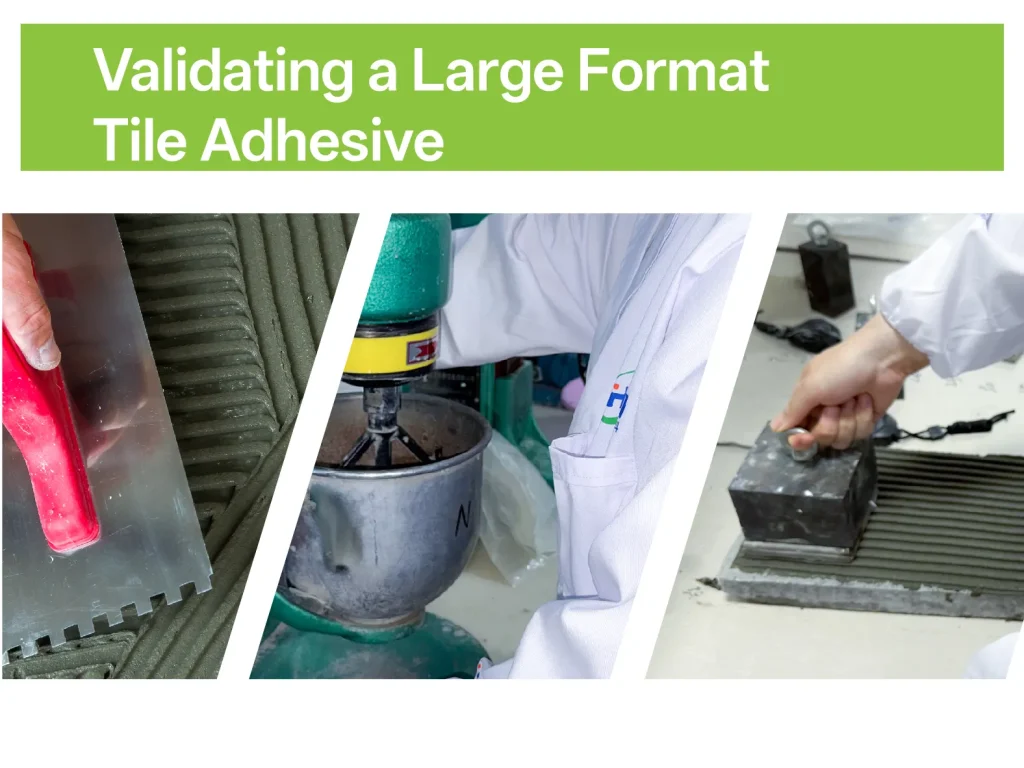
A project may need both products. The mortar bed prepares the supporting surface, while a compatible adhesive provides the tile bond in an approved assembly.
For example, a floor may require correction before tile installation. A suitable leveling or bedding material addresses that preparation need. The adhesive is then used within its stated thickness range. Other approved methods may use different sequences, so follow the selected system.
Avoid using an ordinary thin-bed adhesive as an unrestricted leveling compound. Also avoid assuming that every thick mortar layer will bond porcelain effectively without the specified bonding treatment.
Bed thickness must come from the product and installation method. A universal “3–5 mm versus 10–15 mm” comparison leaves out products and systems with different approved ranges.
Choose by Tile, Substrate and Location
Porcelain and Large Tiles
Select an adhesive explicitly approved for the tile and installation. Consider tile absorption, dimensions, backing, wall or floor placement and expected movement. For thin porcelain panels, obtain the panel manufacturer’s installation requirements.
An improvised cement-and-sand mixture with an unspecified additive is a poor basis for making these decisions. A documented system gives the installer clear requirements to follow and the purchaser identifiable evidence to review.
Interior Ceramic Tiles
For a straightforward interior application, a suitable standard adhesive may meet the project requirements. Buying a more expensive product is not automatically necessary, but reducing cost must not remove required performance or compatibility.
Check the surface preparation instructions and tile limits. Interior use does not mean every substrate is acceptable.
Wet Areas, Heated Floors and Exterior Work
These applications require more than a general bonding claim. Check compatibility with waterproofing or heating systems, exposure limits, curing instructions and the movement-joint design.
For exterior walls, confirm the complete fixing specification, including any required mechanical support. Adhesive classification alone does not establish a facade design.
Installation Quality Can Decide the Result
Begin with a sound, prepared substrate. Remove contaminants by the approved method, repair defects and use the specified primer when required. A higher-performance adhesive cannot compensate for a weak surface layer.
Measure the mixing water and follow the resting and remixing procedure. Adding extra water, cement, sand or an unapproved bonding liquid changes a finished adhesive’s formulation. Only use such additions when the manufacturer explicitly specifies them.
Distinguish pot life from open time. Pot life concerns the usable mixed material. Open time concerns the spread adhesive’s ability to achieve the required bond after a placement delay. Mortar can remain workable in the bucket while a thin spread layer has already skinned.
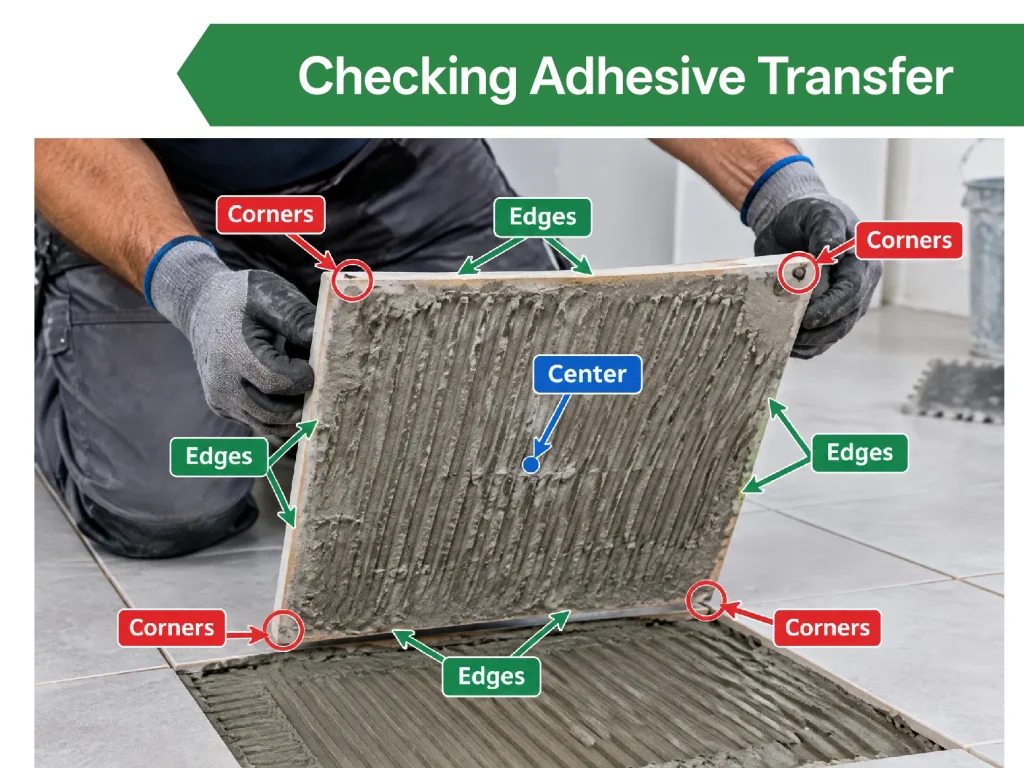
Work in manageable areas and inspect actual transfer by lifting trial tiles. Check the center, edges and corners against the coverage requirement for the installation. Adjust the method before continuing if contact is inadequate.
Observe the product’s curing schedule before grouting, loading or water exposure. A single waiting period cannot cover all adhesive types, climates and bed thicknesses.
How Zhiwei RDP and HEMC Fit the Formulation
For dry-mix manufacturers, the more useful question is how to formulate a mortar that meets the intended tile-adhesive requirements.
RDP supplies a polymer component to the dry blend. Its influence on adhesion and mechanical behavior depends on polymer chemistry, dosage, the mineral system and curing conditions. It is a formulation ingredient, not a finished tile adhesive.
HEMC helps control water retention, consistency and application behavior. Our HEMC for cement-based tile adhesive guidance explains why cement, particle grading, polymer content and mixing conditions need to be considered together.
Increasing either additive without a clear target can create trade-offs. A mortar that feels very stiff may hold a wall tile but transfer poorly. A mix that spreads easily may need further adjustment to maintain the required slip resistance.
Explore Zhiwei’s RDP product website and cellulose ether website when planning raw-material screening. Evaluate the complete mortar before assigning a finished-product classification.
Zhiwei RDP Grades for Targeted Trials
| Grade | Product positioning | Relevant trial direction |
|---|---|---|
| ZW-4023N | Neutral general-purpose grade | Baseline evaluation for standard tile adhesive and general mortar workability. |
| ZW-5010N | Neutral high-strength grade | Strength-focused comparison in standard adhesive formulations, with full application testing. |
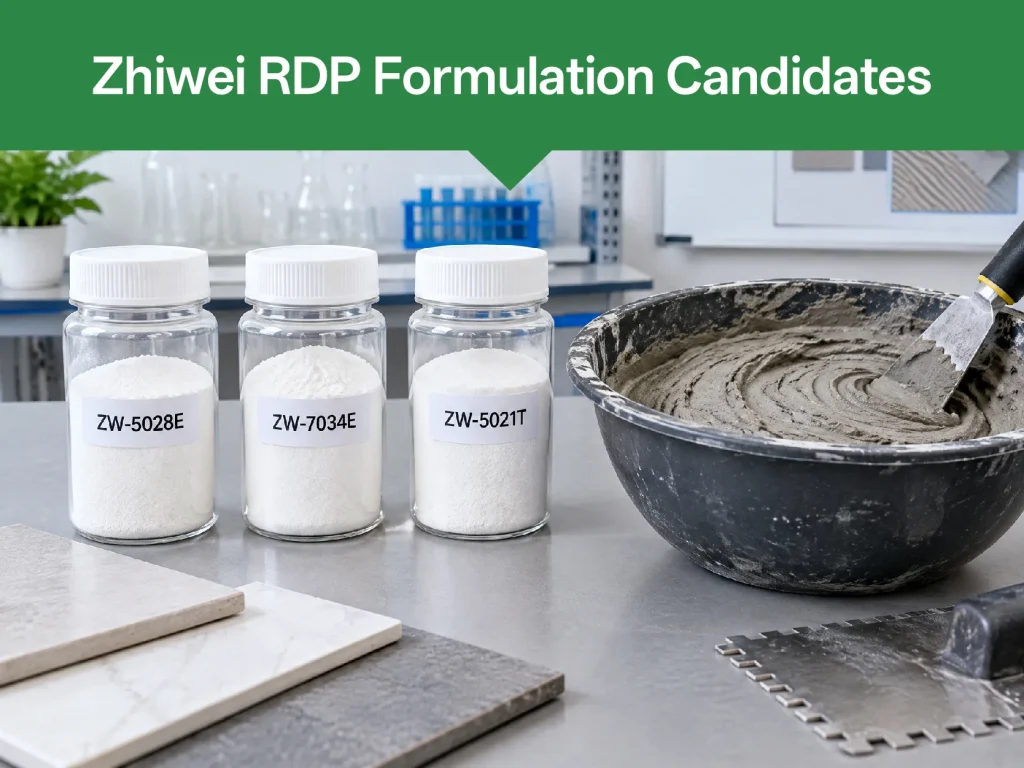
| ZW-5028E | Enhanced tile adhesive grade | A relevant candidate for upgraded tile-adhesive development. |
| ZW-7034E | Enhanced multi-application grade | A comparison candidate for formulations balancing adhesion, flexibility and broader mortar requirements. |
| ZW-5021T | Thixotropic tile adhesive grade | Relevant when anti-sag behavior and wall application are central targets. |
| ZW-5044N | High-flex waterproof grade | Specialist evaluation for flexible waterproofing or repair systems; not an automatic tile-adhesive selection. |
| ZW-8034H | Hydrophobic waterproof grade | Relevant to reduced-water-absorption grout and waterproof mortar development; not proof of a waterproof assembly. |
| ZW-5023L | Self-leveling specialty grade | Relevant to a separately formulated leveling layer, rather than a default wall tile adhesive. |
The table describes portfolio positioning and possible screening directions. It does not certify any grade as C2, S1 or S2. Those claims belong to the tested finished mortar.
Begin with a defined target and a controlled base formula. Compare suitable candidates at documented dosages, then evaluate conditioned adhesion, open time, slip and deformability where required. Include practical spreading and tile-transfer checks.
Compare Installed Cost, Not Just Material Price
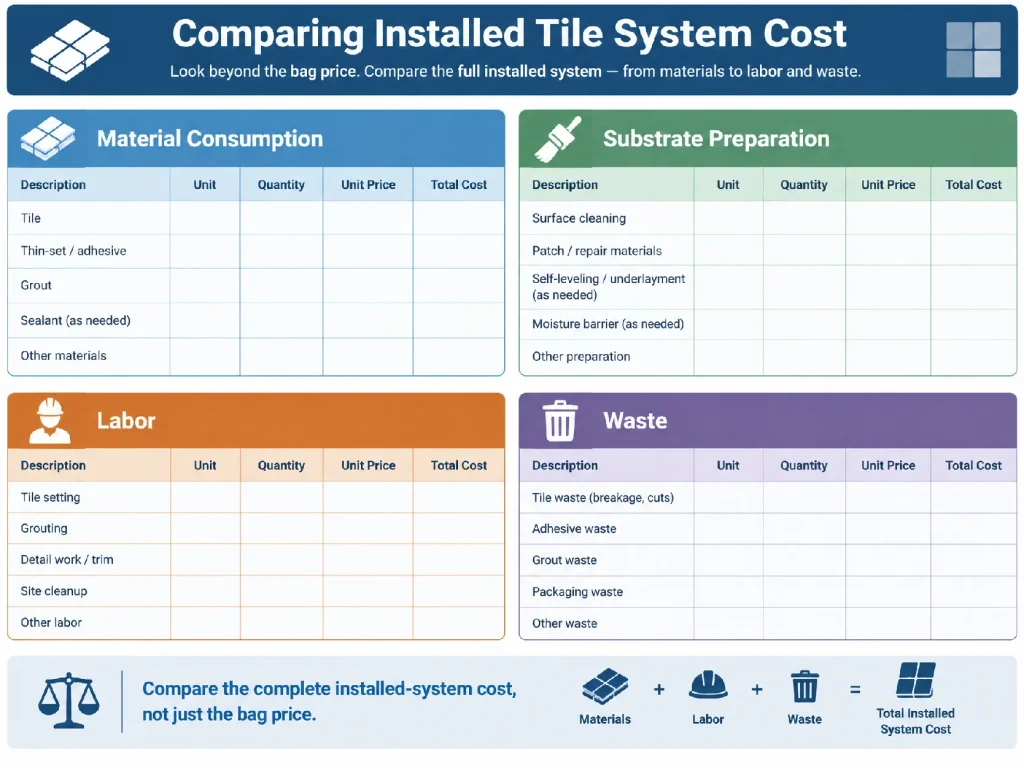
A cheaper bag or bottle may not produce a cheaper completed installation. Compare both options for the same area, substrate condition and performance requirement.
Record the cost of substrate preparation, all ingredients, expected consumption, labor, equipment and waste. Include the batching work required for a site-mixed system. For a finished adhesive, confirm yield at the intended bed thickness rather than assuming that every bag covers the same area.
Use a simple project calculation:
Installed cost per square meter = total material, preparation, labor and equipment cost ÷ completed area.
Discuss possible rework separately instead of inventing a failure rate. Product prices vary by country, packaging, transport and purchase date, so a fixed global price comparison is unlikely to be useful.
The economical choice is the lowest-cost system that meets the project requirements and can be installed consistently by the available team.
Questions to Ask Before Buying
Request the exact product identity and current technical data sheet. Confirm whether you are buying an additive, a primer, a bedding mortar or a finished adhesive.
Then establish the approved tile and substrate types, required mixing ratio, application thickness and exposure limits. Ask which test results support the claims and whether those results cover the intended installation.
For a site-mixed system, obtain the complete documented recipe and method. For a finished adhesive, follow the specified mixing liquid. Keep the batch information and project specification together so that purchasing and site teams work from the same instructions.
Frequently Asked Questions
Is Mortar Glue Better Than Tile Adhesive?
The name alone cannot answer the question. A mortar additive modifies another mixture, while a finished tile adhesive supplies a defined bonding product. Compare the exact systems and choose one approved for the intended installation.
Is Tile Adhesive Also Mortar?
Cementitious tile adhesive is a formulated mortar. The important distinction is its function and tested performance, rather than the word used on the packaging.
Can I Add Mortar Glue to Bagged Tile Adhesive?
Only when the adhesive manufacturer specifies that addition. An unapproved liquid or powder can change water demand, setting, rheology and adhesion, so the original performance claims may no longer apply.
Is Every Tile Adhesive Ready to Use?
No. Dry cementitious adhesives require mixing with the specified liquid. Ready-mixed dispersion adhesives are a separate category with their own tile and application limits.
Does Water-Resistant Adhesive Replace Waterproofing?
No. Adhesive performance after water conditioning does not establish that the entire installation is waterproof. Use the required waterproofing system and compatible materials.
Which Zhiwei RDP Grade Should a Manufacturer Test First?
ZW-4023N or ZW-5010N can provide standard-formulation comparison options. ZW-5028E and ZW-7034E are relevant candidates for upgraded development, while ZW-5021T is useful to investigate when thixotropy and wall handling matter. Confirm the choice through complete mortar testing.
Conclusion
The mortar glue vs tile adhesive decision begins with product identification. Choose a documented bonding system that matches the tile, substrate and exposure. Compare conditioned performance, installation instructions and total installed cost.
For manufacturers, Zhiwei’s RDP and cellulose portfolios provide candidates for controlled formulation development. Share your target classification, base formula and application challenge through zhiweichem.com, and explore our RDP focus at rdppowderfactory.com. Build the final recommendation on repeatable testing of the complete mortar.
Leave A Comment