
 By info@zhiweichem.com

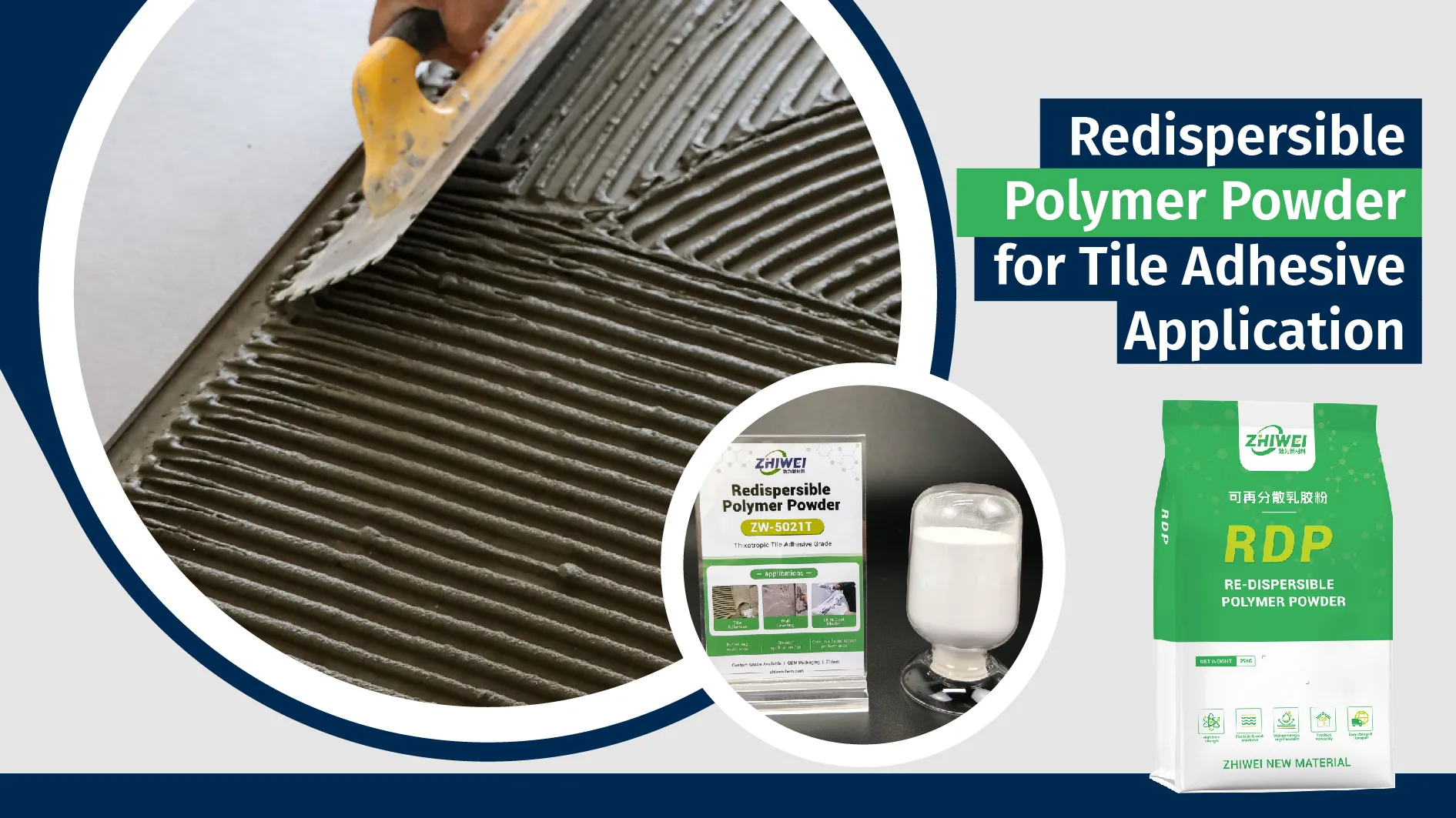
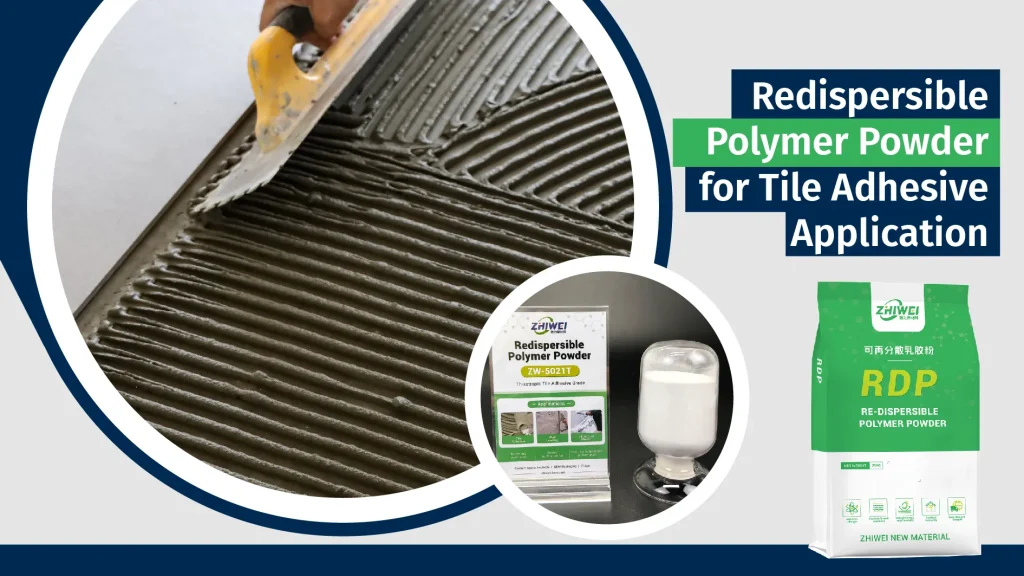
Redispersible polymer powder for tile adhesive is a key binder in modern one-component cementitious dry-mix systems. It helps a mineral mortar bond to ceramic, porcelain, stone, and many difficult substrates. It also helps the hardened adhesive manage movement between the tile and the base.
Modern tile installation places more stress on the adhesive than older methods did. Tiles are larger. Many tiles absorb very little water. Renovation projects may require bonding over old finishes. Exterior walls and floors face heat, cold, water, and daily movement. A basic mixture of cement and sand often cannot meet all these demands on its own.
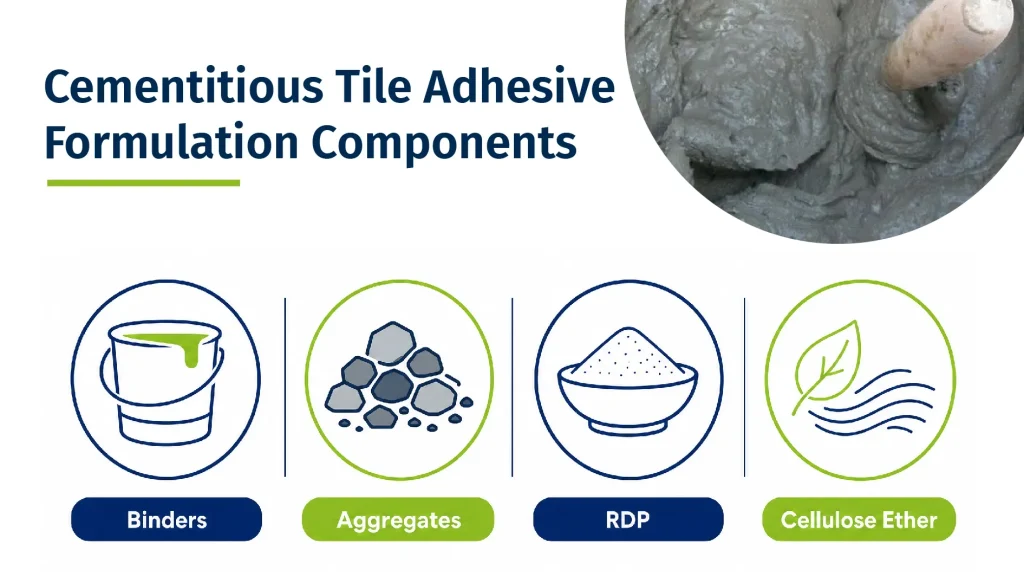
This is why a complete tile adhesive formulation normally uses several functional additives. RDP supports adhesion, cohesion, flexibility, and durability. Cellulose ether controls water retention, consistency, open time, and application feel. Other additives can adjust slip resistance, setting speed, water absorption, and crack control.
Zhiwei (Jinan) New Materials Co., Ltd. supplies a structured RDP portfolio for different dry-mix mortar targets. Zhiwei also supports tile adhesive producers with cellulose ether selection and practical sample testing. The goal is simple: match the polymer system, rheology, and application process to the required performance level.
What Is a Modern Cementitious Tile Adhesive?
A cementitious tile adhesive is a factory-blended dry mortar. The user normally adds a controlled amount of water at the jobsite and mixes the powder into a workable paste. The adhesive is then spread in a thin, even layer with a notched trowel.
The system is different from traditional thick-bed cement and sand mortar. A modern thin-bed adhesive uses carefully graded mineral materials and small amounts of high-value additives. Each additive has a clear task.
| Component | Main Function in the Formulation |
|---|---|
| Cement or another mineral binder | Develops the main mineral strength after hydration |
| Graded sand and fillers | Control body, layer thickness, packing, cost, and dimensional stability |
| Redispersible polymer powder | Supports adhesion, cohesion, flexibility, and stress transfer |
| HEMC or another suitable cellulose ether | Controls water retention, consistency, open time, and troweling behavior |
| Starch ether or rheology modifier | Can improve anti-sag behavior and fresh-mortar stability |
| Calcium formate or another accelerator | Can adjust early strength and setting behavior in suitable systems |
| Hydrophobic additive | Can reduce capillary water uptake when the application requires it |
| Fibrous or crack-control additive | Can support crack resistance and mortar stability in selected designs |
The source material for this article presents standard and higher-bond tile adhesive examples. These examples show an important formulation trend. A higher-performance adhesive usually needs more than extra cement. It needs a better balance of polymer binder, cellulose ether, aggregate grading, water demand, and application properties.
Exact proportions should never be copied into production without checking the full mass balance. A plant should also confirm local raw materials, climate, mixer efficiency, target standard, and cost. Even a small change in cement, sand grading, or cellulose ether can change water demand and open time.
Why Basic Cement Mortar Is Often Not Enough
Traditional mortar relies heavily on mechanical anchoring. This works better when a tile and substrate are porous and rough. The mortar enters surface pores and hardens there.
Many modern porcelain tiles are dense and have low water absorption. Their backs may also be smoother. Large-format tiles create another challenge. They place more stress across a wider bonded area, and incomplete mortar coverage becomes more serious.
Substrates also move. Concrete shrinks. Boards and old finishes respond to heat and moisture. Exterior surfaces face daily temperature cycles. If the adhesive layer is too rigid, stress can build at the interface. This can lead to cracking, loss of adhesion, or hollow areas.
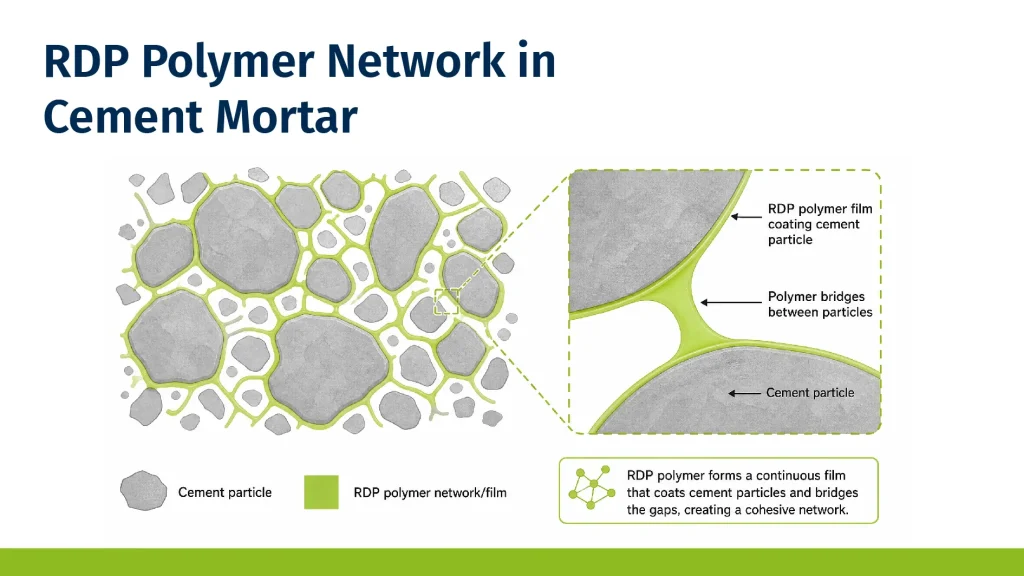
Polymer modification gives the cement matrix a second binding mechanism. According to industry guidance on polymer binders for tile systems, a polymer network inside the mortar can improve adhesion, flexibility, cohesion, open time, and resistance to stress between the tile and substrate. These properties are especially useful for dense tiles, larger formats, exterior work, and difficult substrates.
How Redispersible Polymer Powder for Tile Adhesive Improves Performance
RDP begins as a free-flowing powder. When the dry mix is combined with water, the powder redisperses into small polymer particles. As cement hydration continues and water leaves the mortar, these particles come closer together. They can then form a polymer phase through the mineral matrix.
This combined mineral and polymer structure changes both fresh and hardened performance.
Better Adhesion
The polymer phase helps the mortar contact the tile back and the substrate. It can improve the bond on smooth or low-absorption surfaces when the whole formulation is designed correctly. The result still depends on surface preparation, mortar coverage, open time, curing, polymer level, and the selected test method.
Better Cohesion
The adhesive must not only stick to the tile. Its internal mortar layer must also stay strong. RDP can support cohesive strength and reduce brittle failure inside the adhesive bed.
More Flexibility
Cement is strong but relatively rigid. A suitable polymer powder can make the mortar more deformable. This helps the adhesive distribute movement and temperature stress instead of concentrating it at one point.
Better Workability
The right RDP can improve the creamy feel and spreading behavior of the mortar. It may also support wetting of the tile back. Workability is not created by RDP alone. Cellulose ether, aggregate grading, water level, and rheology additives also have a strong effect.
Improved Performance After Exposure
A tile adhesive may be tested after standard curing, water immersion, heat aging, or freeze-thaw conditioning. A suitable polymer system can help the formulation keep useful adhesion under these conditions. The final result must be confirmed in the complete mortar. A raw-material data point is not a finished-product certification.
RDP and HEMC Have Different Jobs
RDP and cellulose ether are sometimes discussed as if they do the same work. They do not. They support each other, but each controls a different part of the system.
| Performance Area | Main Contribution from RDP | Main Contribution from HEMC |
|---|---|---|
| Bond development | Supports polymer binding, adhesion, and cohesion | Supports water retention and workable contact time |
| Flexibility | Main polymer contribution to deformability and stress distribution | Indirect influence through fresh-state control |
| Open time | May support wetting and working behavior, depending on grade | Major control of moisture retention and usable open time |
| Slip resistance | Some modified or thixotropic RDP grades can support anti-sag behavior | Controls viscosity and rheology; grade selection is important |
| Troweling | Can improve creamy feel and wetting | Controls consistency, spreading, and water demand |
| Cement hydration | Does not replace control of water retention | Helps keep water in the mortar for more stable hydration |
Zhiwei’s HEMC for cement-based tile adhesive is positioned for water retention, open time, smooth troweling, and stable handling. For more demanding systems, the company also provides guidance on HEMC for high-quality tile adhesive. In both cases, the best grade depends on cement type, filler package, sand grading, RDP level, temperature, and mixing order.
This is why changing only one additive may not solve a formulation problem. For example, adding more water may make troweling easier at first, but it may also increase shrinkage and reduce strength. Increasing cellulose ether may improve water retention, but an unsuitable grade or excessive level can change hydration and application feel. Increasing RDP may improve flexibility, but the polymer type must still match the target.
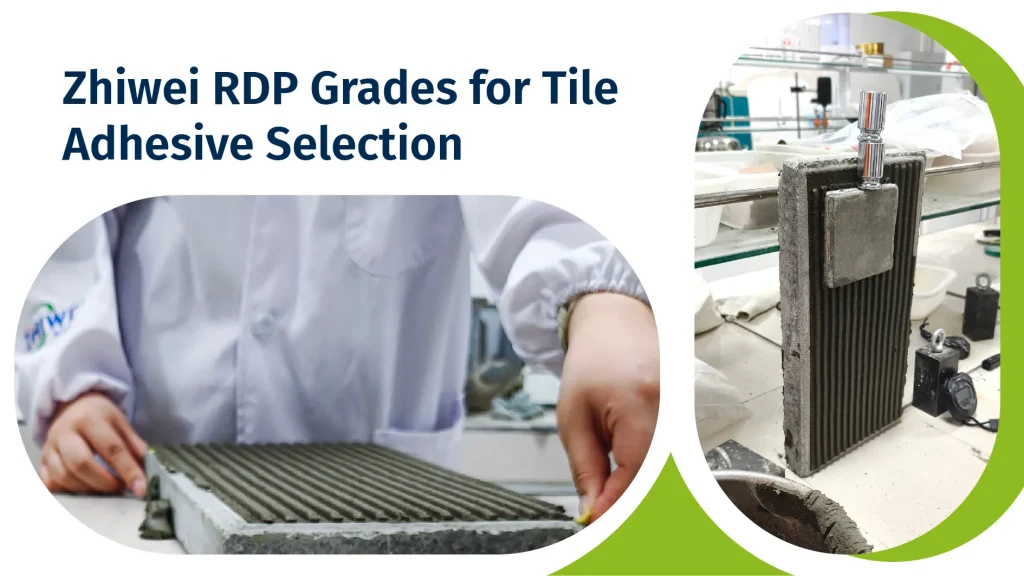
How to Select a Zhiwei RDP Grade for Tile Adhesive
Zhiwei organizes its RDP products by application position. The table below gives a practical selection route based on the supplied product workbook. The descriptions are starting points for formulation trials. They are not finished-mortar performance guarantees.
| Zhiwei Grade | Product Positioning | Tile Adhesive Selection Logic |
|---|---|---|
| ZW-4023N | Neutral general-purpose VAc-E grade | A balanced starting point for standard tile adhesive where adhesion, workability, and broad formulation value matter |
| ZW-5010N | Neutral high-strength VAc-E grade | A cost-effective option for standard formulations that place more emphasis on strength and bond performance |
| ZW-5028E | Enhanced tile adhesive VAc-E grade | A focused option for upgraded mid-range tile adhesive with a semi-flexible profile |
| ZW-7034E | Enhanced multi-application VAc-E-based grade | A flexible option for mid-to-high-end tile adhesive and producers that also formulate EIFS, grout, waterproofing, or repair mortar |
| ZW-5021T | Thixotropic tile adhesive VAc-E grade | A targeted option for wall tile adhesive, anti-sag performance, and easier trowel application |
| ZW-5044N | High-flex waterproof VAc-E grade | A very flexible option for systems where deformation, waterproof mortar compatibility, or repair performance has higher priority; use in tile adhesive after targeted testing |
| ZW-8034H | Hydrophobic VC-E-based grade | A supporting choice for low-water-absorption or hydrophobic systems, especially grout and waterproof mortar; tile adhesive use needs application-specific validation |
| ZW-5023L | Self-leveling specialty VAc-E grade | Designed for flow and leveling balance in self-leveling systems, so it is not the first-line choice for a conventional non-sag tile adhesive |
Most grades in the workbook use a suggested solid content above 98%, a suggested bulk density of 400-550 g/L, and a suggested pH of 5-8 in a 10% dispersion. The ash-control target differs by grade. These are product-selection references from the supplied workbook. Buyers should use the current TDS, SDS, COA, and sample test results for commercial approval.
For a standard interior wall or floor adhesive, ZW-4023N or ZW-5010N gives a clear starting point. For an upgraded tile adhesive, ZW-5028E offers a more focused product position. ZW-7034E is useful when a producer wants more flexibility and a wider mortar application range.
For heavy wall tiles or a formula with a clear anti-slip target, ZW-5021T deserves early testing. A thixotropic grade can support fresh-mortar structure, but the full rheology package still matters. The HEMC grade, starch ether, water demand, aggregate curve, and trowel method can all change slip performance.
ZW-5044N and ZW-8034H answer different needs. ZW-5044N is positioned around high flexibility and waterproof or repair systems. ZW-8034H is positioned around hydrophobic effect and low water absorption. Neither should be selected only because a project is in a wet area. The finished tile system may also require a separate waterproofing layer, suitable grout, sealed movement joints, and correct detailing.
Build the Formulation Around the Performance Target
A useful tile adhesive formulation starts with the job requirement. It should not start with a copied recipe.
First, define the tile. Is it porous ceramic, dense porcelain, natural stone, or a large-format slab? Then define the substrate. Concrete, cement render, gypsum board, old tile, and wood-based boards do not create the same demand. The installation location also matters. Interior dry areas, bathrooms, exterior walls, heated floors, and swimming pools need different system design.
Next, define the required fresh properties. A wall adhesive may need strong anti-sag behavior. A hot-climate product may need longer open time. A contractor-focused product may need a creamy feel and easy ridge formation. A large-format application needs reliable wetting and high mortar coverage.
Then define the hardened properties. These may include initial tensile adhesion, adhesion after water immersion, adhesion after heat aging, freeze-thaw performance, deformability, and abrasion resistance. The required tests depend on the target market and standard.
The PDF supplied for this article cites JC/T 547-2005. That version has been superseded. China’s National Public Service Platform for Standards lists JC/T 547-2017 as the replacement. Producers should check the current standard and customer specification before assigning a C1, C2, fast-setting, extended-open-time, low-slip, or deformability claim.
Finally, balance cost against failure risk. A lower additive cost per ton does not always create the lowest installed cost. Poor wetting, tile slip, short open time, callbacks, and debonding can cost far more than the polymer saved.
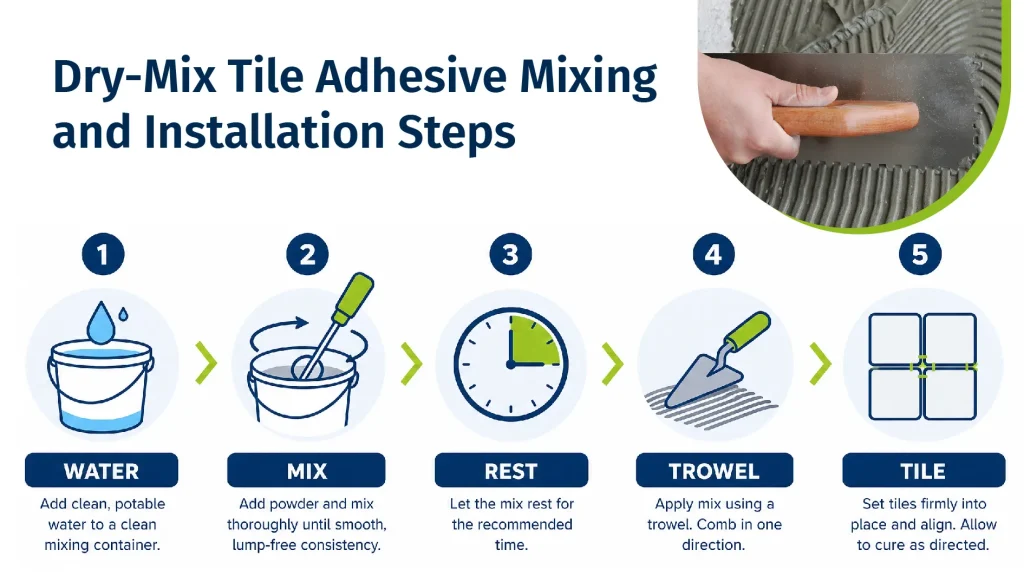
Recommended Mixing and Installation Process
A good formulation can still fail when the mixing and installation process is poor. The following sequence reflects the practical points in the source PDF and current dry-mix practice. The final product TDS and project specification always take priority.
1. Prepare the Substrate
The substrate should be sound, stable, clean, and suitable for bonding. Remove dust, oil, wax, loose material, release agents, and weak coatings. Check flatness before installation. Large uneven areas should be corrected with a suitable leveling material instead of using tile adhesive as a thick patch.
Painted surfaces or old finishes may need mechanical preparation. Highly absorbent or dusty substrates may need an approved primer. New concrete and render must reach the curing condition required by the project specification.
2. Use Controlled Water
Measure the recommended water before adding powder. The source PDF uses roughly 25-30 parts of water per 100 parts of dry powder as an example, but this is not a universal dosage. Cement, fillers, sand, cellulose ether, RDP, and temperature all change water demand.
Do not add extra water only to make the mortar softer. Too much water can reduce body, increase tile slip, increase shrinkage, and weaken the cured layer.
3. Mix, Rest, and Remix
Add the dry powder gradually under steady mixing. Mix until the mortar is uniform and free from dry lumps. Many cementitious adhesives benefit from a short resting period followed by remixing. This allows cellulose ether and other additives to hydrate more fully.
Do not add water to mortar that has already started to set. This practice can destroy the designed binder structure even if the paste appears workable again.
4. Apply with the Correct Notched Trowel
Spread the adhesive over an area that can be tiled within the product’s open time. Hold the trowel at a consistent angle and form even, parallel ridges. The notch size should match tile size, tile-back profile, substrate flatness, and required coverage.
Large, heavy, or deeply profiled tiles may require adhesive on both the substrate and tile back. This method can improve contact and reduce voids. Lift test tiles during installation to verify coverage instead of assuming the ridges have collapsed correctly.
5. Place, Adjust, and Protect
Press the tile firmly into the fresh adhesive and move it across the ridges to build contact. Complete adjustment within the product’s stated working time. Keep movement joints and perimeter joints where the design requires them.
Protect the work from traffic, water, vibration, heat, and rapid drying during early cure. Grout only after the adhesive has cured for the time stated in the product TDS and site conditions allow the next step.
Common Tile Adhesive Problems and Formulation Responses
| Problem | Possible Causes | Practical Evaluation Route |
|---|---|---|
| Wall tiles slip after placement | Low fresh structure, high water, unsuitable cellulose ether, weak rheology package, wrong trowel method | Check water demand, HEMC, starch ether, and ZW-5021T in controlled side-by-side trials |
| Adhesive skins over too quickly | Hot or windy conditions, low water retention, excessive spreading area, poor formulation balance | Measure open time; review HEMC grade and dosage; reduce exposure before tile placement |
| Poor transfer to tile back | Adhesive applied beyond open time, mortar too stiff, poor wetting, wrong ridge direction, low pressure | Run transfer checks at timed intervals and adjust rheology, application method, and polymer system |
| Low bond after water immersion | Unsuitable polymer type or level, high water demand, poor cure, weak substrate, incomplete coverage | Test complete formulations after the required conditioning; compare RDP grades at equal dry-mix conditions |
| Cracking or debonding after temperature change | Adhesive too rigid, moving substrate, missing joints, thick or uneven layer | Review substrate design, movement joints, coverage, and more flexible RDP options such as ZW-7034E or ZW-5044N |
| Mortar feels sticky or hard to trowel | Poor grading, excessive fine material, unsuitable cellulose ether, unbalanced polymer level | Adjust the whole formulation instead of changing water alone |
| High water uptake in grout or waterproof mortar | Open pore structure, shrinkage, incomplete cure, no hydrophobic function | Evaluate ZW-8034H and the total waterproofing design in the correct application |
Troubleshooting should change one controlled variable at a time. Keep cement, aggregate, water, mixing energy, resting time, and test conditions constant when comparing RDP grades. Otherwise, the result may reflect a process change instead of the polymer powder.
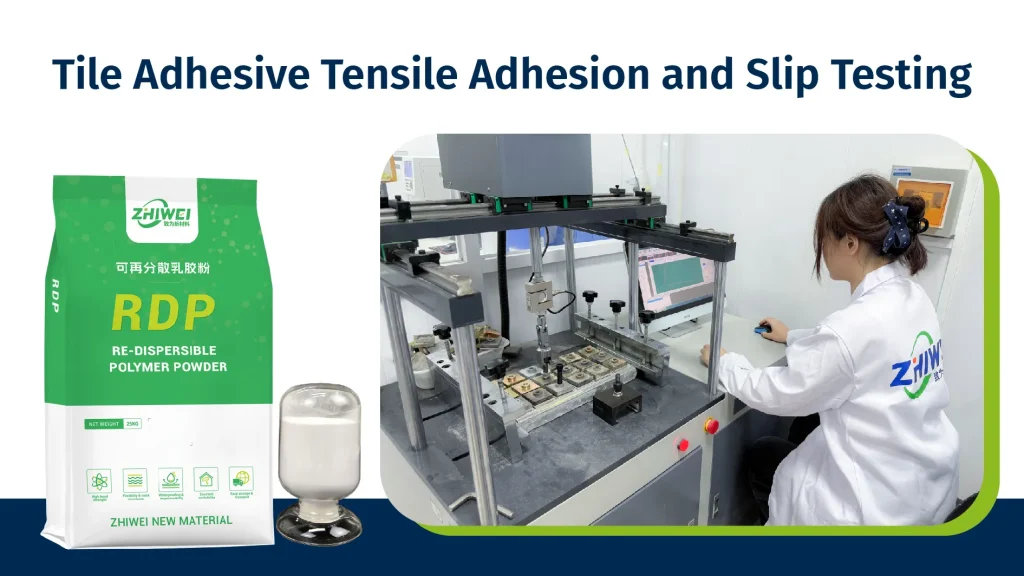
Testing Before Commercial Production
A tile adhesive should be tested as a complete system. RDP specifications help with raw-material control, but they cannot predict every interaction in the mortar.
A practical lab program may include:
- Powder appearance, moisture, ash, bulk density, and dispersion checks
- Fresh-mortar density and consistency
- Water demand and troweling feel
- Slip or sag on a vertical test panel
- Open time and tile-back transfer at set intervals
- Adjustment time
- Tensile adhesion after standard curing
- Tensile adhesion after water immersion
- Tensile adhesion after heat aging
- Freeze-thaw conditioning where required
- Deformability for flexible adhesive targets
- Pot life and early strength where relevant
The test matrix should compare a control formula with one change at a time. The chosen RDP should then be checked with the final HEMC grade. It should also be checked with the actual cement, sand, fillers, and local water used by the plant.
Production trials are the next step. A laboratory mixer and a plant mixer do not always create the same dispersion. The producer should verify powder flow, mixer time, bag filling, storage stability, and jobsite mixing. Retained samples and batch records make later troubleshooting faster.
Zhiwei can use the customer’s application data to narrow the first trial set. Useful information includes the target standard, tile type, substrate, climate, cement source, sand grading, current RDP, cellulose ether, water demand, and main failure. Zhiwei can then suggest grades, samples, and a simple comparison plan. Current TDS and SDS documents should be reviewed before scale-up, and a batch COA should be checked during commercial supply.
Frequently Asked Questions
What Does Redispersible Polymer Powder for Tile Adhesive Do?
Redispersible polymer powder for tile adhesive supports adhesion, cohesion, flexibility, and stress distribution in a cementitious mortar. It redisperses when the dry mix is combined with water. During curing, it forms a polymer phase within the mineral matrix. The result still depends on the polymer grade, dosage, cement, aggregate, water, cellulose ether, curing, and application method.
Are RDP and HEMC the Same Additive?
No. RDP acts mainly as a polymer binder. HEMC is a cellulose ether that controls water retention, consistency, open time, and troweling behavior. A reliable tile adhesive usually needs the two functions to work together. One material should not be treated as a direct replacement for the other.
Which Zhiwei Grade Is a Good Starting Point for Standard Tile Adhesive?
ZW-4023N is the neutral general-purpose option, and ZW-5010N is the neutral high-strength option. Both are practical starting points for standard formulations. ZW-5028E is more focused on upgraded mid-range tile adhesive. The final choice should follow side-by-side tests in the customer’s own formula.
Which Grade Should Be Tested for Anti-Sag Tile Adhesive?
ZW-5021T is Zhiwei’s thixotropic tile adhesive grade. It is positioned for anti-sag behavior and easy trowel application. The producer should test it with the selected HEMC, starch ether, water level, and aggregate grading because fresh-mortar structure comes from the complete rheology package.
Does More RDP Always Produce Better Tile Adhesive?
No. More redispersible polymer powder for tile adhesive does not automatically create a balanced product. The polymer type and dosage must match the required adhesion, flexibility, workability, and cost. Excessive or poorly matched polymer can change consistency, water demand, setting behavior, and economics. A controlled dosage study gives a better answer than a single high-addition trial.
Can Hydrophobic RDP Replace a Waterproofing System?
Not automatically. ZW-8034H can support hydrophobicity and lower-water-absorption targets in suitable mortar systems. It does not remove the need for project-specific waterproofing membranes, joint treatment, drainage, movement joints, or correct installation details. The whole assembly must meet the relevant specification.
Conclusion
Modern tile adhesive is a balanced polymer-modified mortar. Cement provides mineral strength. Graded aggregate controls structure and dimensional stability. HEMC manages water retention, open time, consistency, and application feel. RDP supports adhesion, cohesion, flexibility, and stress control.
The best RDP is the grade that fits the tile, substrate, climate, standard, and cost target. ZW-4023N and ZW-5010N offer practical starting points for standard systems. ZW-5028E targets upgraded tile adhesive. ZW-7034E supports flexible, multi-application development. ZW-5021T focuses on anti-sag and trowel-applied systems. ZW-5044N and ZW-8034H serve more specialized flexibility or hydrophobic needs. ZW-5023L remains a self-leveling specialty grade rather than a first choice for conventional wall tile adhesive.
Zhiwei (Jinan) New Materials Co., Ltd. supports grade selection, sample evaluation, and batch documentation. Send Zhiwei your current formula, target standard, tile type, substrate, water demand, and main performance problem. The team can help build a focused test plan instead of relying on a generic recipe.