
 By info@zhiweichem.com
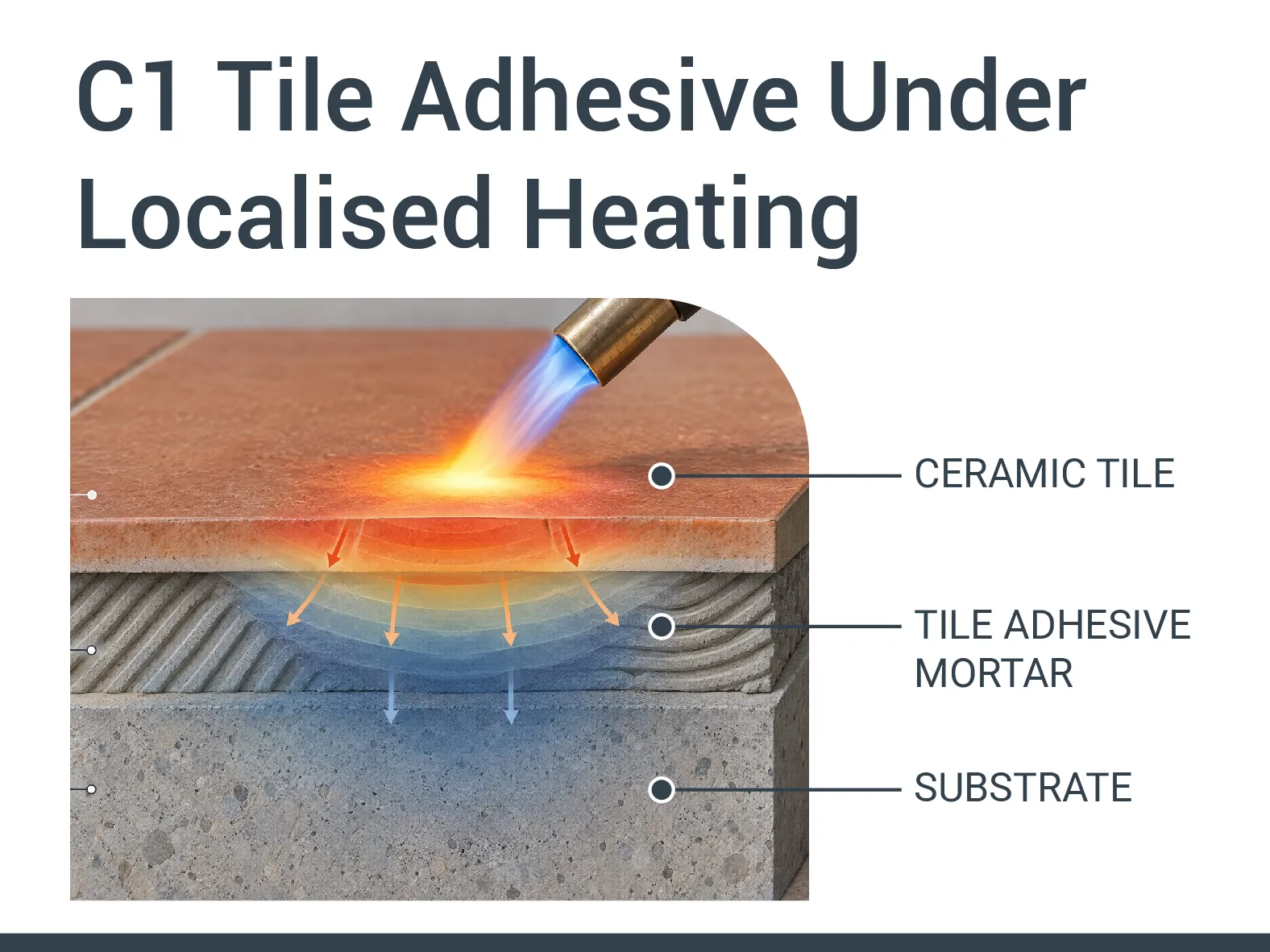
C1 tile adhesive can suffer damage when installed tiles are heated with a torch. However, debonding is not an inevitable result of every exposure, and a hollow sound alone does not prove that the adhesive has failed. The outcome depends on the heat reaching the assembly, the duration of exposure, curing age, moisture, tile properties, and the condition of the underlying layers.
Direct flame is not an appropriate routine method for curing tile adhesive or checking its quality. It creates a local heat source that differs greatly from normal installation conditions and controlled laboratory testing.
At Zhiwei (Jinan) New Materials Co., Ltd., we approach tile adhesive development through raw-material selection and finished-mortar evaluation. RDP and cellulose ether can improve a formulation, but their contribution must be considered alongside cement, aggregate, mixing water, and installation practice. No additive should be presented as permission to expose a freshly tiled surface to a torch.
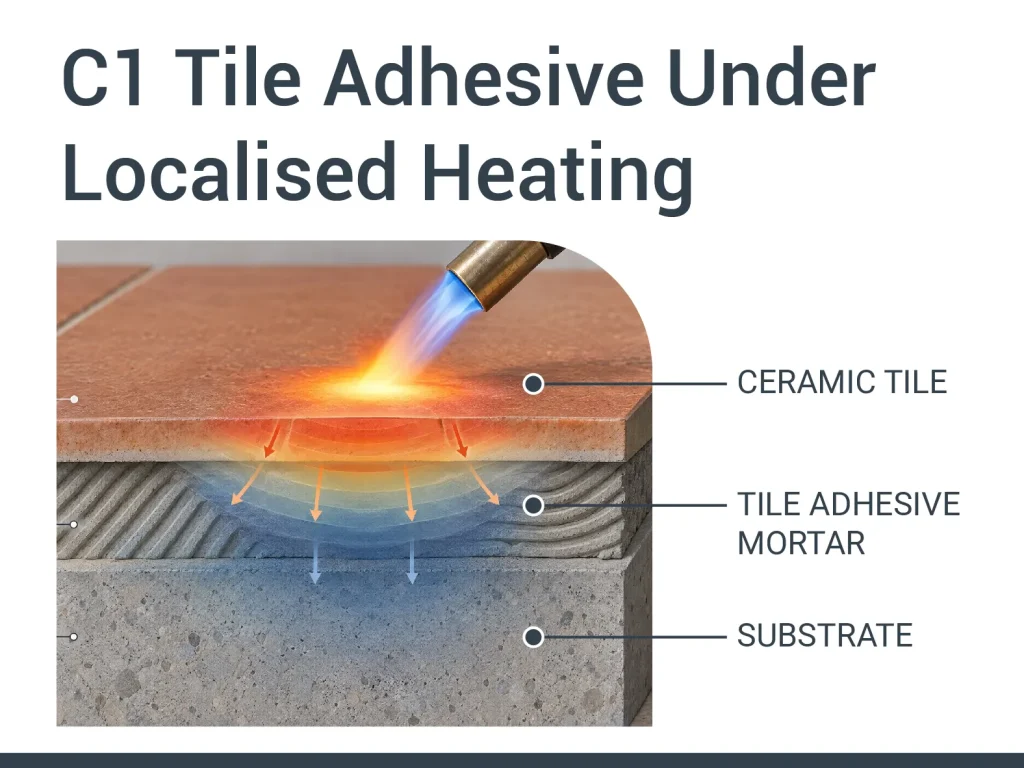
Why C1 Tile Adhesive Is Not A Torch-Resistance Rating
The C1 designation identifies a normal cementitious tile adhesive performance class. C2 identifies improved performance. Neither designation defines a universal tile-size limit or grants approval for direct flame exposure.
Other letters describe separate properties. T refers to reduced slip, E to extended open time, and S1 or S2 to deformability. A C2TES1 label therefore does not mean a product is fireproof or that its allowable temperature range increases by a fixed percentage.
Manufacturers publish application conditions and intended uses for individual products. Those instructions remain necessary even when the classification is known. For example, a published C2TES1 adhesive technical data sheet separately specifies application temperature, preparation, mixing, and curing information. The classification alone cannot supply those instructions.
Three temperatures must also be distinguished: the flame temperature, the tile surface temperature, and the temperature inside the adhesive bed. They are not interchangeable. A reading taken from the surface after heating stops cannot reconstruct the maximum temperature previously reached at every interface.
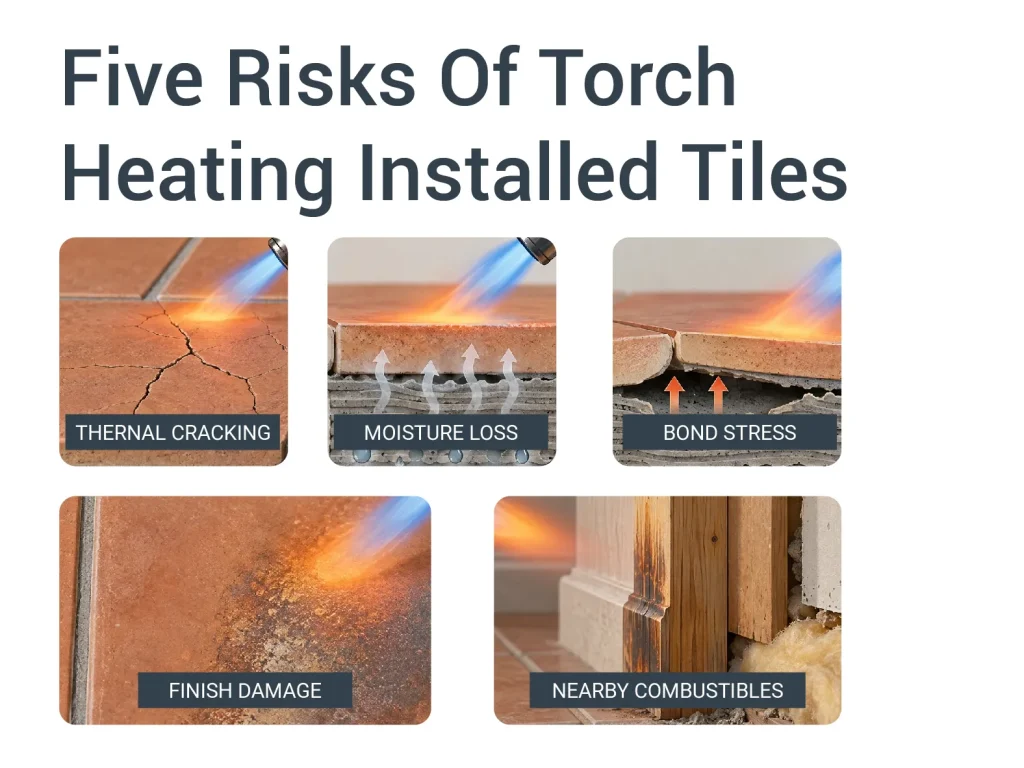
Five Risks Of Torch Heating Installed Tiles
1. Thermal Stress Can Crack The Tile
A torch heats a limited area quickly. The heated region may expand while neighbouring regions remain cooler. That uneven movement can create stress within the tile and across the bonded assembly.
The likelihood of cracking depends on the tile body, dimensions, thickness, existing flaws, restraint, and heating pattern. There is no single temperature difference at which every ceramic tile will crack. A tile may show immediate cracking, develop less obvious damage, or show no visible change after a particular exposure.
Visible survival also does not establish that the layers below remain unaffected. Tile appearance is only one part of the assessment.
2. Rapid Moisture Loss Can Disrupt Early Strength Development
Fresh cementitious adhesive needs suitable conditions for hydration and bond development. Localised heat can accelerate moisture loss in exposed or heated regions. This can interfere with the development of a sound mortar structure, particularly early in curing.
The practical inference is that a recently installed assembly deserves particular caution after forced heating. It is not sound to assign a universal percentage strength loss to a given number of seconds under a torch. Such a claim would require a defined exposure method, specimens, and test results.
Fast drying and proper curing are not the same process. Making the surface feel dry does not demonstrate that the adhesive beneath it has developed the required strength.
3. Differential Movement Can Stress The Bond
Tile, adhesive, and substrate respond differently to heat. Uneven expansion can load the interfaces in shear or tension. Existing gaps, poor contact, or weak substrate material may make the assembly more vulnerable.
Polymer modification can improve adhesion and flexibility in cementitious mortars. It does not remove the effects of an uncontrolled thermal load. At sufficiently severe exposure, organic components and cementitious materials can also undergo changes that impair performance. The relevant conditions depend on the particular materials and exposure history.
This is why the suspected failure location matters. A damaged installation may separate at the tile-to-adhesive interface, within the mortar, or in a layer beneath it. Treating every case as failure of the adhesive powder can lead to the wrong corrective action.
4. Finishes And Concealed Layers May Be Damaged
The tiled surface is only the visible part of the installation. Sealers, decorative coatings, resin components, waterproofing, and certain backing materials may have different heat limits from the tile body.
Potential effects include discolouration, coating damage, cracking, or deterioration of a concealed layer. The outcome depends on the assembly. It is inaccurate to state that a short torch exposure will necessarily melt every tile glaze. Fired ceramic finishes and applied surface treatments do not behave identically.
Repair planning must therefore consider what is behind or below the tile. Replacing only the visible finish may leave an affected waterproofing or support layer unaddressed.
5. Open Flame Adds Fire And Injury Risks
A noncombustible tile face does not make the surrounding work area noncombustible. Packaging, timber, insulation, sealants, or materials behind openings may be exposed to heat. Heated tiles and fragments can also cause injury.
There is no technical benefit in introducing these hazards as a routine adhesive-quality demonstration. A controlled test with a defined method gives a meaningful result; a torch demonstration does not establish a tile adhesive classification.
Does A Hollow Sound Mean The Adhesive Has Debonded?
A hollow sound is an observation that needs context. Some floor assemblies can sound hollow even when the tile remains bonded. The underlying construction and intentionally separated layers can affect the response. TCNA guidance on hollow and loose tile explains this distinction.
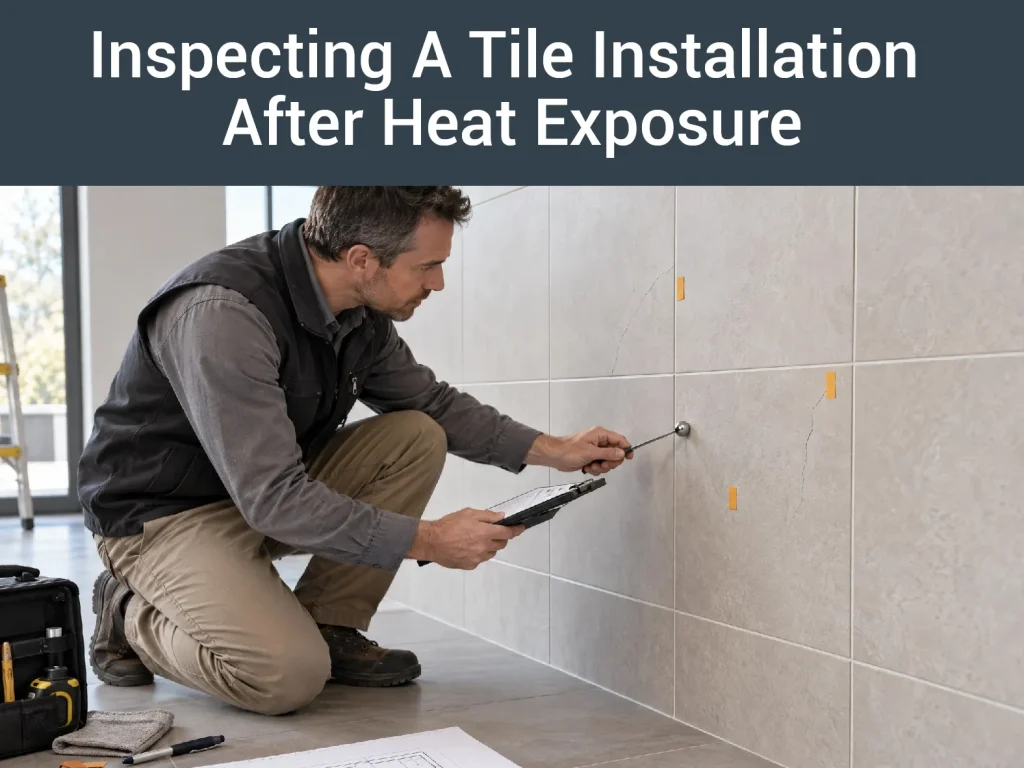
For an affected installation, compare sound differences with visible cracks, movement, joint condition, and the construction details. Tapping cannot measure tensile adhesion or identify the failed interface by itself.
Avoid rules such as “a clear sound always passes” or “a dull sound always fails.” The tile and supporting assembly influence the sound. Likewise, a percentage estimated by tapping is not an automatic repair threshold.
The timing of the observation also matters. If nobody recorded the condition before heating, a sound difference afterwards does not prove that the torch created it. Heat damage is a possible cause, but pre-existing contact or substrate problems must also be considered.
What To Do If Tiles Have Already Been Heated
Stop applying heat. Allow the area to cool without sudden water cooling. If there is smoke, evidence of fire, or a risk of falling wall tiles, keep people clear and obtain the appropriate immediate assistance.
Once access is safe, record the adhesive product, installation date, approximate exposure duration, affected area, and any observed changes. Retain packaging and batch details if available. Photographs taken before repair can help the manufacturer or inspector assess the case.
Do not use one surface-temperature reading as a pass certificate. Do not assume that spraying water restores a bond that may have been damaged. Additional wetting must follow product-specific advice rather than a generic schedule.
| Observation | Appropriate Follow-Up |
|---|---|
| No visible change after cooling | Review exposure and curing history before accepting the area |
| Sound differences without movement | Investigate the assembly and compare affected and unaffected locations |
| Cracks, lifting, or loose tiles | Restrict use as needed and arrange an installation assessment |
| Possible damage to waterproofing or backing | Include concealed layers in the inspection and repair scope |
| Disputed cause or product performance | Seek a documented investigation using an agreed sampling and test method |
A qualified assessor may recommend selective removal or adhesion testing when justified. Sample preparation and failure location affect interpretation. Unplanned destructive checks can damage neighbouring tiles or waterproofing, so they should form part of an agreed inspection plan.
Epoxy injection is not an automatic solution for every hollow area. A repair must address the cause and suit the materials involved. TCNA also notes that an injection repair may be limited in scope and may not last if the underlying cause remains unresolved. Hollow-tile repair considerations
Better Ways To Manage Curing And Cold Conditions
Control The Environment Within Product Limits
Use the adhesive manufacturer’s requirements for air, substrate, and material temperatures. A warmer room does not necessarily mean that a cold slab has reached a suitable temperature.
Where environmental conditioning is permitted, maintain gradual, reasonably uniform conditions. Protect the work from frost and excessive drying. Avoid directing a heat gun or concentrated hot airflow at newly installed tiles. Replacing a torch with another local heat source does not resolve the underlying issue.
Plan For The Actual Working Time
Pot life, open time, adjustment time, and readiness for grouting describe different stages. Follow the specified instructions for the actual site conditions. Do not add water to partly set adhesive to recover workability.
If the schedule requires earlier access, select a suitable rapid-setting system before installation and follow its instructions. Forced heating is not a substitute for that product choice.
Confirm Contact During Installation
Prepare a suitable substrate and use the specified mixing water. Match the trowel and bedding procedure to the tile and adhesive. Check transfer by lifting a freshly placed tile while the adhesive is still workable.
The required coverage and bed thickness come from the product and installation specification. Increasing thickness is not a general remedy for rapid drying. Preserve movement joints and follow the system’s instructions for commissioning underfloor heating.
How Manufacturers Should Evaluate Heat-Related Performance
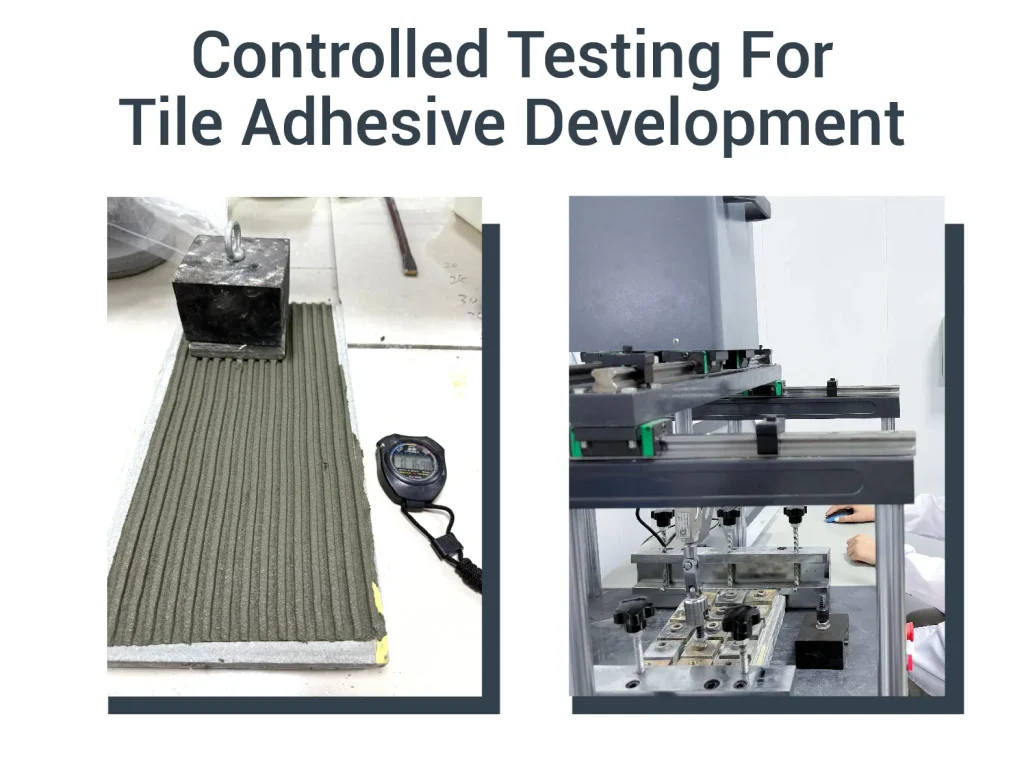
A useful development programme starts with a defined claim. Standard heat-ageing performance, hot-weather workability, and continuous service near a heat source are different questions. Each needs an appropriate evaluation method.
A controlled conditioning test fixes important variables such as specimen preparation, curing, temperature, duration, and the subsequent measurement. Direct flame on an installed tile does not reproduce that controlled exposure. Passing a heat-ageing requirement therefore should not be marketed as approval for torch heating.
For formulation trials, record cement source, aggregate grading, RDP grade, cellulose ether, water ratio, and mixing procedure. Keep an unaltered control formula. Compare the candidate after the required conditioning, not only under favourable initial conditions.
Photograph failure surfaces and record where separation occurs. A higher measured value is useful only when the method and failure interpretation remain valid. Production variability must also be considered before a laboratory result becomes a commercial claim.
Hot-weather handling deserves separate attention. A mortar can perform well after controlled curing yet provide insufficient working time on a hot or absorbent substrate. Evaluate wetting and application behaviour under relevant, documented conditions in addition to the classification tests.
The Roles Of RDP And HEMC
RDP contributes a polymer phase to the cementitious mortar. Suitable polymer modification can improve adhesion, cohesion, and flexibility. These effects support product development for different tile and substrate combinations. Polymer binders in tile adhesive provide a technical basis for this approach.
Zhiwei’s HEMC for cement-based tile adhesive supports water retention, open time, and application behaviour. Its role complements the polymer binder. Water retention does not guarantee adequate curing under direct flame or extreme local drying.
The complete formula determines the result. More RDP or a higher-viscosity cellulose ether is not automatically the correct response to a heat-related complaint. First establish whether the problem concerns curing, coverage, substrate condition, material compatibility, or exposure beyond the intended use.
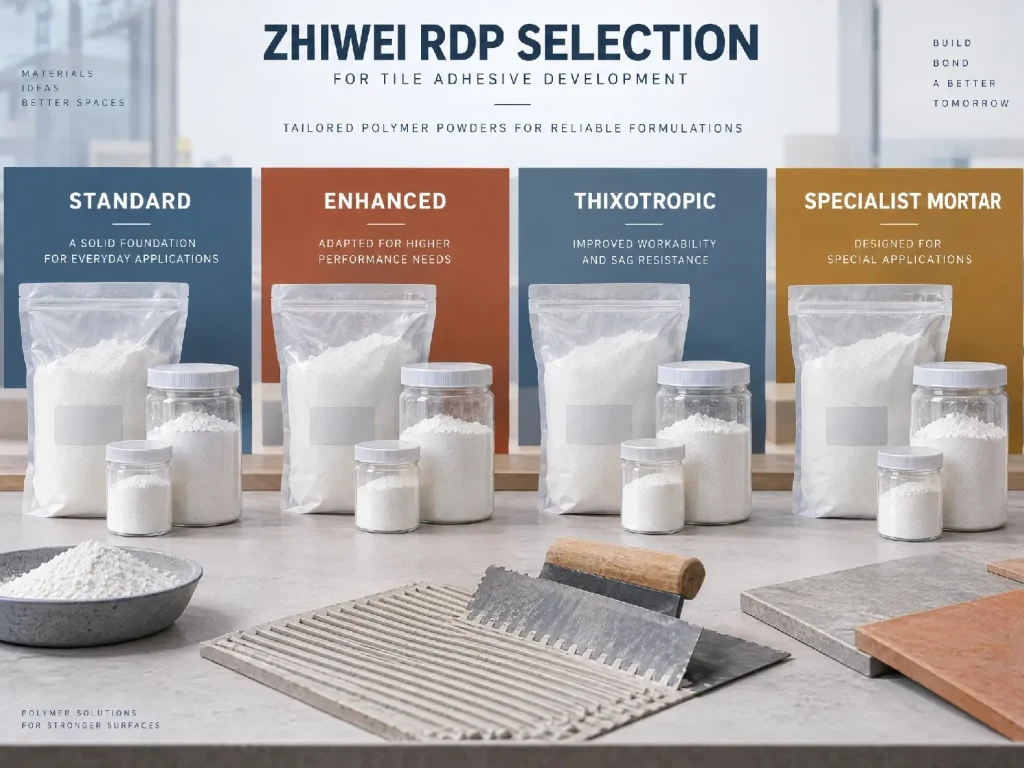
Zhiwei RDP Selection For Tile Adhesive Development
Our portfolio includes eight grades with distinct application positions. The following options are starting points for formulation trials. They are not classifications of the finished adhesive and do not represent flame-resistance ratings.
| Grade | Positioning | Appropriate Screening Direction |
|---|---|---|
| ZW-4023N | Neutral general-purpose grade | Standard tile adhesive trials with balanced adhesion and workability |
| ZW-5010N | Neutral high-strength grade | Strength and cost-performance evaluation in standard formulations |
| ZW-5028E | Enhanced tile adhesive grade | Upgraded tile adhesive formulation programmes |
| ZW-5021T | Thixotropic tile adhesive grade | Reduced-sag and easy-application development |
| ZW-7034E | Enhanced multi-application grade | Flexible mortar development across tile adhesive and related applications |
| ZW-5044N | High-flex waterproof grade | Specialist high-flex, waterproofing, EIFS, and repair mortar trials |
| ZW-8034H | Hydrophobic waterproof grade | Grout, waterproof mortar, skim coat, and EIFS with water-absorption objectives |
| ZW-5023L | Self-leveling specialty grade | Flow and levelling balance in self-leveling compounds |
For a standard tile adhesive project, ZW-4023N and ZW-5010N offer two initial screening directions. ZW-5028E is positioned for upgraded tile adhesive. ZW-5021T is relevant when wall application and sag control are central requirements.
ZW-7034E broadens the screening range for flexible systems. ZW-5044N serves specialist high-flex applications, while ZW-8034H addresses hydrophobic objectives. Neither specialist position establishes improved tolerance to direct flame.
ZW-5023L belongs to self-leveling development. A flooring project may use a levelling compound beneath its adhesive, but the materials have different fresh-state requirements. The grade should not be selected for a wall adhesive merely because both products are dry mortars.
Confirm the current technical data and evaluate samples in the intended formulation. The grade name, polymer characteristics, or dosage cannot independently guarantee C1, C2, or an S-class result.
Frequently Asked Questions
Will Torch Heating Always Cause C1 Tile Adhesive To Debond?
No. Damage depends on exposure and the assembly. However, uncertainty about the outcome does not make torch heating an acceptable curing or quality-test method.
Does C2TES1 Mean The Adhesive Is Fireproof?
No. The designation describes adhesion, reduced slip, extended open time, and deformability. It does not approve direct flame exposure or define one universal service-temperature range.
Can A Heat Gun Safely Speed Up Curing?
Do not assume so. Concentrated hot air can create uneven heating and drying. Use only environmental conditioning permitted by the product manufacturer.
Does A Hollow Sound Prove Heat Damage?
No. Sound differences need to be assessed alongside the construction, installation history, and other evidence. They do not identify the cause or quantify adhesion by themselves.
Can Water Spraying Restore A Heat-Damaged Bond?
Water spraying is not a demonstrated general repair for a damaged interface. Avoid sudden cooling, and obtain product-specific advice before changing curing conditions.
Can More RDP Make A Torch Test Acceptable?
No. RDP selection helps formulate mortar for defined performance targets. It does not convert an uncontrolled torch demonstration into a recognised classification test.
Conclusion
C1 tile adhesive may be damaged by torch heating, particularly when the assembly is young or the heat is severe and uneven. The main concerns are tile cracking, disrupted curing, stress at interfaces, damage to other layers, and fire or injury hazards. Actual damage requires assessment rather than an automatic conclusion from the adhesive class or tapping sound.
For manufacturers, reliable performance starts with a defined application and controlled testing. Zhiwei provides RDP grades and cellulose ether options for developing the required balance of adhesion and handling.
Contact Zhiwei with your target adhesive class, cement and aggregate system, current additive package, water ratio, and measured results. These details help us identify relevant sample options for your next formulation trial.
Leave A Comment