
 By info@zhiweichem.com
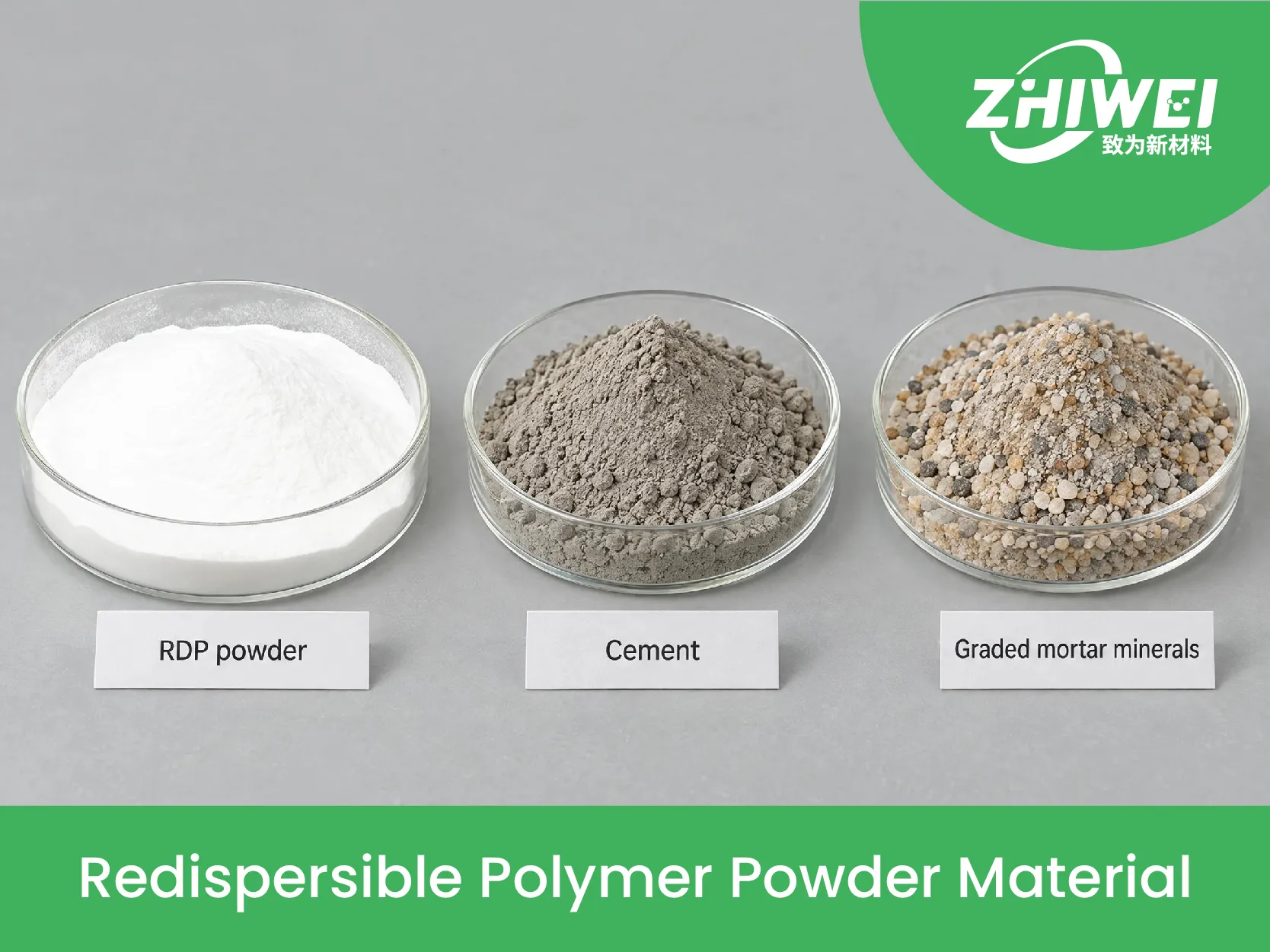
Redispersible polymer powder is a polymer binder supplied as a dry powder that can form a polymer dispersion again when mixed with water. Manufacturers blend it into products such as tile adhesive, wall putty, grout and leveling mortar to modify their performance. Its common abbreviation is RDP.
The powder format allows the polymer to become part of a dry blend before that blend reaches the construction site. The installer then follows the finished mortar’s mixing instructions. Polymer selection and dosage are formulation decisions made around the product’s intended use.
At Zhiwei, we treat RDP as an application-specific ingredient. A grade suitable for a vertical tile adhesive may not offer the right balance for a flowing floor compound. Understanding the material helps buyers compare options and helps formulators design useful trials.
What Is Inside an RDP Powder?
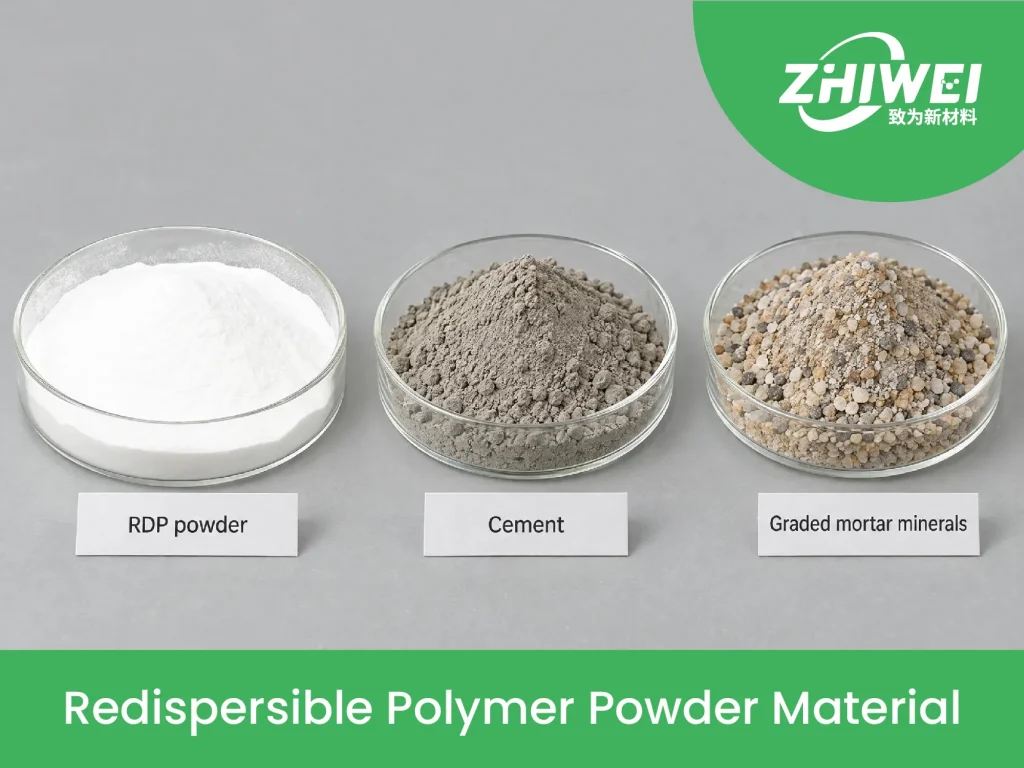
A commercial RDP contains a polymer component together with ingredients that support its production, redispersion and handling. Common formulations include protective colloids and mineral anti-blocking materials. The exact composition varies by grade.
Vinyl acetate-ethylene, commonly abbreviated VAE or VAc-E, is an established polymer platform. The industry also uses other monomer combinations to develop different characteristics. “RDP” identifies the product form; it does not specify one universal polymer composition.
This distinction matters when comparing two similar-looking white powders. Appearance alone cannot reveal polymer chemistry, film behavior or suitability for a particular mortar.
Ask for the exact grade name and current technical documentation. A TDS helps identify product specifications and intended uses. An SDS covers safety and handling information within its reporting scope. A batch COA can document agreed quality checks for the supplied material.
How Powder Production Preserves Redispersibility
RDP production starts with a suitable polymer dispersion. The manufacturing process removes water while aiming to preserve the ability to redisperse the polymer particles later.
Spray drying is a widely used route. The feed is atomized, water evaporates, and the resulting powder is collected and conditioned. Protective components help limit unwanted irreversible aggregation during this transformation.
Celanese’s ELOTEX overview describes polymer powders produced by spray drying aqueous dispersions. Process controls and formulation choices give different powders their different characteristics.
A dry powder is not automatically redispersible just because its source was a polymer liquid. Redispersion is a property that needs appropriate evaluation. Storage conditions also matter because moisture and caking can interfere with handling.
For more detail on the manufacturing stages, see Zhiwei’s redispersible polymer powder manufacturing guide.
What Happens After Water Is Added?
The Dry Blend Becomes a Fresh Mortar
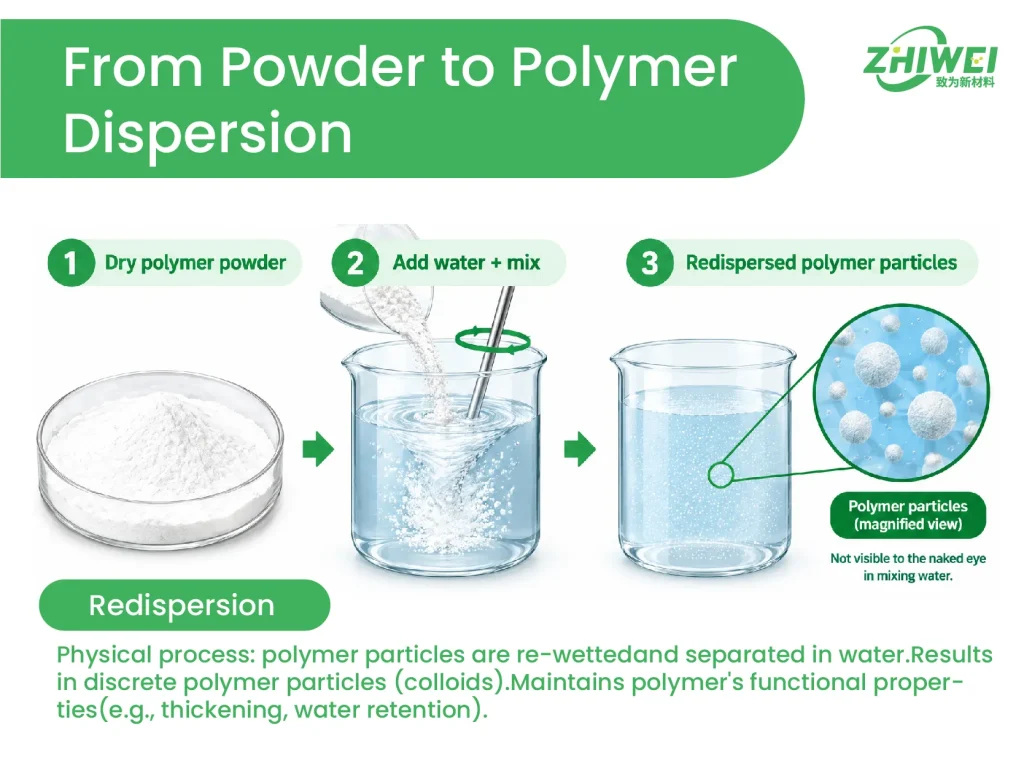
Water wets the ingredients and the mixing process distributes them. The RDP releases polymer particles into an aqueous dispersion while the mineral binder begins its own reactions.
Redispersion should be distinguished from molecular dissolution. A polymer dispersion contains particles. It is not the same process as dissolving a simple soluble salt.
Polymer Films Develop Under Suitable Conditions
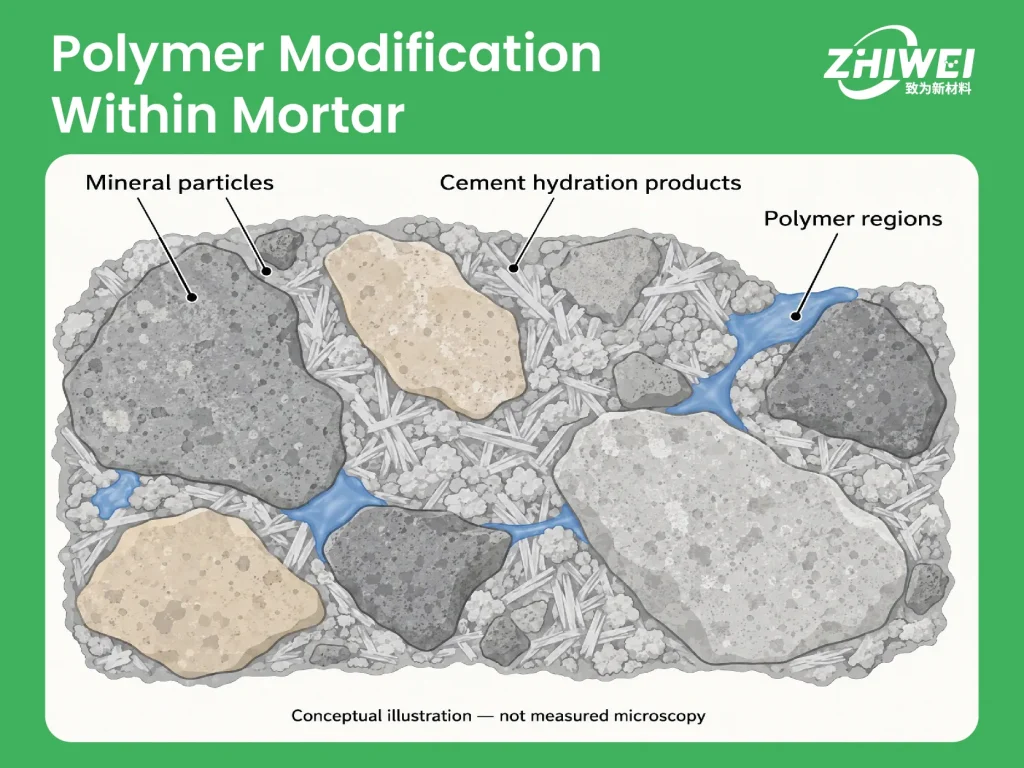
As the mortar develops and water is removed, dispersed polymer particles can come together and form films or connected polymer regions. Temperature, polymer properties and the mortar environment influence this process.
These regions coexist with cement hydration products and mineral particles. The result is a composite material whose behavior depends on all of its ingredients.
The practical goal is an appropriate balance of bonding, mechanical response and application properties. WACKER’s tile-adhesive binder guidance explains how polymer modification contributes to adhesion, cohesion and flexibility in cementitious systems.
What Can RDP Change in a Formulation?
Bonding to the Substrate
For an adhesive or finishing mortar, bond performance is a central development target. The polymer can contribute to the bond, but surface preparation and mortar contact remain essential.
An RDP-containing adhesive applied over a weak, dusty layer can still fail. Evaluate a representative substrate and identify where a failed specimen separates. Failure within the substrate tells a different story from failure at the adhesive interface.
Deformation and Cohesion
Polymer modification can change how the material responds to stress. That can be relevant where a product needs deformation capacity or resistance to particular types of cracking.
The finished mortar still needs the appropriate test. A powder described as flexible does not establish that its tile adhesive meets S1 or S2 requirements. Those are finished-product properties.
Water-Related Performance
Certain grades are developed for hydrophobic or water-resistant formulations. Define the target carefully: reduced absorption, adhesion after water conditioning and waterproofing performance are separate requirements.
Do not infer that an RDP-containing grout or skim coat is a waterproof membrane. Validate the material and the complete assembly for the intended exposure.
Fresh Application Behavior
RDP can affect fresh mortar behavior, but it works alongside cellulose ether, mineral grading, water content and other additives. Evaluate mixing, spreading, transfer and the usable application window together.
A strong laboratory bond result does not solve an application problem caused by poor transfer or a surface that skins before placement. Practical trial panels help expose these issues.
Applications Require Different Balances
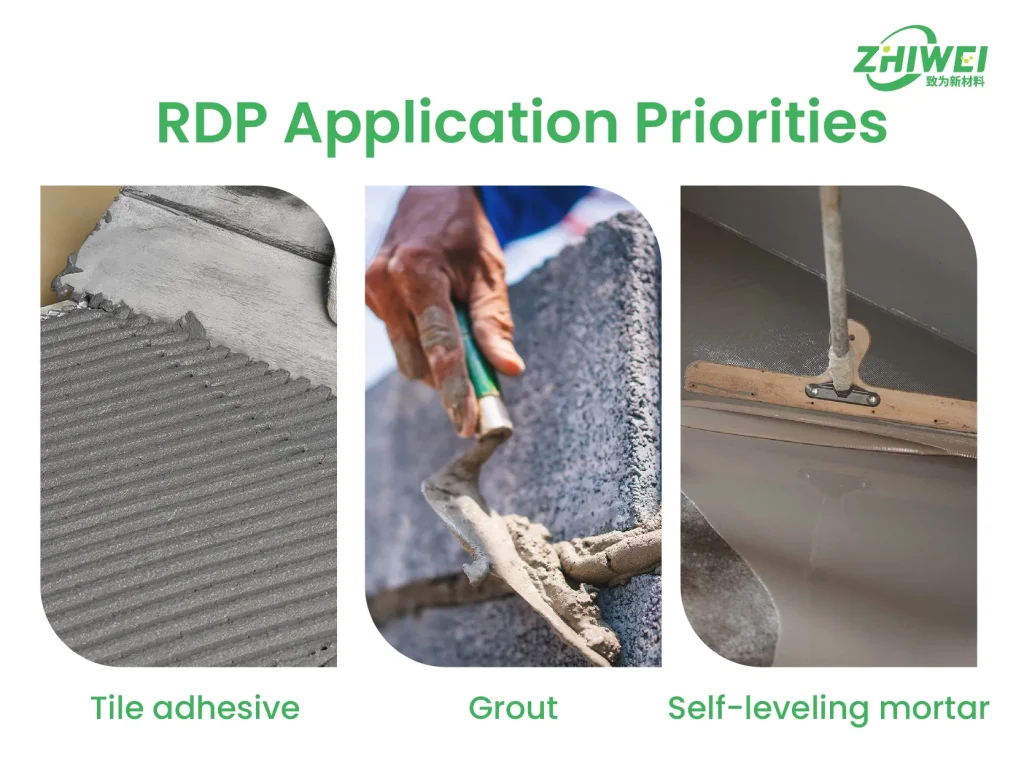
| Mortar application | Useful development priorities | Important evaluation |
|---|---|---|
| Tile adhesive | Bonding, transfer and placement behavior | Conditioned adhesion, open time and slip where required |
| Wall putty or skim coat | Surface integrity and troweling | Bonding, finish quality and compatibility with subsequent coatings |
| Tile grout | Joint adhesion and service performance | Water-related behavior, wear and appearance |
| EIFS/ETICS mortar | Insulation bonding and base-coat behavior | Compatibility with the approved insulation system |
| Waterproof or repair mortar | Application-specific mechanical and exposure properties | The relevant finished-material and system tests |
| Self-leveling compound | Flow, stability and cured integrity | Flow behavior, separation, surface defects and specified strength properties |
Use this table to define a trial objective, rather than selecting a powder from a broad application label alone.
For example, a tile-adhesive project might prioritize transfer and vertical holding. A leveling project might prioritize flow without separation. The same polymer could produce different outcomes in these two mineral systems.
RDP, Liquid Polymer and Cellulose Ether
Powder Versus Liquid Polymer
RDP offers a route to incorporating polymer into a dry blend. A liquid dispersion offers a different formulation and supply format. Both can be useful when their chemistry and application are suitable.
Replacing one with the other requires more than matching package weight. A liquid dispersion contains water and polymer solids. A commercial powder can also contain protective and mineral components. Compare the relevant composition and water balance, then test the reformulated product.
A conversion can change processing and fresh behavior even when the nominal polymer addition looks similar. Treat it as a development project.
RDP Versus HEMC or HPMC
RDP supplies polymer modification. Cellulose ethers are commonly used to control water retention and rheology. They perform complementary functions in many mortar formulations.
When both are used, assess them together. Changing cellulose grade or dosage can alter handling and practical placement, which can affect the outcome of an RDP comparison.
Zhiwei’s HEMC for cement-based tile adhesive guidance explains why binder, grading, polymer and mixing conditions matter to fresh mortar behavior. Our cellulose ether portfolio provides another starting point for formulation discussions.
How to Interpret an RDP Data Sheet
Polymer Base and Film Behavior
Review the polymer family and grade positioning first. Minimum film-forming temperature, or MFFT, concerns film formation under a specified test. Glass-transition temperature, or Tg, describes a different aspect of polymer thermal behavior.
Neither value alone gives a complete mortar performance rating. A powder’s MFFT should not be used as the sole minimum application temperature for a cementitious product. Cement hydration and other ingredients also influence application requirements.
Moisture, Ash and Bulk Density
These specifications help describe the powder and support quality control. Compare results obtained using compatible methods.
Ash can reflect intentional mineral content; lower ash is not a universal guarantee of better mortar performance. Likewise, bulk density affects handling but does not identify the strongest adhesive grade.
Use raw-material checks to confirm consistency, then use mortar tests to confirm suitability.
Dosage Basis
Specify the denominator when discussing dosage. Percent of total dry mortar and percent of cement mass are different expressions.
For example, adding 20 kg of RDP to a final 1,000 kg dry blend represents 2% of total dry mass. If that blend contains 300 kg of cement, the RDP mass is about 6.7% of the cement mass. This is an arithmetic example, not a recommended production recipe.
Record whether dosage concerns supplied powder or calculated polymer content. Consistent definitions make comparisons much easier to interpret.
Zhiwei RDP Grades for Different Formulation Goals
Our RDP product range includes eight grades. Their positioning helps narrow the trial list before complete mortar evaluation.
| Grade | Positioning | Relevant development direction |
|---|---|---|
| ZW-4023N | Neutral general-purpose | Standard tile adhesive, putty and general grout comparisons |
| ZW-5010N | Neutral high-strength | Strength-focused tile adhesive, grout and skim-coat trials |
| ZW-5044N | High-flex waterproof | Flexible insulation, waterproof and repair mortar systems |
| ZW-5028E | Enhanced tile adhesive | Upgraded tile-adhesive formulation development |
| ZW-7034E | Enhanced multi-application | Broader formulation comparisons involving adhesive, insulation and repair needs |
| ZW-8034H | Hydrophobic waterproof | Reduced-water-absorption grout and compatible waterproof mortar development |
| ZW-5021T | Thixotropic tile adhesive | Wall application and anti-sag handling trials |
| ZW-5023L | Self-leveling specialty | Flow and leveling balance in self-leveling compounds |
For a tile-adhesive development project, ZW-5028E is a relevant enhanced-grade candidate. For hydrophobic development, evaluate ZW-8034H against the actual water-related target. For leveling compounds, ZW-5023L provides a distinct specialty direction.
These examples are starting points. No grade name or fixed addition establishes certification of the finished mortar. Confirm the current grade documentation and validate the complete product.
A Useful Workflow for Comparing Samples
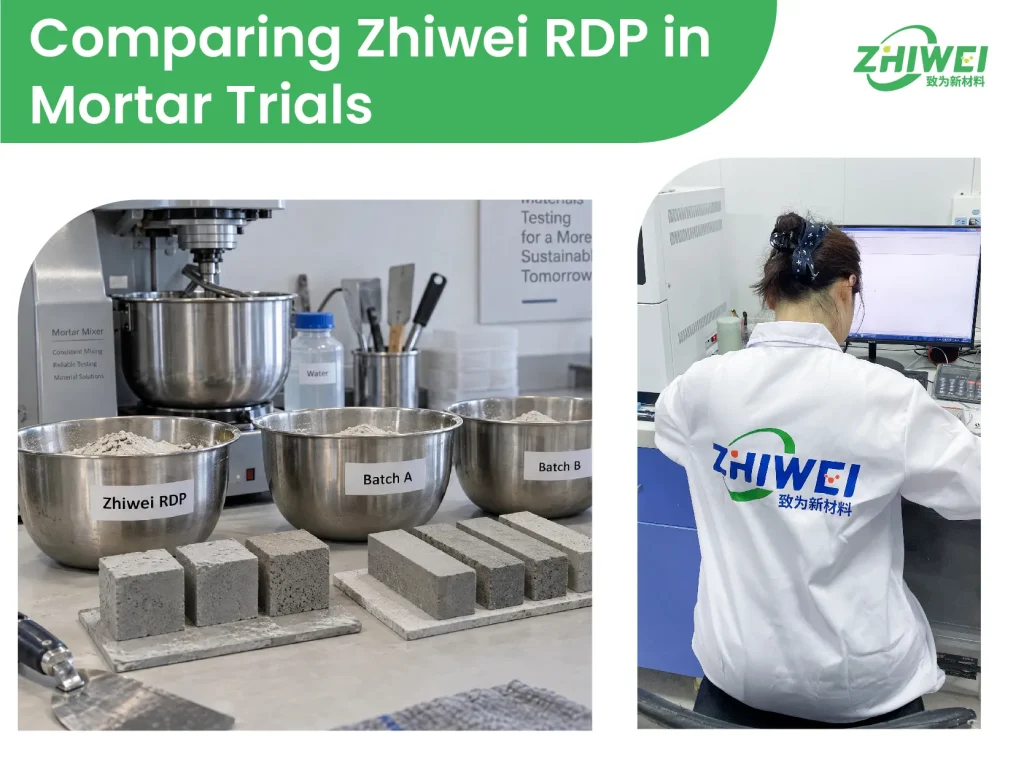
Define One Primary Objective
Describe the application and its main problem. “Improve mortar” is too broad. “Improve conditioned adhesion while maintaining acceptable spreading and slip” gives the comparison a clearer purpose.
Record the target market and test requirements. Include the substrate and service conditions relevant to the finished product.
Control the Base Formula
Keep cement, minerals, cellulose ether and other ingredients consistent when comparing polymer candidates. Record mixing water, processing and curing. If water needs adjustment, document it rather than hiding the change.
Evaluate a manageable set of grade-and-dosage combinations. Use fresh behavior checks to identify application defects before spending time on extended conditioning tests.
Measure the Complete Outcome
Assess the properties required by the application. For a tile adhesive, these may include conditioned adhesion, open time, slip and deformability. For a leveling compound, flow and stability require different checks.
Review failed samples as well as passing results. Identify the failure location and note whether preparation, mixing or application affected the comparison.
Confirm Reproducibility
Repeat promising formulations with representative batches and production conditions. A single good specimen is insufficient evidence of consistent manufacturing performance.
Compare cost at the dosage that achieves the required complete result. A lower price per kilogram can be offset by higher consumption or an unacceptable trade-off in another property.
Storage and Procurement Essentials
Follow the grade’s stated storage conditions, packaging requirements and shelf life. Protect the powder from moisture, keep batch identification available and use a consistent stock-rotation procedure.
Ask for the exact grade and required documents when purchasing. Avoid substituting an unspecified “equivalent RDP” solely because appearance and one specification look similar.
If a supply change is proposed, compare it in the actual mortar before authorizing a production substitution. Raw-material consistency and finished-product evidence should guide the decision.
Frequently Asked Questions
Is Redispersible Polymer Powder a Finished Adhesive?
No. It is a formulation ingredient. A finished adhesive combines binder, minerals and additives in a tested product with defined mixing and application instructions.
Does It Dissolve in Water?
It redisperses into an aqueous polymer dispersion. This is different from molecular dissolution.
Is Every White Polymer Powder an RDP?
No. Appearance does not establish chemistry or redispersibility. Confirm the product identity and technical documentation.
Does More RDP Always Improve Mortar?
No. Dosage changes several properties and formulation cost. Select the amount that meets the complete target, based on controlled trials.
Can One Grade Serve Every Dry-Mix Application?
One grade may suit several applications, but each formulation needs evaluation. Vertical holding, surface finishing and self-leveling flow can require different balances.
Does RDP Guarantee Waterproof or Flexible Performance?
No. Grade positioning helps select candidates. The finished mortar and relevant assembly must establish the required performance through testing.
Conclusion
Redispersible polymer powder gives dry-mix manufacturers a way to incorporate polymer modification into a powder product. Its value depends on how its chemistry, redispersion and film behavior fit the complete mortar.
Choose by application, define the dosage clearly and validate the result under representative conditions. Explore Zhiwei’s RDP catalog and contact our team through zhiweichem.com with your base formula, target performance and application challenge. Those details help us propose a focused sample comparison.