
 By info@zhiweichem.com

The redispersible polymer powder manufacturing process converts a water-based polymer dispersion into a free-flowing powder without losing the polymer’s ability to disperse in water again. That short description sounds simple. The real process is not.
The polymer particles must remain separated while water is removed very quickly. The powder must survive collection, cooling, storage, shipping, and dry blending. It must then redisperse when the customer adds water to a mortar. After the mortar dries, the polymer particles must come together again and form the phase that supports adhesion, cohesion, flexibility, and durability.
Each production stage affects that result. The base polymer controls much of the final film behavior. The protective colloid helps preserve redispersibility. Atomization controls droplet size. Inlet and outlet conditions control the drying history. The anti-caking system affects flow and storage stability. Post-processing controls particle distribution and batch uniformity.
This guide explains how redispersible polymer powder is made, which production variables matter, how quality is tested, and why two white powders can perform very differently in the same dry-mix mortar. It also shows how Zhiwei (Jinan) New Materials Co., Ltd. organizes eight RDP grades for tile adhesive, grout, EIFS, putty, waterproof mortar, repair mortar, and self-leveling systems.
What Is Redispersible Polymer Powder?
Redispersible polymer powder, usually called RDP, is a spray-dried polymer binder. A typical construction grade starts with an aqueous polymer dispersion. Many grades are based on vinyl acetate-ethylene, often written as VAc-E or VAE. Other monomers and polymer systems can be used when the application needs a different balance of flexibility, water response, adhesion, or film formation.
During powder production, the liquid dispersion is stabilized and atomized into small droplets. Heated air removes water from those droplets. Protective colloid and anti-caking material help stop the polymer particles from fusing into one irreversible mass. The finished material becomes a dry powder that can be blended with cement, gypsum, lime, sand, fillers, cellulose ether, and other additives.
When a dry-mix mortar is mixed with water, the powder breaks down and releases polymer particles into the aqueous phase. As the mortar cures and water leaves the system, the particles move closer together and form a polymer phase inside the mineral matrix. That phase does not replace cement hydration. It works with the mineral binder.
This is why RDP is more than dried glue. A useful construction grade must complete three transformations:
- A stable liquid polymer dispersion must become a dry powder.
- The dry powder must redisperse when water is added.
- The redispersed polymer must form an effective film or network as the mortar dries.
Failure at any of these stages can reduce performance.
RDP Production Has Two Main Parts
The complete production route has two linked parts.
Part 1: Make the Base Polymer Dispersion
The polymer is first created or prepared as a stable aqueous dispersion. Monomer choice and polymerization conditions set important features such as glass transition temperature, minimum film-forming temperature, particle size, molecular structure, and surface chemistry.
These properties influence whether a grade behaves as hard, semi-flexible, flexible, or very flexible. They also affect blocking tendency during drying and storage. A soft polymer may offer useful flexibility in mortar, but it can be more difficult to convert into a free-flowing powder. A harder polymer may be easier to handle, but it may not provide enough deformation for a flexible waterproofing system.
Part 2: Convert the Dispersion Into a Redispersible Powder
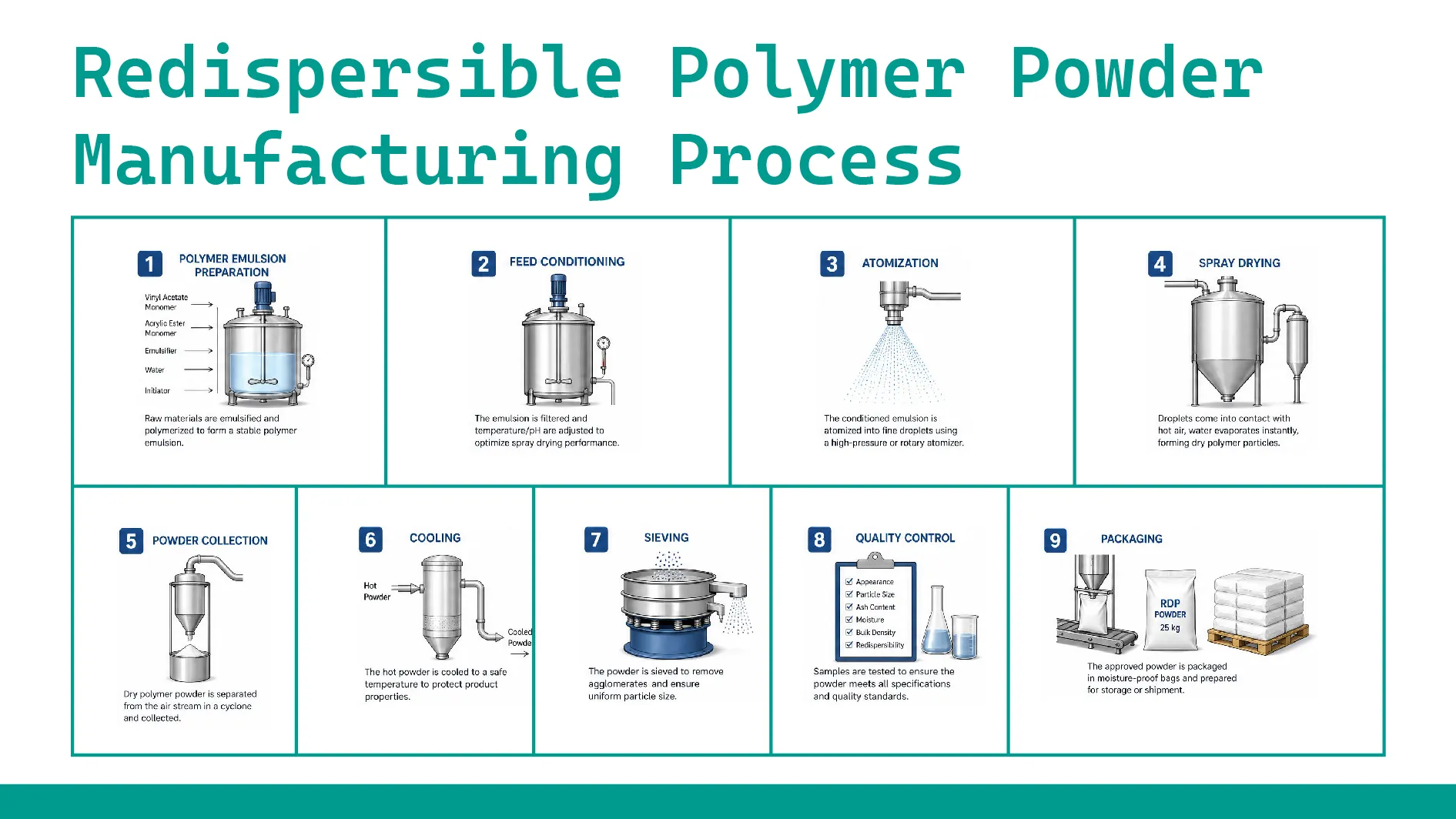
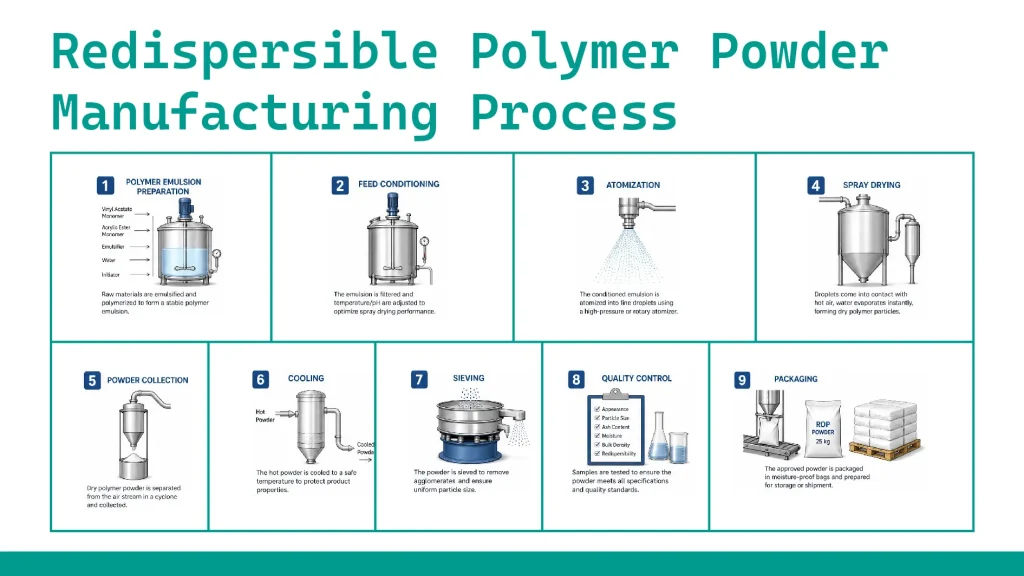
The liquid dispersion is combined with a drying aid, normally a protective colloid, and any required process additives. The feed is then filtered, conditioned, atomized, dried, separated from air, cooled, sieved, blended, tested, and packed.
Spray drying is the main industrial route because it changes a large amount of liquid feed into powder in a short time. Celanese describes commercial redispersible polymer powders as free-flowing products made by spray-drying aqueous polymer dispersions. The method is fast, but the operating window must be matched to the polymer.
What Goes Into Redispersible Polymer Powder?
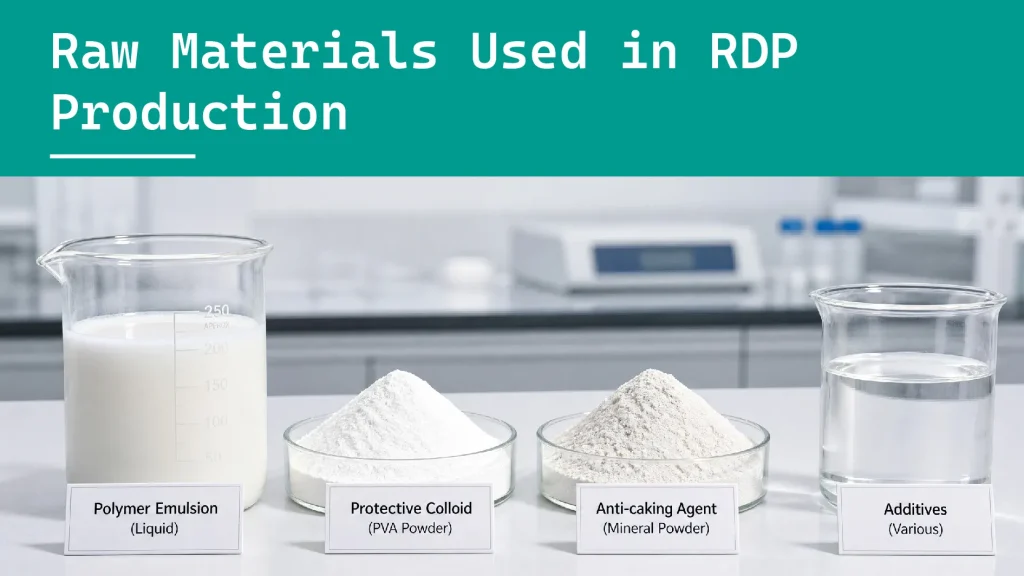
There is no single universal RDP recipe. The main material groups are consistent, but their exact chemistry and level change by product.
| Material Group | Main Function During Production | Influence on the Finished Powder |
|---|---|---|
| Aqueous polymer dispersion | Supplies the main organic binder | Controls much of the adhesion, flexibility, cohesion, Tg, and MFFT profile |
| Protective colloid | Stabilizes polymer particles during drying and redispersion | Supports redispersibility and helps limit irreversible particle fusion |
| Water | Carries the polymer dispersion and controls feed concentration | Affects viscosity, pumpability, atomization, energy demand, and drying load |
| Defoamer | Controls foam during preparation, circulation, and feeding | Supports stable feed density and more consistent atomization |
| Anti-caking or anti-blocking agent | Reduces particle-to-particle sticking | Improves powder flow, storage stability, and handling |
| Functional additives | Adjust selected properties when required | Can support hydrophobicity, rheology, setting behavior, or another specialty target |
Polyvinyl alcohol is widely used as a protective colloid in many RDP systems. Its degree of hydrolysis, molecular weight, amount, and compatibility with the polymer all matter. The goal is not simply to add more stabilizer. Too little may give poor redispersion. Too much may change water demand, viscosity, or the behavior of the finished mortar.
Anti-caking agents are usually fine mineral materials. Commercial product data show that anti-caking content is a normal controlled property of RDP. For example, Vinavil lists anti-caking agent levels together with polymer type, Tg, moisture, and pH in its redispersible powder product data. The selected mineral, particle size, surface treatment, and dosage affect both flow and ash content.
More anti-caking material is not always better. It can improve powder flow, but it also increases the inorganic fraction. Excessive mineral addition can dilute the effective polymer content and change mortar performance. This balance is one reason why ash control is a meaningful product specification.
The Redispersible Polymer Powder Manufacturing Process Step by Step
Step 1: Define the Target RDP Grade
Production should begin with the application target, not with the spray dryer.
A general-purpose tile adhesive grade does not need the same polymer profile as a flexible waterproofing grade. A thixotropic wall-tile product has a different fresh-state target from a self-leveling compound. A hydrophobic grout grade also needs a different balance from a neutral general-purpose powder.
The target normally includes:
- Polymer base and comonomer balance
- Tg and MFFT range
- Flexibility level
- Target solids or organic content
- Ash-control range
- Bulk density
- pH of a defined dispersion
- Moisture limit
- Redispersibility
- Flow and storage stability
- Performance in a reference mortar
This product definition guides the polymer dispersion, protective colloid, anti-caking system, drying conditions, and final testing plan.
Step 2: Prepare and Check the Polymer Dispersion
The base polymer dispersion must be stable before drying. A plant may manufacture it through emulsion polymerization or receive a qualified dispersion from an integrated upstream process.
Important incoming checks include solids content, viscosity, pH, particle size, coagulum, odor, appearance, and storage history. A dispersion with unstable viscosity or excessive coagulum can block filters, disturb feed pressure, produce inconsistent droplets, and create deposits in the dryer.
The base polymer also determines how difficult the drying stage will be. A low-Tg, flexible polymer tends to be softer at a given temperature. It may need stronger stabilization and more careful control to avoid sticking. A harder polymer may tolerate drying more easily, but its mortar performance will be different.
Step 3: Prepare the Protective Colloid Solution
The protective colloid is normally dissolved or prepared in water before it is blended with the polymer dispersion. The operator must avoid dry lumps and incomplete dissolution. The solution should be uniform before it enters the feed system.
One illustrative process window prepares a protective colloid solution at about 19.5-20.5% solids and around 2,500 mPa·s. Those values are not universal specifications. Protective-colloid type, water quality, dissolution temperature, mixing energy, and the plant’s feed design can require a different range.
The finished solution should be checked for undissolved material, viscosity, solids, and foam. Poor preparation can later appear as blocked nozzles, unstable atomization, coarse particles, or weak redispersibility.
Step 4: Condition the Spray-Dryer Feed
The protective colloid solution is mixed with the polymer dispersion. Defoamer, water, and selected functional additives may then be adjusted. The feed is filtered before atomization.
This stage is where the plant sets practical properties such as:
- Feed solids
- Viscosity
- Temperature
- pH
- Foam level
- Filtration quality
- Pump stability
An illustrative process may use about 39-42% feed solids, 70-200 mPa·s viscosity, and a feed temperature near 50-55°C. These numbers are useful for understanding the process, but they are not a universal recipe. A different dispersion, atomizer, tower size, or target particle distribution can need a different operating window.
Higher feed solids can reduce the energy needed to remove water. However, high solids also raise viscosity and can make atomization harder. A low-solids feed may atomize easily, but it increases drying load and can change particle structure. The correct point is a balance.
Step 5: Atomize the Feed Into Fine Droplets
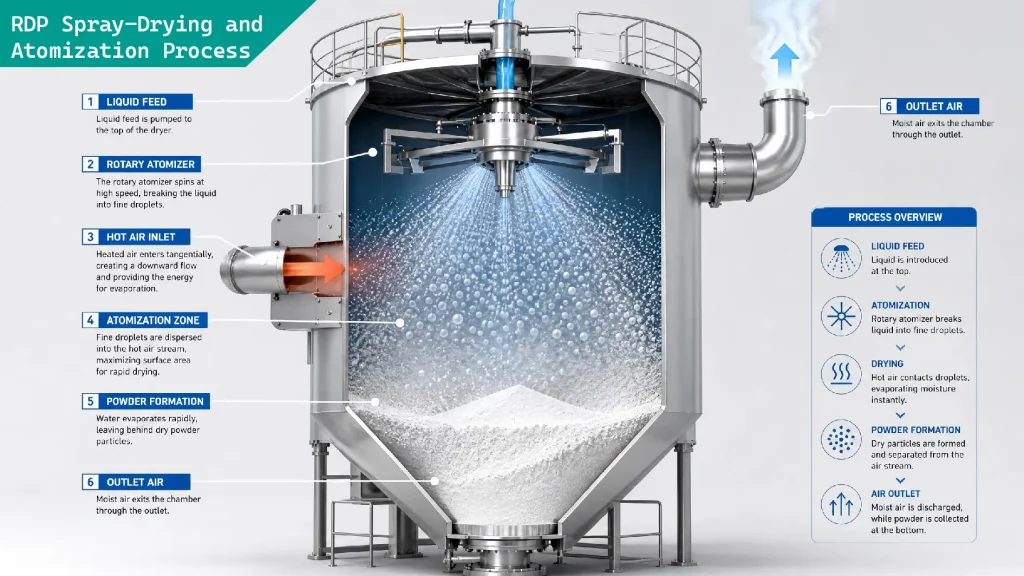
The conditioned feed enters the top or designated feed zone of the spray dryer. A rotary atomizer or pressure nozzle turns the liquid into many small droplets.
Atomization is one of the most important controls in the RDP production process. Droplet size affects drying speed, particle size, bulk density, powder flow, and the amount of fine material that reaches the collection system.
An illustrative droplet range may be about 10-100 micrometers. The real distribution is broader and depends on feed viscosity, solids, surface tension, atomizer speed, nozzle pressure, feed rate, and equipment geometry.
If droplets are too large, the center may remain wet when the surface reaches a sticky stage. This can create deposits, high residual moisture, coarse material, or unstable powder. If droplets are too small, the dryer can create too many fines. These fines increase collection load, dust handling needs, and product loss if the recovery system is not well controlled.
Step 6: Dry the Droplets in Hot Air
The atomized droplets meet a controlled stream of heated air. Water evaporates rapidly. The droplet surface becomes richer in polymer and protective colloid, and a dry particle forms.
The inlet temperature tells only part of the story. The outlet temperature, feed rate, air volume, humidity, droplet size, residence time, and product temperature also matter. A process window near 140-150°C inlet air and 79-81°C outlet air can appear in some RDP production examples. Those values should be treated as an equipment- and formulation-specific starting point, not as a general manufacturing standard.
The polymer particle does not remain at the inlet-air temperature for the full drying time. Evaporation cools the droplet. Even so, excessive thermal stress can damage redispersibility, increase deposits, discolor the powder, or change odor. Insufficient drying can leave too much moisture and increase caking.
The process must remove enough water while preventing the soft polymer particles from forming a permanent film inside the dryer. This is the central challenge of spray-drying RDP.
Step 7: Add the Anti-Caking System at the Correct Point
Fine anti-caking material can be introduced during drying, into the powder recovery stream, or through another validated route. The purpose is to reduce contact and sticking between polymer-rich particles.
Timing and distribution matter. If the mineral does not reach the particle surface evenly, the batch can contain both free-flowing areas and sticky agglomerates. If too much is added, ash rises and the effective polymer fraction falls.
The plant should control the anti-caking agent by mass balance and verify the result through ash, flow, bulk-density, and application tests. Visual appearance alone cannot show whether the level is correct.
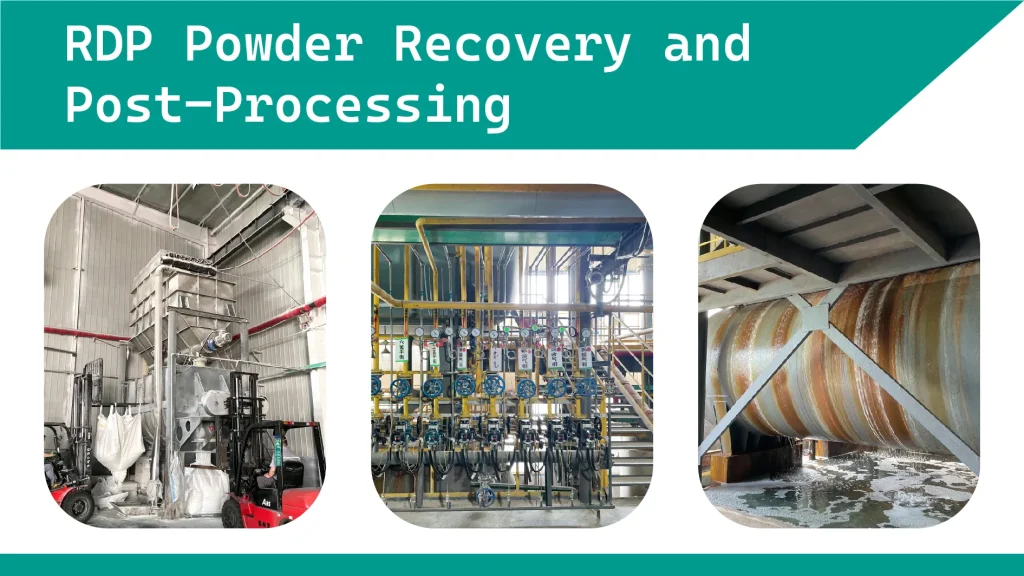
Step 8: Separate, Recover, and Cool the Powder
The gas-solid stream leaves the drying zone and enters the recovery system. Cyclones, bag filters, or a combined collection design separate powder from the air.
Fine particles may follow a different recovery path from coarse particles. The plant must decide whether and how collected fines return to the product stream. Uncontrolled fines recycling can change particle-size distribution, bulk density, dustiness, and redispersion speed.
The recovered powder should be cooled under controlled humidity. Cooling is not a minor step. Warm powder sealed too early can create condensation inside a bag. Moisture can then cause lumps, reduce flow, and shorten storage stability.
Step 9: Sieve, Blend, and Pack the Finished RDP
The powder passes through a suitable sieve or classifier to remove oversized material and foreign particles. Batch blending can then improve uniformity across the production run. Metal control and final sampling are added where required by the plant’s quality plan.
Packaging must limit moisture pickup and contamination. The bag and liner should match shipping distance, climate, pallet pattern, and expected storage period. Bags should be sealed and coded for traceability.
The label and batch documents should identify the grade, lot, net weight, production date, storage guidance, and safety information required for the destination market. A current TDS, SDS, and batch COA should support commercial approval.
Which Process Controls Matter Most?
The table below connects major process variables with the defects they can create.
| Process Variable | If Too Low or Unstable | If Too High or Aggressive | Main Finished-Powder Risk |
|---|---|---|---|
| Feed solids | High energy demand and possible change in particle structure | High viscosity and poor atomization | Variable moisture, density, and particle size |
| Feed viscosity | Unstable feed and very fine spray in some systems | Poor pumping and coarse droplets | Broad particle distribution and deposits |
| Atomization energy | Large droplets and incomplete drying | Excess fines and high collection load | Coarse wet particles or dusty fine powder |
| Inlet and outlet conditions | High residual moisture and caking | Thermal stress and particle fusion | Poor storage stability or poor redispersibility |
| Protective colloid level | Irreversible aggregation and weak redispersion | Changed viscosity, water demand, or mortar behavior | Failure to redisperse or unexpected application response |
| Anti-caking agent level | Blocking, clumping, and poor flow | High ash and lower effective polymer fraction | Storage failure or diluted performance |
| Cooling conditions | Warm packing and condensation risk | Overexposure to humid cooling air | Lumps and moisture pickup |
| Fines recycle | Product loss if useful fines are discarded | Density and dustiness drift if recycle is uncontrolled | Batch inconsistency |
Good production control does not mean holding one number at all costs. It means understanding the relationship between feed properties, air conditions, atomization, powder recovery, and finished-product performance.
How Does the Powder Redisperse in Water?
The dry RDP particle is an engineered assembly. It contains polymer, protective colloid, and a controlled inorganic fraction. When water reaches the particle, the water-soluble phase begins to hydrate. The dry agglomerate breaks down and releases much smaller polymer particles into the liquid.
Good redispersion requires the polymer particles to separate without leaving large, irreversible agglomerates. Protective colloid chemistry and drying history are both important. A well-designed formulation can still redisperse poorly if it was dried too aggressively. A carefully controlled dryer also cannot rescue an unsuitable stabilization system.
After redispersion in a mortar, cement hydration and water loss change the local environment. Polymer particles become concentrated in pores and at interfaces. As conditions allow, they coalesce or form a continuous polymer phase.
This phase can support:
- Adhesion to mineral and selected low-absorption surfaces
- Cohesion inside the mortar
- Flexural and tensile behavior
- Deformability and stress distribution
- Abrasion resistance
- Reduced cracking in suitable formulations
- Water-response control when the grade and full formula are designed for it
RDP does not automatically improve every property. Some polymer modification can reduce compressive strength while improving flexural strength, adhesion, and deformation. Hydrophobicity also depends on the selected chemistry, dosage, binder system, curing, and other additives. Finished-mortar testing is always required.
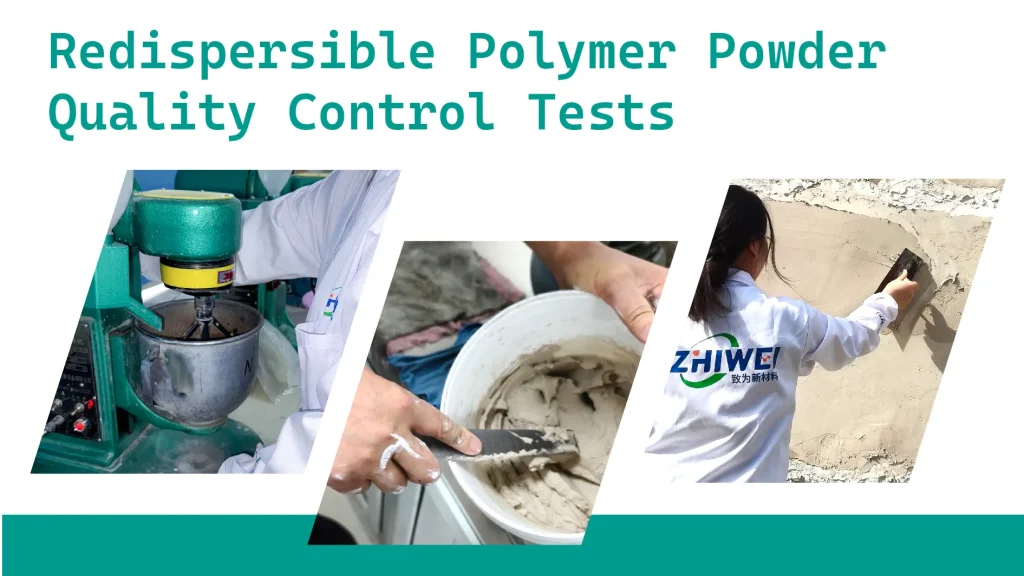
How RDP Quality Is Tested
A complete quality plan uses three levels of testing.
1. Raw-Material and Feed Tests
The plant checks polymer dispersion solids, viscosity, pH, particle stability, coagulum, and appearance. It also verifies the protective colloid, anti-caking mineral, water quality, defoamer, and other functional inputs.
2. Finished-Powder Tests
Common controls include:
- Appearance
- Solids or volatile matter
- Moisture
- Ash content
- Bulk density
- pH at a defined concentration
- Particle-size distribution or sieve residue
- Flow and caking tendency
- Redispersion behavior
- Tg or MFFT where required by the grade specification
The test method must be stated. A pH value without dispersion concentration, water quality, temperature, and method is incomplete. The same rule applies to bulk density and particle size.
3. Reference-Mortar Tests
Physical powder data cannot fully predict application performance. A batch should also be tested in a controlled mortar when the grade or customer specification requires it.
The reference formula may check tensile adhesion, flexural strength, deformation, water absorption, abrasion, wet adhesion, heat aging, freeze-thaw response, workability, slip, open time, or leveling. The test should match the grade’s intended use.
China’s current JC/T 2189-2024 covers redispersible polymer powder for cement-based construction dry-mix mortar and replaced JC/T 2189-2013 on May 1, 2025. GB/T 29594-2013 remains a current national standard for redispersible polymer powder. GB/T 34557-2017 is another current reference for latex and redispersible polymer powder used in mortar and concrete.
These standards do not replace the finished-product standard for tile adhesive, EIFS mortar, waterproofing, grout, or self-leveling. The RDP supplier, mortar producer, and customer must agree on the relevant method and acceptance limits.
Common RDP Manufacturing Problems
The Powder Cakes During Storage
Likely causes include high residual moisture, warm packing, humid storage, insufficient or poorly distributed anti-caking material, and a drying profile that leaves sticky particles.
The solution should begin with batch records. Check outlet conditions, final moisture, product temperature before packing, cooling-air humidity, ash, bulk density, and packaging integrity. Adding more anti-caking material without finding the real cause may hide the symptom and reduce effective polymer content.
The Powder Does Not Redisperse Well
Possible causes include unsuitable protective-colloid chemistry, insufficient stabilization, excessive drying stress, long exposure to heat, particle fusion, contamination, or moisture damage during storage.
A quick beaker test is useful for screening, but it is not enough. The laboratory should compare dispersion residue, particle size after redispersion, film behavior, and performance in a reference mortar.
Bulk Density Changes Between Batches
Bulk density can move when droplet size, atomizer conditions, feed solids, fines recovery, anti-caking level, or agglomeration changes. Density variation affects bag filling and customer dosing by volume. It can also signal a deeper shift in particle structure.
Ash Is Higher Than the Target
High ash can come from excess anti-caking material, a wrong mineral feed rate, contamination, or a raw-material change. Since the Zhiwei RDP portfolio uses different ash-control targets by grade, the batch must be compared with the correct product specification rather than one general limit.
The Spray Dryer Develops Deposits
Deposits can form when large or wet droplets reach the wall, the feed becomes unstable, the polymer is too sticky for the current thermal profile, air distribution is uneven, or the anti-caking system does not reach the particle at the correct time.
Cleaning alone does not solve a repeated process problem. The plant should review atomization, feed filtration, viscosity, solids, air pattern, inlet and outlet trends, tower pressure, and polymer softness.
The Finished Mortar Passes Powder Tests but Fails Application Tests
RDP solids, ash, pH, and density show whether the powder is physically consistent. They do not prove that a mortar will meet its target.
The wrong grade may have been selected. The dosage may be unsuitable. Cement, sand, filler, water, cellulose ether, antifoam, accelerator, retarder, or hydrophobic additive may also be changing the result. The final decision must come from the complete formula.
Production Safety and Environmental Control
Spray drying, powder recovery, sieving, blending, and bagging create fine organic and mineral dust. Industrial production therefore needs formal process-hazard review, closed transfer where practical, dust collection, grounding and bonding, ignition control, explosion protection, ventilation, housekeeping, and suitable worker protection.
The hazard must be assessed for the actual powder and equipment. OSHA includes plastic dust and other organic powders among materials that can present combustible-dust concerns. Its guidance also identifies spray dryers, cyclones, baghouses, sifters, and connected ducts as equipment that needs proper hazard control. A useful starting point is the OSHA combustible dust guidance.
The plant must follow the laws and engineering standards that apply at its location. Safety settings should never be copied from a product article.
Environmental control also matters. Efficient powder collection reduces material loss and particulate emissions. Stable feed and drying control reduce off-spec product and cleaning waste. Heat recovery and higher feed solids can reduce energy demand when the product and equipment permit them. These improvements must be made without weakening drying stability or powder quality.
How Manufacturing Choices Become Different Zhiwei RDP Grades
Two RDP grades may have similar solids, pH, and bulk density but still behave differently. Polymer base, comonomer balance, Tg, MFFT, flexibility, protective-colloid system, anti-caking level, and functional modification can all change the application result.
Zhiwei uses a structured portfolio so formulators can begin with the application target.
| Zhiwei Grade | Positioning | Flexibility and Film Profile | Ash Control | Recommended Main Applications |
|---|---|---|---|---|
| ZW-4023N | Neutral general-purpose grade | Hard; MFFT about 1°C; Tg 0-5°C | 13 ± 2% | Standard tile adhesive, putty, general grout |
| ZW-5010N | Neutral high-strength grade | Hard; MFFT about 4°C; Tg 10-15°C | 13 ± 2% | Tile adhesive, grout, skim coat mortar |
| ZW-5044N | High-flex waterproof grade | Very flexible; MFFT about 0°C; Tg -15 to -10°C | 12 ± 2% | EIFS, waterproof mortar, repair mortar, high-flex systems |
| ZW-5028E | Enhanced tile adhesive grade | Semi-flexible; MFFT about 4°C; Tg 0-5°C | 12 ± 2% | Upgraded mid-range tile adhesive |
| ZW-7034E | Enhanced multi-application grade | Flexible; MFFT about 0°C; Tg -5 to 0°C | 10 ± 2% | Tile adhesive, EIFS, grout, waterproofing, repair |
| ZW-8034H | Hydrophobic waterproof grade | Flexible; MFFT about 0°C; Tg -5 to 0°C | 8 ± 2% | Tile grout, waterproof mortar, skim coat, EIFS |
| ZW-5021T | Thixotropic tile adhesive grade | Semi-flexible; MFFT about 4°C; Tg 0-5°C | 12 ± 2% | Anti-sag tile adhesive and trowel-applied wall systems |
| ZW-5023L | Self-leveling specialty grade | Semi-flexible; MFFT about 4°C; Tg 0-5°C | 12 ± 2% | Cementitious self-leveling systems |
The portfolio uses a suggested solids level above 98%, bulk density of 400-550 g/L, and pH of 5-8 in a 10% dispersion. These values are selection references. The current TDS, SDS, COA, and sample result should control each commercial approval.
The table also shows why ash cannot be judged without grade context. ZW-8034H has a lower ash-control target than the neutral general-purpose grades. That difference is part of the product design. It is not enough to compare one isolated number without checking the intended application and complete specification.
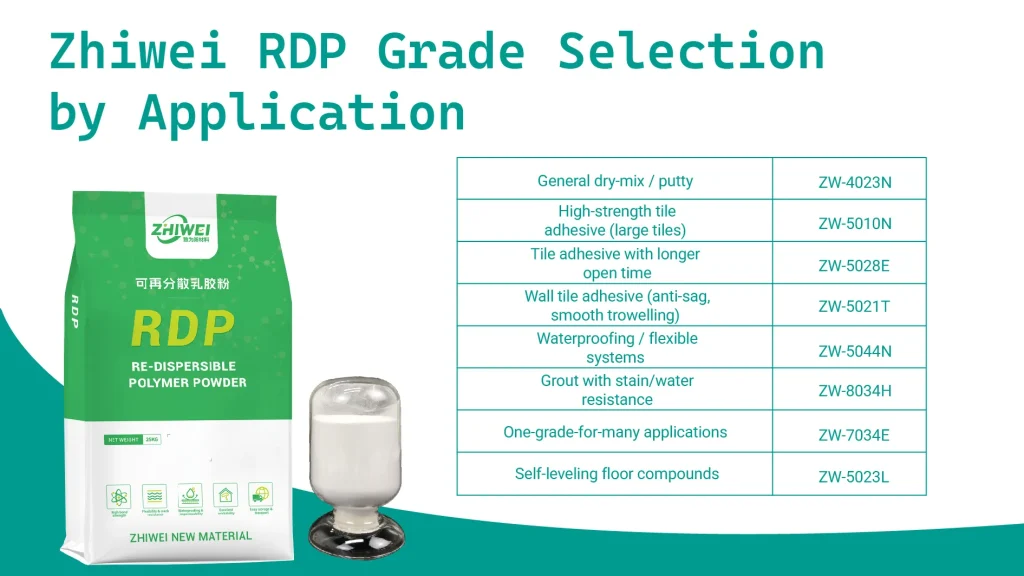
Selecting a Zhiwei Grade by Mortar Type
Tile Adhesive
ZW-4023N and ZW-5010N are practical starting points for standard formulations. ZW-5028E is more focused on upgraded tile adhesive. ZW-7034E supports a broader flexible application range. ZW-5021T is the targeted option when anti-sag behavior and easy troweling are priorities.
RDP selection should be combined with cellulose ether selection. Zhiwei’s HEMC for cement-based tile adhesive supports water retention, open time, workability, and fresh-mortar handling. RDP mainly contributes through polymer binding, cohesion, flexibility, and stress distribution. The two additives have different jobs.
EIFS and ETICS Mortar
ZW-5044N and ZW-7034E are the stronger application matches in the workbook. ZW-8034H is another option when water-response control is part of the target. HEMC for EIFS can support water retention, spreading, and vertical stability in the fresh mortar.
Waterproof and Repair Mortar
ZW-5044N is positioned for high flexibility, waterproofing, and repair systems. ZW-8034H is the dedicated hydrophobic option for waterproof and low-water-absorption directions. ZW-7034E is useful when the producer wants one flexible grade for several mid-to-high-end mortar families.
The result must be verified with the complete binder, filler, sand, cellulose ether, water, and curing system. Zhiwei also provides application guidance for repair mortar and cementitious waterproof mortar.
Self-Leveling Compound
ZW-5023L is the dedicated self-leveling specialty grade. It is designed around flow and leveling balance. It should not be replaced by an anti-sag tile adhesive grade simply because the basic powder data look similar.
What Should an RDP Buyer Ask a Supplier?
A useful supplier review goes beyond price and solids content. Buyers should ask:
- What is the polymer base and intended application?
- What are the Tg, MFFT, flexibility, ash, bulk-density, pH, and moisture specifications?
- Which test methods are used?
- Is pH measured at a defined concentration?
- Does the supplier test redispersibility and a reference mortar?
- Can it provide a current TDS, SDS, and batch COA?
- How are batch changes controlled?
- What storage and packaging conditions are required?
- Can the supplier support a sample trial with the buyer’s cement, sand, filler, and cellulose ether?
- Which grade is recommended when the customer’s first option does not meet the target?
Zhiwei (Jinan) New Materials Co., Ltd. supports grade selection through application details and sample testing. A useful request should include the mortar type, target standard, cement, aggregate or filler system, cellulose ether, expected RDP dosage range, climate, and current problem. Buyers can contact Zhiwei to request a trial direction and the latest technical documents.
Frequently Asked Questions
How Is Redispersible Polymer Powder Made?
RDP is normally made by stabilizing an aqueous polymer dispersion, atomizing it into fine droplets, and rapidly removing water in a spray dryer. The powder is then separated from the air, cooled, sieved, blended, tested, and packed. Protective colloid and anti-caking material help preserve redispersibility and storage stability.
Is RDP Made Directly From Dry Raw Materials?
No. The main polymer normally exists first as a water-based dispersion. Spray drying converts that liquid dispersion into a powder. The finished RDP can then be dry blended with cement, sand, fillers, cellulose ether, and other mortar additives.
Why Is Protective Colloid Used in RDP?
Protective colloid helps keep polymer particles from fusing irreversibly during drying and storage. It also supports the release and separation of polymer particles when water is added again. The chemistry and dosage must match the polymer and application.
Why Is Anti-Caking Agent Added?
RDP polymers can become sticky, especially when they are flexible or exposed to heat and moisture. A fine anti-caking mineral reduces direct contact between particles and improves powder flow. Excessive addition can raise ash and reduce the effective polymer fraction.
Are 140-150°C Inlet and 79-81°C Outlet Universal RDP Drying Temperatures?
No. These values can describe one practical process window, but they are not universal. The correct temperatures depend on the polymer, feed solids, viscosity, atomizer, tower design, air volume, humidity, feed rate, residence time, and required moisture.
Can Powder Specifications Prove Mortar Performance?
No. Solids, ash, pH, moisture, and bulk density are important controls, but they do not prove adhesion, flexibility, water resistance, anti-sag behavior, or leveling. The selected RDP must be tested in the complete mortar formulation under the required conditioning method.
Which Zhiwei RDP Grade Should I Start With?
Use the application as the first filter. ZW-4023N and ZW-5010N suit general tile adhesive directions. ZW-5028E is focused on enhanced tile adhesive. ZW-5021T targets thixotropic and anti-sag systems. ZW-5044N is intended for high-flex waterproofing and repair. ZW-7034E covers several flexible mortar applications. ZW-8034H is hydrophobic. ZW-5023L is designed for self-leveling.
Conclusion
The redispersible polymer powder manufacturing process is a controlled conversion, not a simple drying step. The plant must build the right polymer dispersion, stabilize it, create a consistent feed, atomize it correctly, remove water without causing irreversible film formation, distribute anti-caking material evenly, recover and cool the powder, and verify both powder properties and mortar performance.
The most useful production numbers are not copied temperatures or fixed percentages. They are validated operating ranges connected to a defined polymer, dryer, product specification, and application test.
Zhiwei combines this production logic with a clear eight-grade RDP portfolio. The grade names separate general-purpose, high-strength, enhanced, flexible, hydrophobic, thixotropic, and self-leveling directions. This structure helps dry-mix mortar producers begin testing with a product that matches the real application instead of choosing a powder from one isolated COA value.
Leave A Comment