 By info@zhiweichem.com

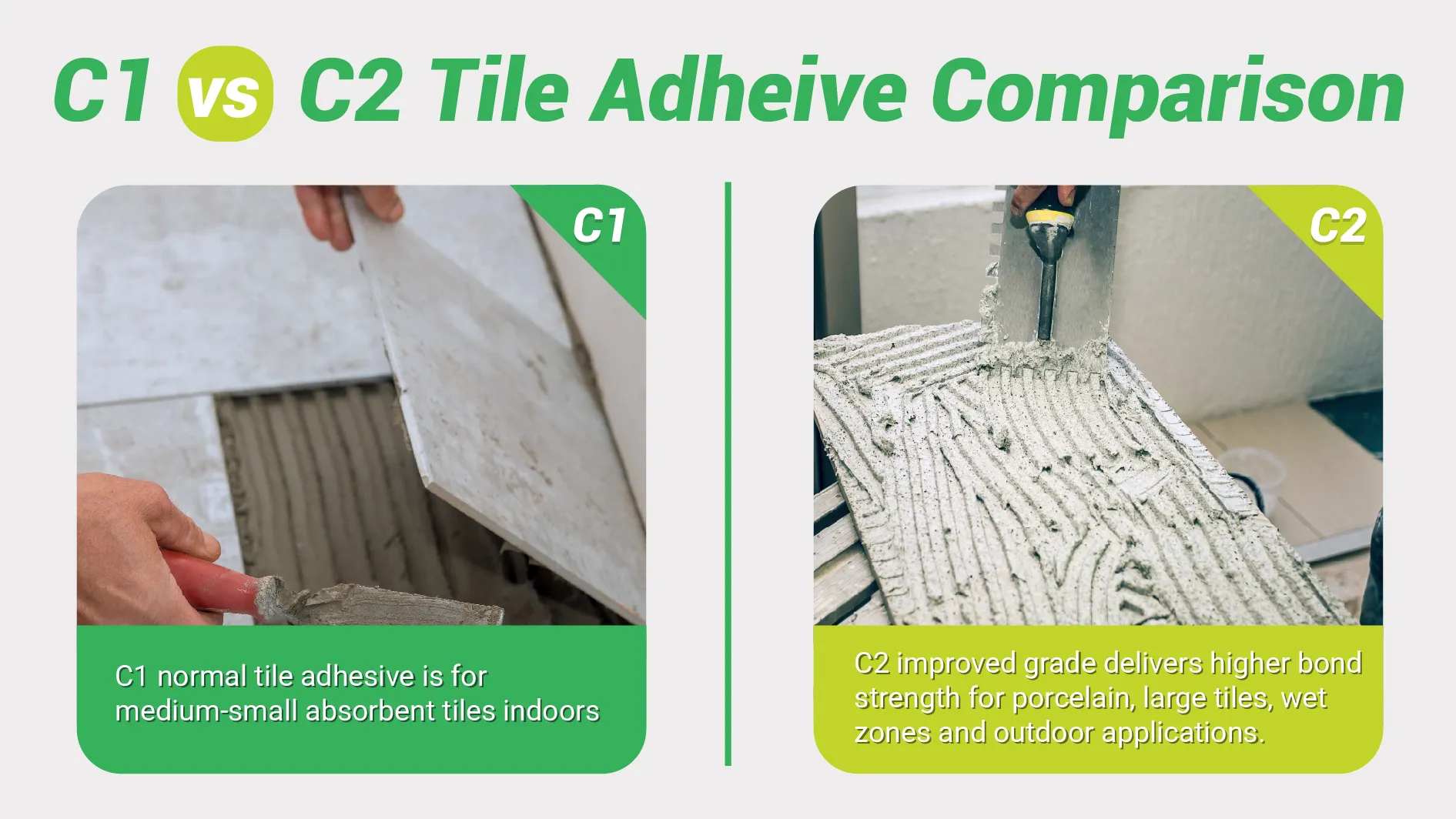
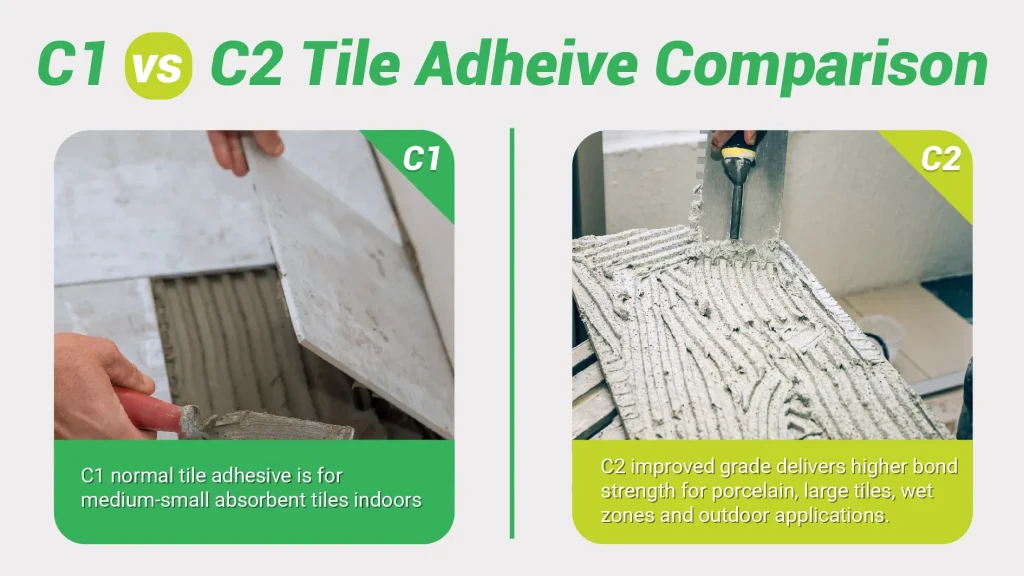
C1 vs C2 tile adhesive is not simply a choice between a cheap product and a premium product. The two classes represent different tested performance levels for cementitious tile adhesives. The difference affects raw-material selection, polymer demand, laboratory work, product claims, and the type of installation that a manufacturer can support.
C1 is the normal-performance class. C2 is the improved-performance class. Under the widely used ISO 13007 and EN 12004 systems, a C1 adhesive must reach at least 0.5 N/mm² tensile adhesion strength under the required test conditions. A C2 adhesive must reach at least 1.0 N/mm² under those conditions. Since 1 N/mm² equals 1 MPa, the two units express the same stress value.
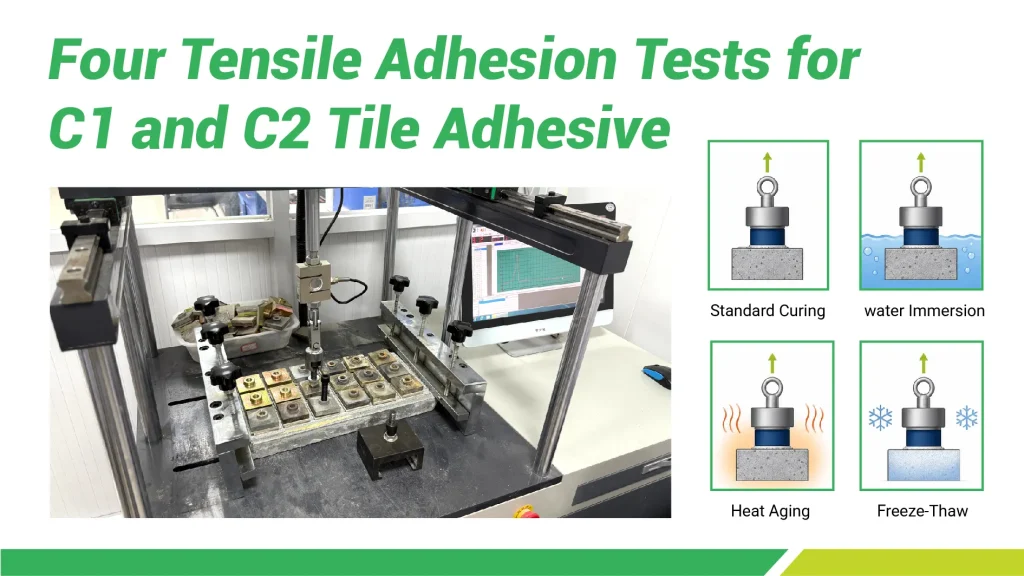
This higher threshold changes the formulation challenge. A C2 adhesive must keep its bond after standard curing, water exposure, heat aging, and freeze-thaw conditioning. A producer cannot confirm the class through one dry-condition test. A product name, RDP dosage, or raw-material certificate also cannot replace finished-mortar testing.
Zhiwei (Jinan) New Materials Co., Ltd. supplies redispersible polymer powder and cellulose ether options for cementitious tile adhesive development. Our approach starts with the target class and the real test method. We then match the RDP, HEMC or HPMC, cement, aggregate curve, rheology, water demand, and curing behavior to that target.
What C1 and C2 Actually Mean
The letter C identifies a cementitious adhesive. The number identifies its basic performance class.
- C1 means normal cementitious adhesive.
- C2 means improved cementitious adhesive.
The ISO 13007-1 standard defines terms, classifications, and specifications for ceramic tile adhesives. The EN 12004 system uses the same familiar C1 and C2 language in many international markets. China’s current GB/T 41059-2021 is a modified adoption of ISO 13007-1:2014. A producer should still confirm the exact standard, test method, and project requirement for every target country.
C1 and C2 describe measured adhesive performance. They do not describe one fixed recipe. Two manufacturers may use different cement, sand, filler, RDP, cellulose ether, and rheology packages, but both products may reach the same class after testing.
The classification also does not approve every possible application. Tile type, tile size, substrate, climate, installation height, moisture exposure, movement, and local building rules still matter. A C2 result gives a stronger performance base, but the project designer must confirm whether the full installation system is suitable.
C1 vs C2 Tile Adhesive Requirements
The table below gives the main cementitious adhesive requirements commonly used under ISO 13007 and EN 12004 classification. A manufacturer should obtain the licensed standard and use the specified laboratory method before making a compliance claim.
| Performance Item | C1 Normal Adhesive | C2 Improved Adhesive | What the Result Shows |
|---|---|---|---|
| Initial tensile adhesion strength | ≥ 0.5 N/mm² | ≥ 1.0 N/mm² | Bond after standard conditioning |
| Tensile adhesion after water immersion | ≥ 0.5 N/mm² | ≥ 1.0 N/mm² | Ability to keep bond after water exposure |
| Tensile adhesion after heat aging | ≥ 0.5 N/mm² | ≥ 1.0 N/mm² | Ability to keep bond after elevated-temperature conditioning |
| Tensile adhesion after freeze-thaw cycles | ≥ 0.5 N/mm² | ≥ 1.0 N/mm² | Ability to keep bond after repeated thermal and moisture stress |
| Open-time adhesion at the normal test time | ≥ 0.5 N/mm² | ≥ 0.5 N/mm² | Ability to bond after the adhesive has remained exposed before tile placement |
These C1 and C2 classification thresholds are minimum values. A single strong result does not compensate for a failed condition. For example, a formula may show high initial adhesion and still lose too much performance after heat aging. That formula cannot be treated as a stable C2 product until it passes the full required set.
Failure mode also matters. A pull-off test can fail at the tile interface, within the adhesive, at the substrate interface, or inside the substrate. The strength number and the failure location together help the formulator understand the weak point.
Three Common Misunderstandings About the C1 and C2 Difference
C2 Does Not Automatically Mean Flexible
C2 identifies improved adhesion performance. It does not by itself confirm deformability.
The S1 and S2 codes describe transverse deformation. S1 normally means deformation of at least 2.5 mm and less than 5 mm. S2 means deformation of at least 5 mm. A product that needs both improved adhesion and deformability may carry a code such as C2S1, C2TES1, or C2TES2 after it passes every applicable test.
This distinction matters in formulation work. A hard polymer system may help a mortar reach high adhesion, but it may not create the deformation required for S1. A flexible RDP can support deformation, but excessive softness can affect fresh handling, strength development, or other properties. The formulator must balance the full system.
C2 Is Not Defined by a Percentage Retention Rule
The common ISO and EN classification tables use minimum tensile adhesion values after each conditioning method. They do not classify C1 by “80% strength retention” or C2 by “no more than 25% freeze-thaw loss.” A percentage can still be useful for internal comparison, but the class claim depends on the value and method stated in the applicable standard.
Water Retention Alone Does Not Determine C1 or C2
Water retention is very important for cement hydration, open time, wetting, and site consistency. However, a water-retention result by itself does not prove C1 or C2 performance under ISO 13007 or EN 12004.
Cellulose ether helps control the fresh mortar. RDP helps the hardened mortar develop polymer-modified adhesion, cohesion, and stress tolerance. Cement quality, filler packing, water ratio, and curing also influence the final test results.
The Four Adhesion Tests Behind C1 and C2
Initial Tensile Adhesion
The initial test provides the basic reference after controlled curing. It shows whether the cementitious binder, polymer system, water balance, and interfaces can create a useful bond.
A low result may come from insufficient polymer modification, poor cement performance, excess water, weak wetting, excessive entrained air, poor tile contact, or a mismatch between the additive package and the mineral system. A producer should review the failure surface before increasing one raw material.
Adhesion After Water Immersion
Water exposure challenges the interface and the internal mortar structure. Some formulations develop a good dry bond but lose strength after immersion. The polymer chemistry, cement hydration, filler design, and pore structure all influence the result.
A hydrophobic additive may reduce capillary water uptake, but hydrophobicity and wet adhesion are not the same property. A water-repellent effect cannot replace the polymer and mineral structure required to pass the wet adhesion test.
Adhesion After Heat Aging
Heat aging can expose a brittle formulation. The tile, adhesive bed, and substrate respond differently as temperature changes. The adhesive must keep enough bond after the specified conditioning process.
A polymer with a suitable flexibility profile can help the mortar distribute stress. The formulation still needs stable cement hydration and a controlled water-cement balance. Excess organic additive can also change air content or hydration, so the complete formula must be tested.
Adhesion After Freeze-Thaw Cycles
Freeze-thaw conditioning combines water and repeated temperature change. Water inside pores expands when it freezes. Repeated cycles can damage a weak matrix or interface.
The test result depends on more than one ingredient. Polymer modification, pore structure, air content, cement development, water absorption, and interface quality all contribute. This is one reason why an exterior or cold-climate product needs a complete durability program.
How T, E, S1, and S2 Change the Product Target
C1 and C2 form the basic performance class. Additional letters describe other properties.
| Code | Meaning | Typical Requirement or Function |
|---|---|---|
| T | Reduced slip | Vertical slip is limited under the stated test method, commonly to no more than 0.5 mm |
| E | Extended open time | The adhesive keeps at least 0.5 N/mm² adhesion after an extended placement time, commonly 30 minutes |
| F | Fast setting | The adhesive develops the required early adhesion within the specified shorter period |
| S1 | Deformable | Transverse deformation is at least 2.5 mm and less than 5 mm |
| S2 | Highly deformable | Transverse deformation is at least 5 mm |
A wall tile product may need T because heavy tiles can slide before the mortar sets. A product for hot weather or large working areas may need E because installers need a longer placement window. A heated floor, exterior façade, lightweight panel, or large slab may need S1 or S2 because the system experiences more movement.
These codes cannot be added as marketing decoration. The finished adhesive must pass the matching test. Zhiwei’s guide to tile adhesive codes C1, C2, T, E, and S gives a practical explanation of how the full code is read.
When C1 May Be a Practical Target
C1 can be a practical target for standard cementitious tile adhesive used in controlled and less demanding conditions. Common examples may include smaller, more absorbent ceramic tiles on strong and stable mineral substrates in dry interior areas.
A C1 formula usually focuses on cost balance, reliable basic adhesion, good troweling, acceptable open time, and stable production. The producer still needs to test all required conditions. A low-cost formula that only passes the initial test is not a compliant C1 product.
The project team should not select C1 only because the installation is indoors. Large porcelain tiles, old-tile overlays, heated floors, waterproof membranes, flexible boards, and wet service areas can create higher demands even inside a building.
When C2 Becomes the Better Direction
C2 is normally considered when the tile, substrate, environment, or service conditions demand stronger adhesion and better durability.
Low-absorption porcelain and vitrified tiles provide less mechanical anchoring than porous ceramic tiles. Large-format units place more stress across the bonded area and make full adhesive coverage more important. Exterior surfaces face heat, rain, wind, and temperature cycling. Wet areas and balconies add moisture exposure. Renovation work may involve dense or difficult substrates.
C2 gives the formulator a higher tested bond target. However, the project may also need T, E, S1, or S2. C2 alone does not answer every installation need.
A manufacturer should review five factors before choosing the target:
- Tile: material, size, weight, water absorption, back texture, and surface treatment.
- Substrate: strength, porosity, stability, flatness, moisture, and surface contamination.
- Environment: interior or exterior, dry or wet, temperature range, and freeze-thaw exposure.
- Installation: wall or floor, adhesive thickness, trowel size, back-buttering, and working speed.
- Standard: target country, test method, project specification, and required classification code.
Formulation Differences Between C1 and C2 Tile Adhesive
A C2 formula is not created by doubling one ingredient. It needs a stronger balance across the whole mortar.
Cement and Mineral Binder
Cement provides the main mineral skeleton. Its strength class, fineness, setting behavior, alkali level, and compatibility with additives can change the adhesive result. A stable cement source makes laboratory optimization and production control easier.
More cement does not always create better tile adhesion. Excess cement can increase shrinkage, rigidity, heat, and water demand. The formulator should optimize binder level together with the polymer and aggregate package.
Sand and Filler Curve
Sand and mineral filler control packing, body, shrinkage, troweling, water demand, and cost. Too many fines can raise water demand. Poor grading can reduce packing efficiency and make the paste rough or unstable.
A C2 product needs enough contact and cohesion across a thin adhesive bed. Stable particle-size distribution helps the factory keep those properties from batch to batch.
Redispersible Polymer Powder
RDP adds a polymer-binding phase to the cementitious matrix. It supports adhesion to dense surfaces, internal cohesion, flexibility, and resistance to stress. The required type and level depend on the target code and other raw materials.
A standard C1 product may use a balanced general-purpose RDP. An improved C2 product often needs a more focused polymer grade, a higher effective polymer contribution, or both. A C2S1 or C2S2 target normally needs a suitable flexible polymer system and careful control of the entire formulation.
HEMC or HPMC
Cellulose ether controls water retention, viscosity, open time, wetting time, troweling feel, and fresh-mortar stability. It helps the adhesive keep enough moisture for cement hydration and tile placement.
HEMC or HPMC does not replace RDP. It cannot create C2 adhesion or S1 deformation by itself. The best result comes from matching the cellulose ether to the RDP, cement, sand curve, temperature, water ratio, and target application.
Rheology and Special Additives
Starch ether, fibers, accelerators, retarders, defoamers, and hydrophobic additives can solve specific problems. A T-grade wall adhesive may need stronger yield behavior. A fast-setting product needs controlled early reaction. A wet-area product may need lower water uptake.
Every extra additive can also affect air content, hydration, open time, or strength. A producer should add it for a measured reason and verify the result in the full mortar.
Why RDP Becomes More Important in C2 Formulations
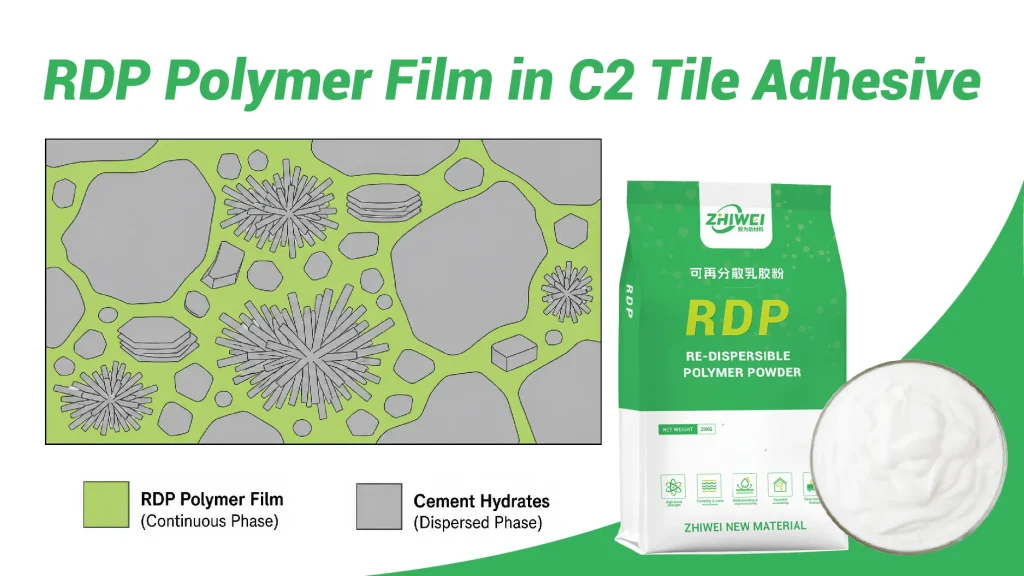
When dry tile adhesive is mixed with water, RDP redisperses into small polymer particles. Cement hydration proceeds at the same time. As water leaves the mortar, the polymer particles move closer and form a polymer phase through the mineral structure.
This phase helps the mortar connect to the tile and substrate. It can bridge small stress zones and reduce brittle behavior. It also supports cohesion inside the adhesive layer.
WACKER’s overview of dispersible polymer powders identifies adhesion and flexibility as two critical characteristics that polymer binders improve in mortars and coatings. Those two properties are central to many C2 and deformable tile adhesive designs.
The polymer result still depends on formulation conditions. A very flexible RDP is not automatically the best choice for every C2 product. A hard grade may support strength and cost balance. A semi-flexible grade may give a useful middle position. A thixotropic grade may help a wall adhesive. A hydrophobic grade may support lower water uptake. The producer must choose the property package that matches the test target.
Zhiwei RDP Grade Selection for C1 and C2 Development
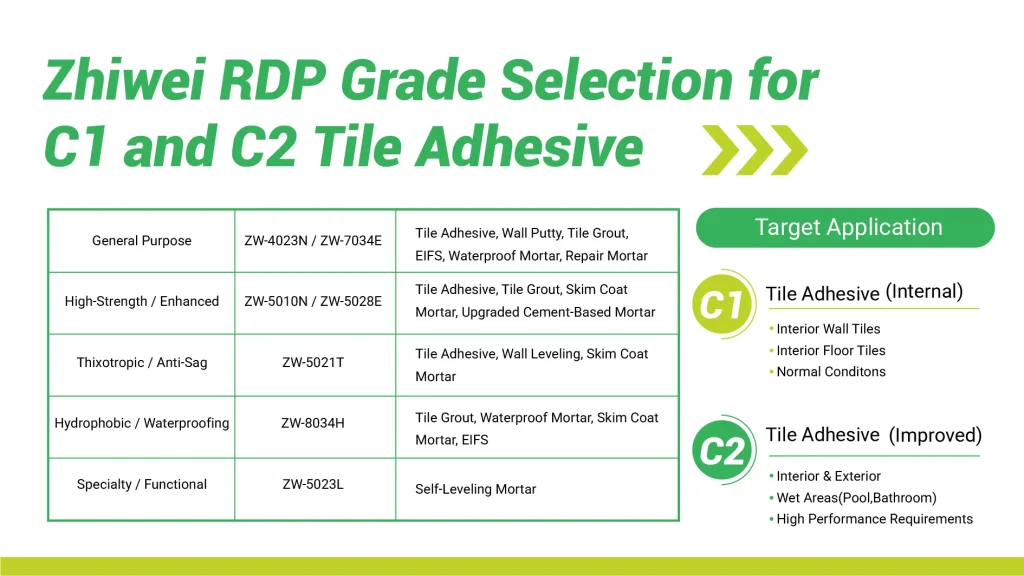
Zhiwei offers eight RDP grades with different application directions. The recommendations below are screening routes for laboratory trials. They are not finished-adhesive certifications.
| Zhiwei Grade | Positioning | Best Starting Direction for Tile Adhesive Work |
|---|---|---|
| ZW-4023N | Neutral general-purpose VAc-E grade | Cost-balanced C1 and standard tile adhesive trials that need broad adhesion and workability |
| ZW-5010N | Neutral high-strength VAc-E grade | Strength-focused C1 and C2 screening where cost-performance balance is important |
| ZW-5028E | Enhanced tile adhesive VAc-E grade | Upgraded mid-range tile adhesive and direct C2 development trials |
| ZW-7034E | Flexible, enhanced multi-application grade | C2, flexible tile adhesive, and broader mid-to-high-end dry-mix programs |
| ZW-5021T | Thixotropic tile adhesive VAc-E grade | Wall tile adhesive, reduced-slip targets, and C1T or C2T development |
| ZW-5044N | Very flexible, high-flex waterproof grade | C2S1 or other high-flex screening, plus waterproof and repair system development |
| ZW-8034H | Flexible hydrophobic grade | Low-water-absorption and wet-area system trials where hydrophobic support is required |
| ZW-5023L | Self-leveling specialty grade | Self-leveling mortar; it is not the first choice for a conventional non-sag tile adhesive |
The portfolio uses several polymer and flexibility directions. Most grades have a suggested solid content above 98%, a suggested bulk density of 400-550 g/L, and a suggested pH of 5-8 in a 10% dispersion. Ash-control targets vary by grade. Buyers should use the current TDS, SDS, batch COA, and sample result when approving a product.
Practical C1 Screening Route
ZW-4023N gives a balanced starting point for a standard C1 adhesive. ZW-5010N can be tested when the formula needs a stronger bond direction while keeping a cost-effective position.
ZW-5028E can also be useful when the manufacturer wants more safety margin or plans to build an upgraded product above a basic C1 level. The final choice should depend on all four adhesion conditions, open time, slip, workability, and total formula cost.
Practical C2 Screening Route
ZW-5028E is positioned specifically for enhanced tile adhesive. It gives a clear starting point for a C2 development program. ZW-7034E provides a more flexible, multi-application direction for mid-to-high-end formulations.
ZW-5010N may also enter the screening set when high strength and cost balance are priorities. The formulator should compare the wet, heat-aged, and freeze-thaw results, not only the initial adhesion value.
Reduced-Slip and Flexible Targets
ZW-5021T is the focused option when wall stability and anti-sag behavior are key goals. The product may support C1T or C2T development, but the formula still needs suitable HEMC or HPMC, water control, mineral grading, and rheology adjustment.
ZW-5044N is the very flexible option for high-flex systems. ZW-7034E is another useful candidate when the manufacturer wants a flexible profile with broad mortar compatibility. S1 or S2 claims require transverse-deformation testing of the finished adhesive.
Wet-Area and Hydrophobic Targets
ZW-8034H is positioned for hydrophobic and low-water-absorption systems. It can be tested when moisture resistance and capillary water behavior are part of the product design. ZW-5044N can also be considered when the system needs a flexible and waterproof-mortar direction.
Neither grade turns tile adhesive into a complete waterproofing system by itself. Wet areas may still need an approved waterproof membrane, compatible grout, sealed penetrations, movement joints, and correct construction detailing.
How to Upgrade a Formula from C1 Toward C2
1. Fix the Standard and Test Method First
The laboratory should record the standard edition, tile type, substrate, conditioning, mixing procedure, water ratio, trowel, open time, curing, and pull-off method. A result has little value when the test conditions are unclear.
For the Chinese market, GB/T 41059-2021 provides current product requirements and modifies ISO 13007-1:2014. The current Chinese test-method framework should also be checked before testing. Export products must follow the destination market and customer specification.
2. Measure the C1 Baseline
The producer should test the existing formula after standard curing, water immersion, heat aging, and freeze-thaw conditioning. The failure surface should be photographed and recorded. Fresh properties should also be measured.
This baseline shows the actual weakness. A formula that only fails after heat needs a different response from one that fails in every condition.
3. Screen More Than One RDP Direction
The producer should compare a general-purpose, enhanced, and flexible RDP at controlled conditions. The cement, sand, cellulose ether, water ratio, and mixing procedure should stay constant during the first screen.
The laboratory should compare adhesion, failure mode, open time, slip, consistency, air content, and application feel. The cheapest powder price does not always create the lowest formula cost if the required dosage is higher or the pass margin is small.
4. Rebalance Water and Cellulose Ether
Changing RDP can change water demand, rheology, wetting, and troweling. The HEMC or HPMC grade may need adjustment. The water ratio should be measured and fixed for each test series.
Zhiwei’s HEMC for cement-based tile adhesive supports water retention, open time, workability, and slip control. More demanding formulas can also use the selection logic in the HEMC for high-quality tile adhesive guide.
5. Retest the Complete Requirement Set
An improved initial result is only one step. The candidate formula must pass every required condition and every additional code that will appear on the bag.
The manufacturer should also leave a safety margin for normal variation in cement, sand moisture, filler fineness, production weighing, seasonal temperature, and laboratory repeatability. A formula that only reaches the minimum in one ideal batch creates commercial risk.
6. Confirm Pilot and Production Batches
Laboratory mixing and factory mixing do not create identical shear, dispersion, or air content. The producer should run a pilot batch and then confirm a normal production batch.
The quality plan should define incoming raw-material checks, batch identification, water demand, bulk density, fresh mortar consistency, open time, slip, and scheduled adhesion testing. Retained samples make later investigation easier.
Site Practice Can Still Decide Success or Failure
A laboratory class does not protect an installation from poor site practice.
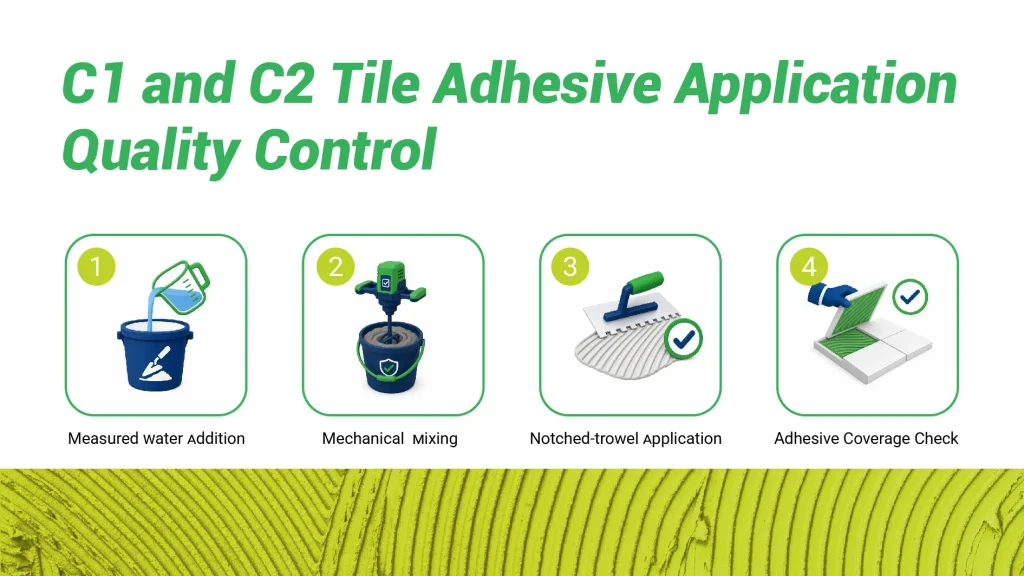
The substrate must be strong, clean, stable, and suitable for tiling. Dust, oil, curing compounds, weak plaster, standing water, and loose coatings can reduce adhesion. A primer can help only when it is compatible and required. It cannot repair a weak substrate.
The installer must use the specified water ratio. Extra water can make the paste feel easier at first, but it can increase shrinkage, reduce fresh stability, and weaken the cured adhesive.
Mechanical mixing helps disperse RDP, cellulose ether, cement, and fine additives. The installer should follow the product’s mixing, rest, remixing, pot-life, and application instructions.
The notched trowel must match the tile and required bed thickness. Large-format tiles often need back-buttering to reach suitable coverage. The installer should press and move the tile across the mortar ridges so the adhesive spreads across the back.
Tiles must be placed before the adhesive surface skins. A skin can look wet but prevent full contact. The installer should check open time during actual temperature, humidity, wind, and substrate conditions.
Exterior work, wet areas, heated floors, and large slabs also need correct movement joints and system detailing. Strong adhesive cannot remove structural movement or replace a designed joint.
What Manufacturers Should Ask an RDP Supplier
A useful supplier discussion should go beyond “Which RDP is best for tile adhesive?” The producer should share the target and the present formula.
Key information includes:
- Target code: C1, C1T, C2, C2TE, C2S1, C2TES1, or another class.
- Standard and market: ISO, EN, GB/T, or a customer-specific method.
- Tile: ceramic, porcelain, vitrified tile, stone, slab, size, and water absorption.
- Substrate: concrete, cement render, old tile, board, membrane, or insulation system.
- Cement and filler: type, strength, sand curve, and fine-powder content.
- Current additives: RDP, HEMC or HPMC, starch ether, accelerator, fiber, and hydrophobic agent.
- Water ratio and mixing process.
- Current results: initial, water, heat, freeze-thaw, open time, slip, and deformation.
- Main problem: weak wet adhesion, heat-aging loss, short open time, sag, poor troweling, brittleness, or cost.
Zhiwei uses this information to narrow the screening range. A focused sample plan saves more time than testing one universal grade in every formula.
Frequently Asked Questions
Is C2 Tile Adhesive Twice as Strong as C1?
The minimum tensile adhesion threshold is 1.0 N/mm² for C2 and 0.5 N/mm² for C1 under the main conditioning tests. This makes the numerical minimum twice as high. However, real product performance and project safety cannot be reduced to one ratio. Failure mode, test variation, tile coverage, substrate, deformability, and installation quality also matter.
Does C2 Always Mean Waterproof?
No. C2 means improved cementitious adhesive performance. It does not mean that the adhesive replaces a waterproofing membrane. A wet-area system needs compatible materials and correct detailing.
Does C2 Automatically Meet S1?
No. C2 and S1 measure different properties. C2 concerns improved adhesion. S1 concerns transverse deformation. A C2S1 product must pass both sets of requirements.
Which Zhiwei RDP Is a Good Starting Point for C1 Tile Adhesive?
ZW-4023N is a balanced general-purpose starting point. ZW-5010N can be tested when the formula needs a stronger bond direction and cost-performance balance. The finished adhesive must pass all required tests.
Which Zhiwei RDP Is a Good Starting Point for C2 Tile Adhesive?
ZW-5028E is positioned for enhanced tile adhesive. ZW-7034E is suitable for flexible, mid-to-high-end development. ZW-5010N can also be screened where strength and cost balance matter.
Which Grade Should Be Tested for Reduced Slip?
ZW-5021T is the focused thixotropic tile adhesive grade. Reduced slip still depends on HEMC or HPMC, starch ether, mineral grading, water ratio, and the complete fresh-mortar structure.
Can More RDP Turn Every C1 Formula into C2?
Not always. More RDP may improve adhesion and flexibility, but the result depends on polymer type, cement, water demand, air content, filler packing, cellulose ether, curing, and the failure interface. The producer should diagnose the failed condition and rebalance the complete formula.
Why Can a Formula Pass Initial Adhesion but Fail After Heat or Water?
The initial test and durability conditions stress the adhesive in different ways. Water can weaken an unsuitable interface. Heat can expose brittleness or incompatibility. Freeze-thaw cycles can damage a porous or weak matrix. The RDP chemistry and the mineral formulation must work together under every required condition.
Conclusion
The main difference in C1 vs C2 tile adhesive is the tested performance threshold. C1 is the normal class with a minimum tensile adhesion strength of 0.5 N/mm² under the main required conditions. C2 is the improved class with a minimum of 1.0 N/mm² under those conditions.
C2 does not automatically mean T, E, S1, S2, or waterproof. Each added code represents another measured property. The product must pass the full test set before the manufacturer prints the claim.
RDP plays a central role in the move from standard to improved tile adhesive. It supports adhesion, cohesion, flexibility, and stress resistance. HEMC or HPMC supports water retention, open time, troweling, and fresh stability. Cement, sand, filler, water, rheology, curing, and site practice complete the system.
Zhiwei provides general-purpose, high-strength, enhanced, thixotropic, flexible, hydrophobic, and self-leveling RDP grades. ZW-4023N and ZW-5010N give practical starting points for standard formulas. ZW-5028E and ZW-7034E support enhanced C2 development. ZW-5021T focuses on wall stability. ZW-5044N supports high-flex trials. ZW-8034H provides a hydrophobic direction. ZW-5023L remains a specialized choice for self-leveling mortar.
Send Zhiwei your target code, standard, tile type, substrate, formula, and current test results. Our technical team can recommend a focused RDP and cellulose ether screening plan for your C1, C2, C2T, or flexible tile adhesive development.